

The world of avocados is vast and full of history. Just imagine: the earliest references in the history of the avocado date back to the Pleistocene. It came from the Americas, first to our continent and then to our country. And here in Spain, it took root so firmly that our country is now the leading avocado producer in the European Union.
On this blog we explore the vast world of avocados for two simple reasons: first, we love them, and second, growing this fruit is fascinating.
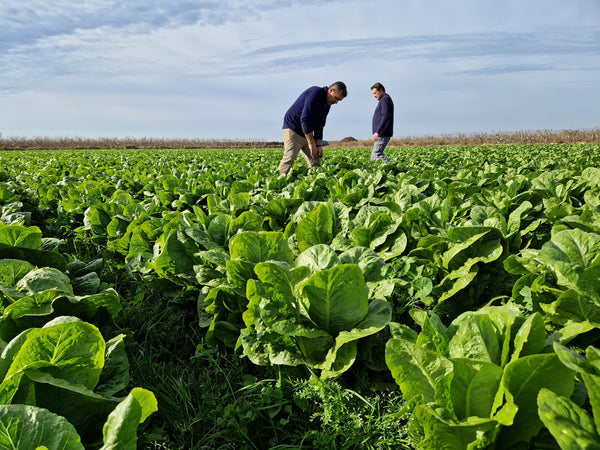
First, we visited Javier, an avocado farmer, out in his fields. We took a long walk in the shade of his trees and he told us all about the cycle, the varieties and the pollination of his avocados.
But since the Campos del Abuelo network of farmers is always growing, this time we went to the avocado orchard of another of our farmers: Salvador. He grows several varieties of this tropical fruit, and we took the chance to ask him about one that isn't so well known: the Bacon variety.
So let's join Salvador and learn about growing this tropical delight that has settled in so well on our land.

Origin of the Bacon avocado
Among the avocado varieties, the Bacon avocado comes from California. It's the result of a hybrid between several varieties, just like the Hass avocado, which came from crossing the Lyon avocado and the Fuerte avocado. The creator of the Bacon avocado was looking for an avocado more cold-resistant than other varieties, and that's how the Bacon variety was born.
Some say it's called Bacon because it has a smoky taste reminiscent of bacon; another theory says it got the name because its flesh is so much like butter. And of course, the most widely accepted idea is that it's named after its creator: James E. Bacon.
Even though this article is dedicated to the Bacon avocado, everyone knows that the most popular variety of all is the Hass avocado variety. So this is the first question we put to Salvador right there in the avocado orchard: Why do you think the Bacon variety isn't as common in the markets? Salvador answers:
It's because the producing country, Mexico, had a bigger presence with this avocado in the US markets, so the Hass avocado became the favourite because that's how it got established. On the other hand, Hass holds up better in transport than Bacon, which has a more delicate skin.
As Salvador says, Bacon has a more delicate skin, which is why it isn't as tough. But the good news is that this same thin skin is really easy to peel. Plus, whether it arrives in good shape depends on how it's packed. That's one of the perks of buying from Campos del Abuelo: since we go straight from the field to your home, we make sure everything is well packed so it arrives in perfect condition.

Growing Bacon avocados and the importance of grafting
On this blog we've talked about grafting trees. This practice comes from the fact that in the field, we have rootstock trees and trees that carry a variety. Grafting is done so that the rootstock tree bears fruit of the variety we graft onto it. Here's how Salvador explains it with his avocado trees:
The avocado rootstock is the lower part of the graft. Specifically, it's the part from the trunk down. In other words, the part that's in contact with the soil
Except it carries a graft, which is joining two parts into one. So when we graft, the top part is the one with the variety. The difference is that the part below is designed to take up nutrients and be in contact with the soil; it withstands waterlogging and diseases, and makes the most of the resources in the soil.
On the other hand, the varieties on top, which can be Hass, Bacon, Lamb Hass, etc., are the commercial ones.
What Salvador explains is all about, in his words, getting a top-quality avocado. Because even though the lower part of the tree, the rootstock, isn't made to produce, it gives the tree strength from below. Still, in his fields he has rootstock trees with no variety grafted on, and there's a reason for that:
In my case, the ones here in the field that are rootstock trees, I'm using as pollinators for other trees… And sometimes they do set fruit, but it has no commercial value because it doesn't taste good and has no seed.
So, as Salvador tells us, rootstock trees need to be grafted with a variety to bear fruit with good size and flavour. But at the same time, the rootstock gives the tree its resilience. By becoming a single tree through grafting, the rootstock and the variety bring the best of each part into one organism.

Although we've talked about caring for avocado plants, our fellow farmers always have something new to add. Salvador, in this case, tells us about his experience growing avocados through temperatures as high as the ones we had this past summer:
This summer we've had very high, extreme temperatures. You can see the consequences because the avocado plant gets stressed. We're talking about plant stress that shows up as the leaf edges drying out. That's because when the plant is stressed, it takes up chlorine from the soil, which builds up in the tips and dries them out.
Chlorine is phytotoxic and it dries out the leaf tips. Chlorine is naturally present in the soil and is toxic to the plant, but not to the crop or to people.
You can tell there are countless hours of work in Salvador's avocado orchard. The trees are lush, and the hanging fruit looks like it might snap the branches. But no, they bear the weight just fine because they're well cared for. One of the techniques Salvador uses has to do with organic farming:
No herbicide is used on my plot. When the weeds grow too much, we simply clear them. In fact, we're repopulating the field with Agret, a typical Valencian plant. It's the plant farmers have traditionally left in their fields so citrus doesn't get waterlogged. It also crowds out other weeds that grow more than they should. Agret, for its part, always stays at a steady height.
On top of that, we're doing sustainable fertilising. We're increasing organic fertilisers, which means we lose less nitrogen to the atmosphere and to the aquifers.
As we always say, working the land is far from easy. It's hard work in itself, and when you add that the avocado comes from a different climate… it needs a lot of care. Avocado trees need a specific climate to grow properly. Here's how Salvador puts it:
As for the climate needed to grow it, the key thing is that it's a tropical plant, needing moderate temperatures, neither too low nor extremely high, plus high rainfall and high relative humidity, in other words, a tropical climate.
Pollination of the Bacon avocado
When it comes to pollination, avocado trees are quite special, because they rely on what's called cross-pollination. Salvador explains:
You might wonder why we have different varieties. Here we've planted Bacon, Topa Topa and also Hass.
We have Bacon as a pollinator and Topa Topa as a rootstock too, to increase yields. In the end, the tree on its own couldn't be pollinated if there weren't two types of varieties.
There are two groups of varieties, A and B. Group A opens its female flowers in the morning and its male flowers during the day, so they can't pollinate each other. So what happens? Hass is in group A and Bacon is in group B, so male and female flowers open at the same time, which doesn't happen within the same variety, because the male ones open during the day and the female ones at night, and they never overlap.

So, as our fellow farmer explains, you absolutely need two avocado varieties to pollinate a tree. That's the natural way, mind you, because as Salvador tells us, there are other, somewhat more artificial methods.
Some farms only have one variety overall, and what they do is use methods to boost pollination by bees. For example, they spray sugars, use attractants or bring in bumblebees.
Main types of rootstock
Salvador is going to tell us about avocado tree rootstocks. It's really interesting because he talks about clones. Farming isn't just hoes and tractors; there's a lot of research and practice too. Here's what Salvador tells us about his clones:
We really have two main types of rootstock: clonal and seedling.
Clonal ones are trickier, because a clonal has three steps: you plant the seed, and after planting it, when it sprouts you graft a variety onto it; this variety is a clone of the rootstock. A clone is used so it has the same traits in terms of disease resistance, nutrient uptake, tolerance to waterlogging, etc. And once you have the first graft, you do the second graft with whatever variety you want, be it Bacon, Hass, Lamb Hass, Maluma, Carmen, whatever you like.
What Salvador tells us is fascinating, because the little tree is grafted twice to combine the strength of the rootstock with the traits of the desired variety:
Really, the rootstock gives the variety superpowers: the ability to withstand frost and harsh weather. You also have to consider which one best suits your soil. Whether it's chalky or acidic, you have to choose the rootstock based on what you've got in the field.
We carry on with Salvador on his plot. It's like a jungle of avocado trees of different varieties, but since this time we're focusing on the Bacon avocado, let's look at its most outstanding features.

Features of the Bacon avocado
Salvador holds two enormous avocados in his hands as he tells us how to recognise this variety:
The first thing you'll notice is the smooth skin. Second, it's eaten in October, November and the first half of December. So if you find it outside those months, bear in mind you're not eating it at the right time.
Another feature is how incredibly creamy it is, just like butter. As for the flavour of the Bacon avocado, I have to tell you it's one of the best flavours out there; personally, it's my favourite.
To be harvested, the avocado has to reach just the right oil content. If it's picked too early, it will likely never ripen properly. In other words, there's an exact moment to pick it. And since they're grown with traditional methods and harvested at the right time, all the properties of the avocado are preserved.
Here's how Salvador knows whether an avocado is ready to harvest:
Trial and error is the most authentic method for knowing when avocados are ripe. We start tasting them three weeks before harvest, checking how they're coming along flavour-wise.
At the start of September we eat them at home, checking their oil content, until we know it's the optimal moment and they're perfectly mature.

The avocado is a climacteric fruit, which means it ripens once it's off the tree. And since at Campos del Abuelo we harvest them and ship them straight to your home, keep in mind that they need to go through the ripening process. Wondering when an avocado is ready to eat is completely normal. Especially in this case, since it arrives at your home straight from the tree, so it won't be ready to eat yet.
Salvador, from the field, tells us what he does to ripen his avocados:
To ripen avocados naturally, the first thing is to put them with fruit that gives off ethylene. The fruits best known for releasing this gas are apples and bananas. What you can do is put your avocados in a pot or an airtight container with some of these fruits.
Since we harvest the avocados at just the right oil content, Salvador also recommends leaving them together with the apples or bananas for about four or five days.
And as we once heard Eduardo, farmer and founder of Campos del Abuelo, say: to know if an avocado is ready, you have to put it to the test. Salvador explains it like this: When you press the skin and it gives a little, it's ready. I'd also recommend not putting them in the fridge, since they keep perfectly at room temperature, and in the fridge they might turn black.
Now we can say we know a bit more about the Bacon avocado, the first avocado of the season. If you want to buy avocados straight from the farmer be sure to visit our online shop. That's all for today. We hope you found this article interesting and that you'll come back soon to our blog, straight from the field.
See you next time, and thanks for reading!


Comments
Buenos días su articulo me ha parecido muy interesante para un aguacate bacon que he comprado a una empresa de Valencia. Si hubiera encontrado antes esta página se lo hubiera pedido a Vds.
Tengo intención de dejarlo en maceta ir poniendo una más grande hasta dejarla en u tamaño para que no crezca demasiado ya que tengo un jardín muy pequeñito donde tengo un limonero un mandarino y un naranjo Washington.
Que tierra necesitaría para poder ir cambiándolo sin que perjudique la planta . Ahora la tengo en una de inició pero la rama ya está alta y con hojas.
Muchas gracias y enhorabuena por su articulo y su pagina