
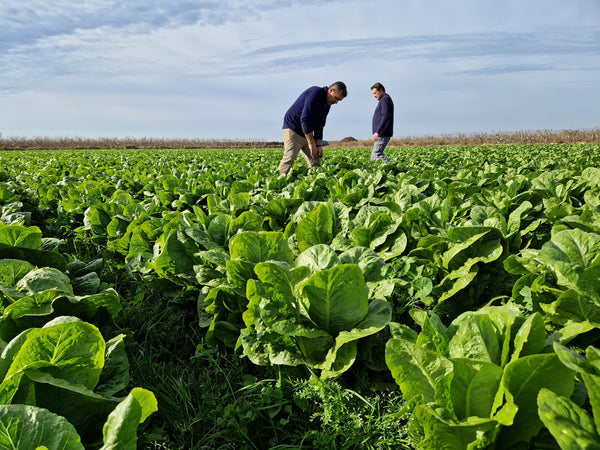

The Valencian orange Crisis is real, and you can feel it on the tree and in your wallet: a smaller harvest, prices below cost and fields running out of hands. In 2026, the sector is living through its shortest season in sixteen years, and we farmers are looking at the sky, at Brussels and at the scales with a knot in our stomachs.
I'm Eduardo, a farmer in La Ribera and part of a family that loves this land. I'll tell you how it is, no frills, with verified data and in the hope that this read helps you choose better which fruit you bring home and which fields you want to support. When you choose well, you can taste it and the land feels it too.

What's happening with the Valencian orange Crisis in 2026?
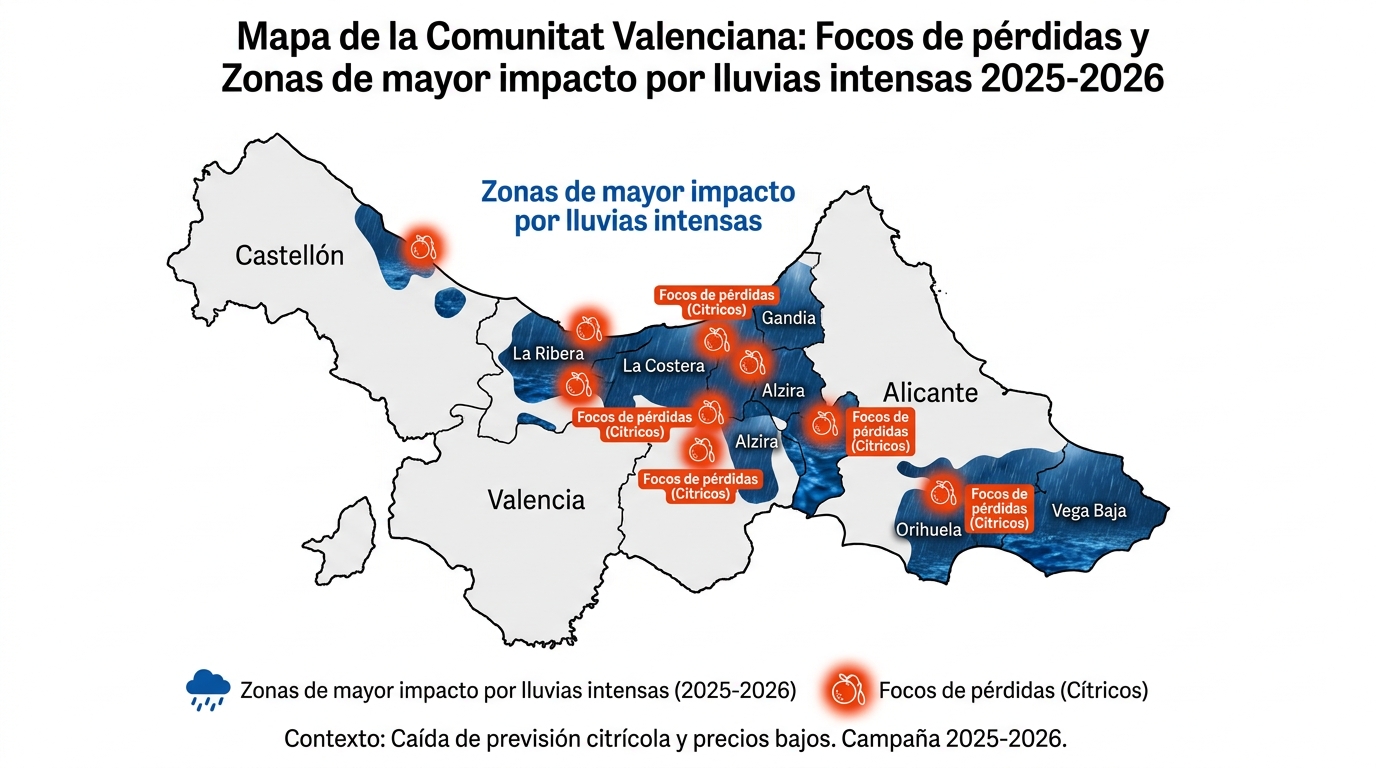
In two clear sentences: there are fewer oranges, and they're paid less than it costs to grow them. The 2025 2026 citrus season arrived with the lowest forecast in sixteen years and a drop of around 8 percent compared to the previous one, topping 2.5 million tonnes in the Valencian Community but far below the usual, as Intercitrus itself summed up.
Spain is at around 5.44 million tonnes when normally it would be quite a bit more, and the difference isn't explained by the weather alone. There are structural factors we all keep repeating out in the fields: soaring costs, competition from countries with different rules and tight margins along the chain that never reach the grower. It's a vicious circle that needs breaking.
2026 snapshot: production, prices and margins
If you like to look things straight in the eye, this table helps you understand the Valencian orange Crisis at a glance. These are recent, public figures from open sources that are easy to check. The conclusion is simple: with these numbers, the small farmer can't cover costs.
| Indicator | Approximate value | Source |
|---|---|---|
| Valencian Community production 2025 - 2026 | Just over 2.5 million t, 8 percent less than the previous season | Intercitrus |
| Spain production 2025 - 2026 | 5.44 million t, lowest in 16 years | Season analysis |
| Grower price in bad times | 0.09 to 0.12 euros per kg | Field report |
| Average production cost | Around 0.30 euros per kg | Food chain observatory |
| Autumn humidity losses | Over 75,000 t lost to rot | Damage report |
| Mercosur imports at the start of the season | 58,004 t, 18 percent more year on year | Market data |
The picture is harsh, but it's honest. When a kilo is paid below 0.30 euros, every box sold creates a hole. That explains why some fruit isn't even picked, and why every year there are more "for sale" signs on plots that, not long ago, were real gems.
Foreign competition and regulatory imbalances
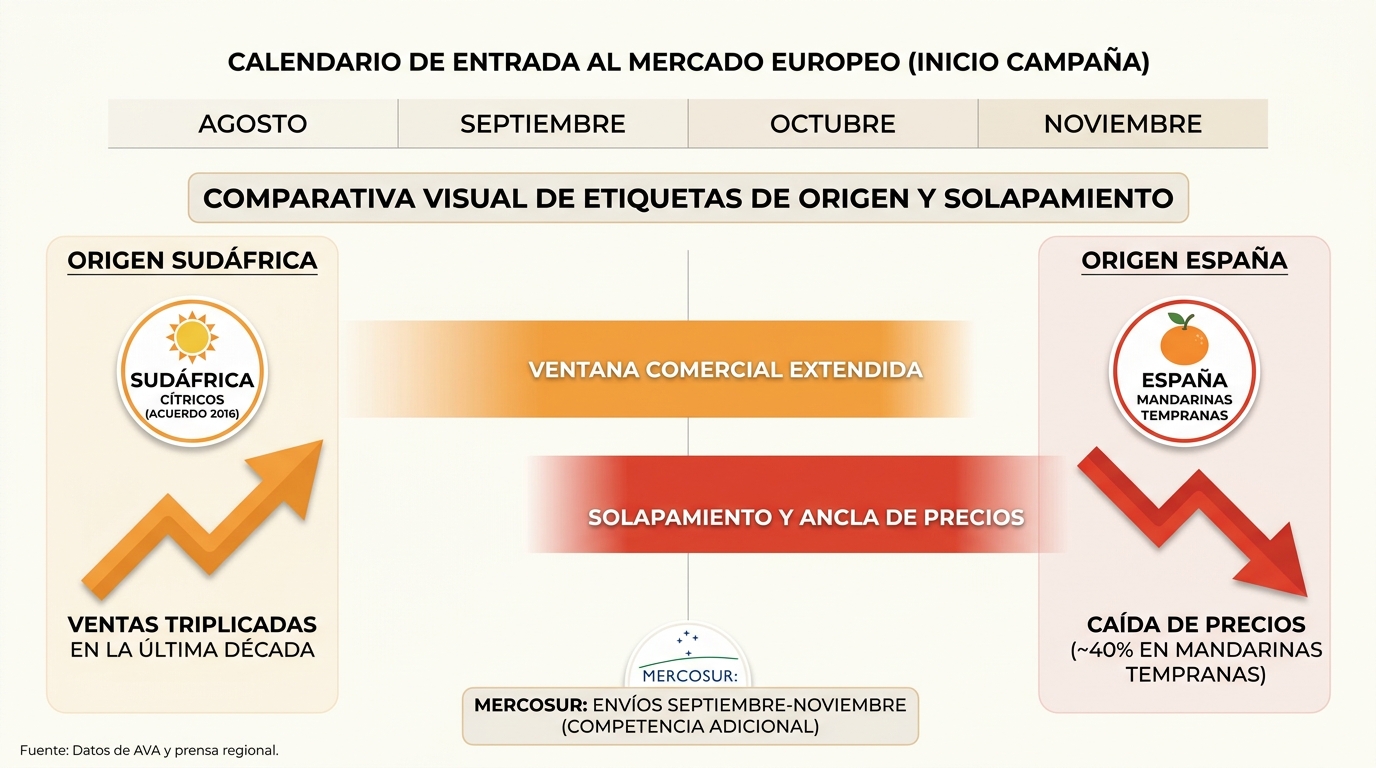
The overlap with South African citrus at the start of our mandarin season has become an anchor dragging prices down. Since the 2016 agreement, the Valencian Farmers' Association (AVA-ASAJA) and other bodies have measured a drop of nearly 40 percent in early mandarins. It's directly linked to overlapping market windows, with South African sales more than tripling over the last decade, as the farmers themselves explain and the regional press reports.
Then there's Mercosur. Between September and November, citrus shipments to the European Union (EU) grew by 18 percent, arriving just as we start picking here. That steady trickle pushes down the starting price on the shelves. And to top it off, Brussels reduced pesticide checks on some imported fruit despite those countries having many recent alerts, as this analysis reported. With different rules at origin and destination, the competition isn't fair. Let's put it more simply:
- Real reciprocity: the same active substances allowed or banned on both sides.
- Clear windows: avoid overlaps that knock down early-season prices.
- Effective controls: inspections in line with each country's alert history.
Have climate and pests changed the game?
Yes. The weather doesn't play along like it used to, and the damage multiplies at critical moments. Between September and December it rained at the wrong time, there was heat during delicate stages, and over 75,000 tonnes were lost to rot, according to technical estimates. Insurance doesn't always cover those losses, and irrigation costs went up in the driest summers. It all adds to the feeling of fragility.
In plant health, the board is shifting too. The Asian vector of Huanglongbing or citrus greening (HLB), the most feared disease in the citrus world, has been detected in the Mediterranean, and the Valencian Institute of Agricultural Research (IVIA) has managed to identify a natural parasitoid with control potential, as this scientific note reports. At the same time, six of the eight highest-impact pests are already in the EU or nearby, according to recent reviews. For example, we make a huge effort season after season to fight sooty mould on citrus. Fewer crop protection tools and more pests is an equation that drives up costs and makes everything harder.
And let's not forget the footprint of very long journeys. Bringing fruit by ship and refrigerated truck has carbon costs and quality risks. Research on climate and transport makes that clear. It's not just a price decision, it's also a decision about consistency with what we want to eat and protect.

The food chain and the retail squeeze
Far too many weeks, the farmer gets paid below cost while shelf prices barely budge. The public Observatory confirms that the middle links capture most of the value and that transparency in the chain is still lacking. The Value Chain Observatory itself spells it out. And if you're wondering about margins, 2023 already brought record supermarket profits. Meanwhile, at the farm, there are days when 13 kilos are paid at 2 euros, as a team of journalists exposed. There's no future like this.
Solutions? Enforce the Food Chain Law with no exceptions, make sure nobody buys below cost, and stop the juice industry from being the sector's rubbish truck. There's room to do things right here, and everyone knows it.
Land, abandonment and succession: what we already see along the tracks
There's a quiet reality weighing on us: many farmers are over 65 and can't find anyone to take over. At the same time, accumulated abandonment far exceeds 30,000 hectares in the Valencian Community, and you can see it in pests, wildfires and the landscape. That's why the sector is calling for a comprehensive modernisation plan, as this sector approach sets out, and for policies that truly encourage young people, along the lines of the announced generational succession package.
We're also seeing crop changes. In the Ribera del Xúquer, the persimmon or Rojo Brillante kaki has gained ground, and some call it the new alternative when oranges get tough. Its good prices in recent years encouraged conversions, although nobody forgets that every crop has its cycle and its risks. The key is to diversify wisely without losing sight of what we do best.
Innovating to stay: varieties, smart irrigation and biological control
Getting out of the Valencian orange Crisis means modernising. New protected varieties, like the Mina mandarin, developed in the Valencian Community, are showing better adaptation to climate change and a longer shelf life, as field trials and the Valencian innovation network point out. It's no magic wand, but it helps bring back profitability. Meanwhile, some orange varieties are losing ground.
Irrigation has changed too. With sensors and scheduling based on real needs, you save water and energy. Farming has evolved over the centuries, and today precision agriculture is no longer a thing of the future: it exists and it lowers costs, as guides on smart farming and technical notes on sensors in citrus explain. And when you combine it with the Valencian Irrigation Strategy 2020 - 2040, which sets a modernisation framework, efficiency becomes the norm.
In pest control, we follow the path of the Valencian Institute of Agricultural Research (IVIA) with natural enemies of the Huanglongbing (HLB) vector and other biological solutions. Fewer active substances and more well-done integrated management. It's slow, but it's the way forward. And please, let's not forget to step up surveillance at ports. The uberisation of the chain can't be allowed to wipe out the plant health of an entire region.
What you hear in the furrow: Villanueva de Castellón, 2026
Here's what a neighbouring farmer with several seasons of experience told us when we interviewed him this week. When we asked about the Navelina oranges season in 2025 and 2026, he answered:
For several years now, and nobody knows why, there's been a big drop in production. Last year, 2025, went the same way; we don't know if it was pests or fungi. Since I'm really, really on top of things, I had a harvest in the upper-middle range, better than most other farmers. This year, 2026, because of the rain and the sudden changes in weather, there's practically no production, very, very little, and it's across the board. So we've been taking hits for several years and farmers' morale is on the floor.
Lots of farmers are giving up. You see more abandoned plots. A small number, some who have their own jobs and treat it as something secondary, have decided to pull out trees and replant, with the same Navelina variety, but they're small plots. This year we've seen trees pulled out and replanted. But what there's most of is abandonment.
When we read the big headlines and then step into the mud, it all fits. The lack of profitability, the back-to-back climate blows and the market uncertainty are sinking in. The way out demands brave decisions at every level.
But while we look for a solution, we keep talking among ourselves, and the truth is that when you ask about orange varieties, two still stand out: Navelina and Salustiana.
Navelinas and Salustianas are, in my experience, the two that usually behave well. Generally, they produce to a greater or lesser extent and tend to be fairly steady, except in years like this one. Navelina isn't like the second-season oranges, the ones that start in January, like Lane Late, which are much more volatile. And it's harder to get them juicy and putting on kilos.
Buying wisely: how to support without overpaying
There's a detail you won't see on the label. Oranges that come from far away usually involve cheaper labour, different controls and weeks in cold storage to survive the journey. It works for the price, but someone pays for it: the flavour pays, the land pays and the local farmer pays. If you'd like to support what's grown close to home, look for proximity, seasonality and direct dealing.
- Choose fruit straight from the grower within 24 hours of picking. Here you can see our seasonal products and our eating oranges.
- Ask about growing practices and harvest dates. In our newsletter we tell you every week what we're picking.
- Value tree-ripening. Our new Summer Powell orange arrived to stretch out the enjoyment when others are finished.
- If you love top-notch mandarins, check out the Orri in full season. And follow us to read more stories from the orchard.

What the sector and the authorities are proposing
Farming organisations are calling for a Marshall-style emergency plan, and the Generalitat will launch conversion measures to replace ageing plantations, improve irrigation and recover abandoned plots. It's the right direction, and now it needs to be carried out well, focusing on young people and professionals, as these plans set out. If we add consumption promotion, orderly market windows and real trade reciprocity, the Valencian orange will shine again.
Frequently asked questions
Why are there so few Valencian oranges this season?
Heavy rain during flowering and fruit set, heat at key moments and bouts of humidity all came together and sent rot soaring, with over 75,000 tonnes lost according to technical estimates. On top of that, the national harvest is the shortest in sixteen years, and every district feels it.
Who sets the price you get paid at the farm?
Buyers, fruit arriving from third countries at the start of the season and big retailers all play a part. The Food Chain Law bans buying below cost, but its real enforcement is still patchy, even with the Food chain observatory as a reference.
Are imported oranges unsafe?
You can't generalise. What we ask for is reciprocity: the same standards as here for crop protection products and controls. Recent reports even point to reduced checks on countries with many alerts, and that's worrying in terms of transparency and unfair competition.
Does switching variety really help?
It helps when the variety adapts better to the climate, keeps its size and holds up well post-harvest. New materials like Mina are delivering results, along with precision irrigation and better management. It's not instant, but it adds to profitability.
What can I do as a consumer right now?
Buy seasonal, local and with clear traceability. If you can, choose fruit straight from the grower and steer clear of impossible promises. We harvest to order and ship in under 24 hours from the tree. You'll notice it in the juice and in the peel.
Sources and recommended reading
If you want to dig deeper, here are some links on the season, the market and plant health: 2025 2026 citrus season, Mercosur imports, humidity losses, natural enemies of HLB and analysis on the chain and platforms.
Conclusion: a way out through quality, transparency and unity
The Valencian orange Crisis isn't a one-off bump. It's the result of a smaller harvest, unfair prices and competition playing by different rules. The good news is that there are clear levers: trade reciprocity, modernising the fields, biological control and informed buying.
If you love oranges that taste like oranges, we're still here, hands in the soil and minds on what matters. You can help by buying direct, with no middlemen and a harvest picked to order. Take a look at our oranges straight from the tree and sign up for our newsletter to find out what we're picking each week.
Thanks for being on the other side.


