

Cherry tree pruning, done well and at the right time, is the key to having balanced trees and cherries with good size, firmness, and flavor. In Spain, it's best to prune right after the harvest and finish up at the end of winter, always adjusting to your local climate and the vigor of each tree.
I'll tell you this in confidence, with my boots on: Here, we treat pruning like tuning an instrument. We open up the canopy to let in light, regulate the load so the tree doesn't get out of control, and protect each cut as if it were a gateway to the cherry tree's health. If you like comprehensive guides, our blog has more on cherry cultivation in Spain, but today we'll stay in the field, next to the trunk.
When to prune a cherry tree in Spain without risking it?
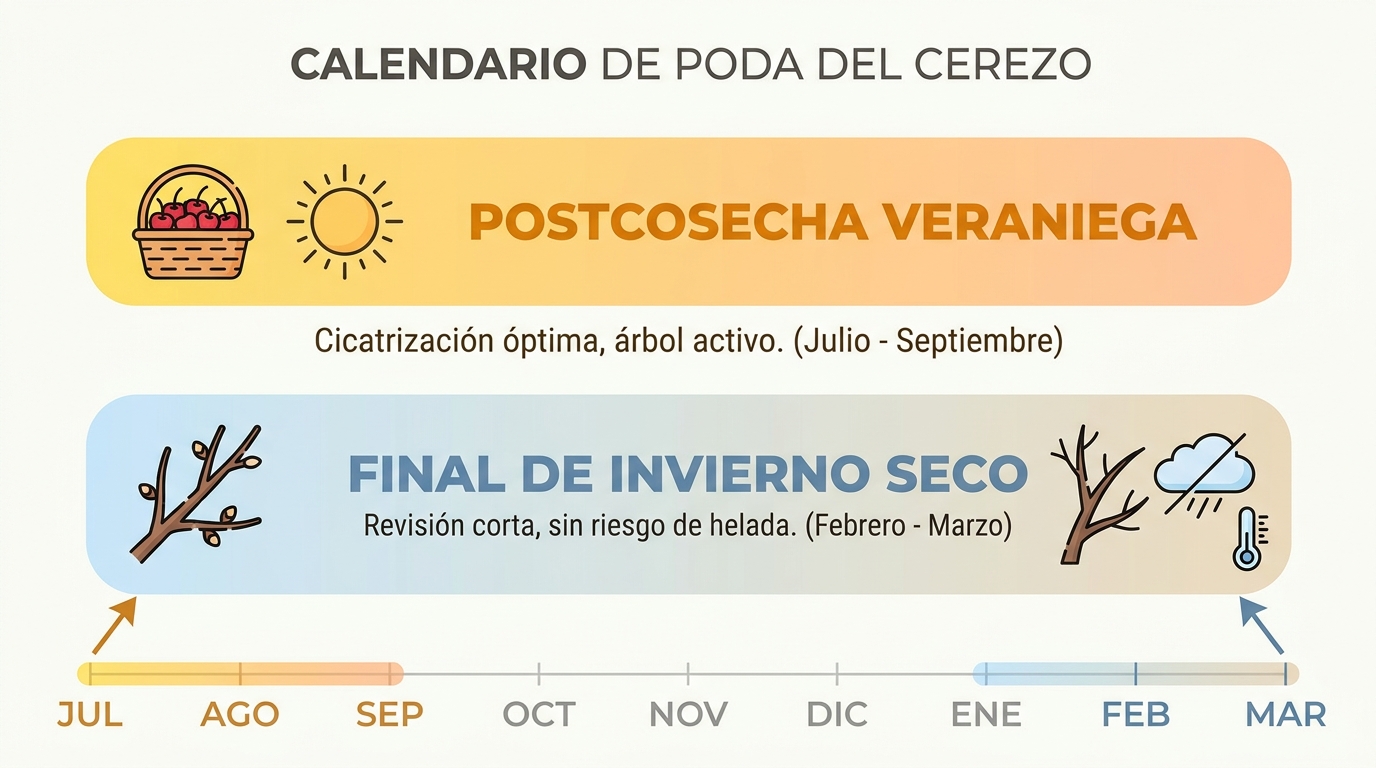
In Spain, cherry trees heal best when the tree is active. Therefore, the prime window is post-harvest and early summer, followed by a light review at the end of winter if the weather is dry and there's no risk of frost. In humid areas, it's advisable to shift more pruning to summer to avoid infections in open wounds during winter. This guideline is supported by guides like that of the Protected Designation of Origin Cereza del Jerte (DO Jerte) and technical manuals that recommend opening the canopy and renewing wood during dry periods with sap flow (techniques and timings, timing and tools).
Always avoid pruning when the tree is wet or when temperatures are near zero. If you work in mountains or valleys with late frosts, delay major cuts until the risk has passed. In dry Mediterranean climates, February and March can work, but local forecasts dictate (technical sheet).
| Situation | Recommended window | Main objective |
|---|---|---|
| Mediterranean interior and Ebro Valley | Post-harvest until September and touch-up in February if dry | Rapid healing and vigor control |
| Mountainous areas like Jerte or Gredos | Post-harvest and summer; late winter without frost | Renew wood and reduce height |
| Humid Atlantic North | More emphasis on summer; winter only on dry days | Minimize gummosis and wood fungi |
The basics: how the cherry tree responds to pruning
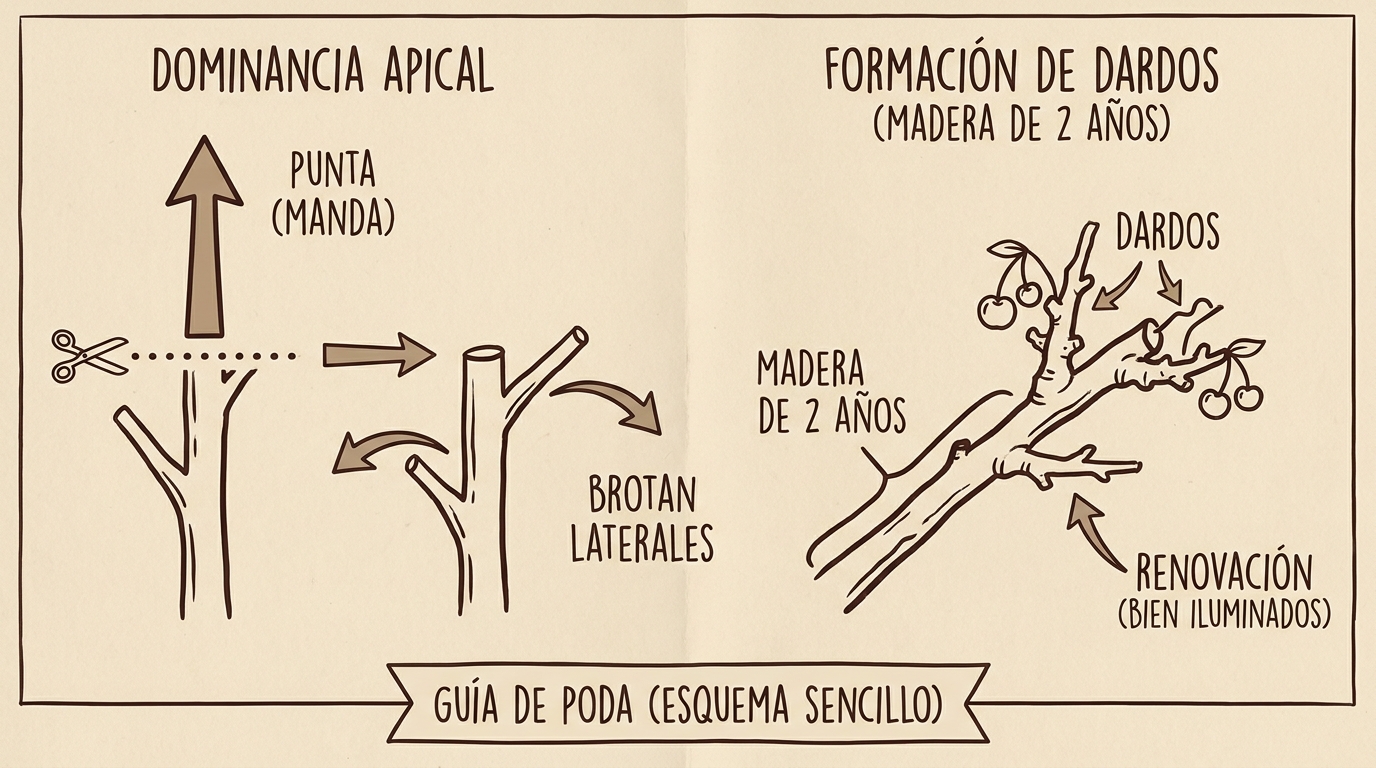
The cherry tree has very marked apical dominance. If you leave the tip, it dominates. If you cut it, lateral shoots sprout. Knowing this allows you to decide whether to stimulate or curb vigor depending on the season. In winter, a strong cut triggers shoots in spring, while green pruning moderates growth and opens the canopy. Inside, fruit grows on spurs that last for years, but if they are shaded or age, the size decreases. The key is to renew young, well-lit spurs each season (pruning guide).
Another sensitive point: the cherry tree heals slowly. Very thick cuts and humid climates are the combination that opens the door to Pseudomonas and wood fungi. Hence the emphasis on clean cuts, correct angles, and tool disinfection, in addition to preferring periods of vegetative activity for quick closure (technical criteria).
Cherry tree training pruning: improved vase and central leader systems that work
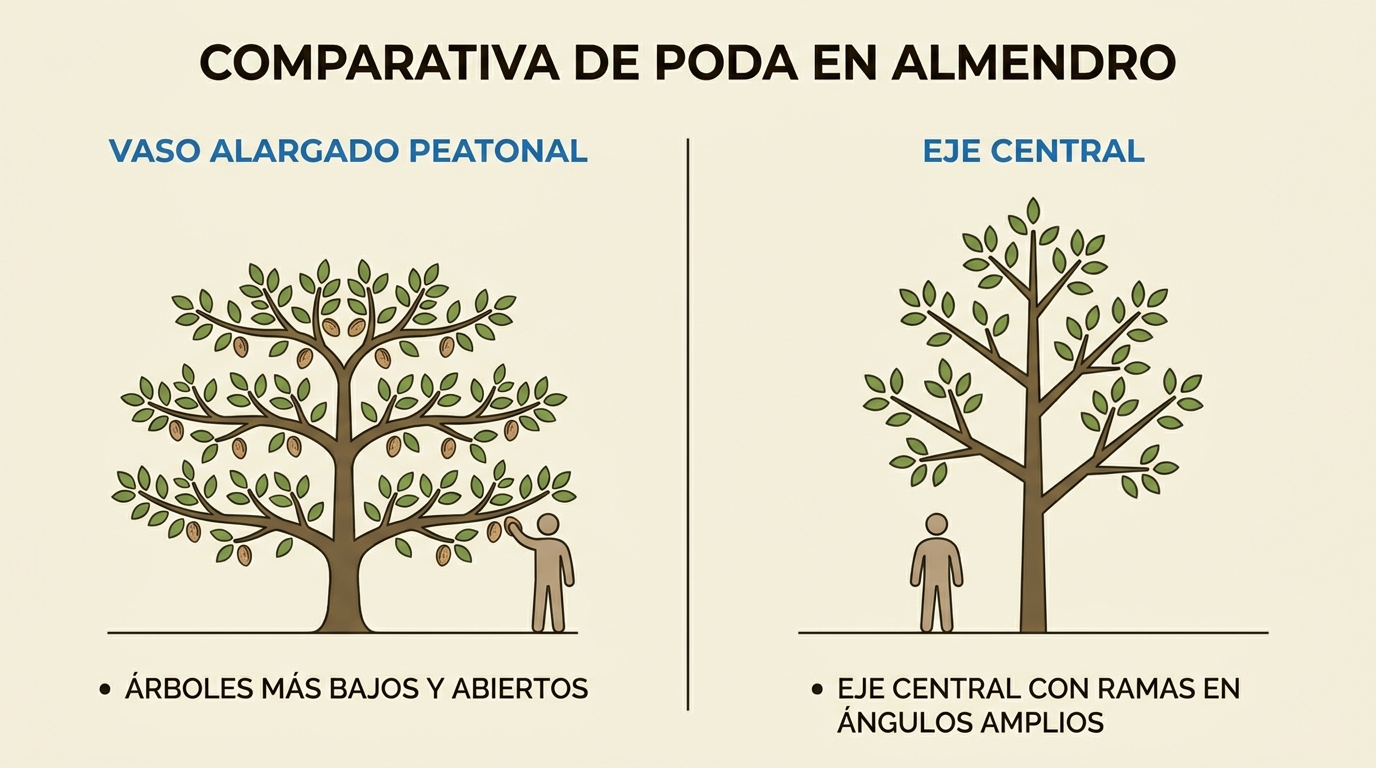
In Spain, pedestrian orchards have gained traction: lower, well-opened trees that are easy to harvest. In the improved vase system, the first year the seedling is cut to about forty centimeters, leaving three or four buds to branch; the second year, this is repeated to create a second tier, and from the fourth year, internal growth is removed and height is penalized. Not all branches are cut the same: vertical and thick ones are left longer, while thin lower ones are pruned more to standardize fruit size (improved vase).
The central leader system distributes branches in tiers with good angles to withstand the load. In high-density planting, less pruning is better in the early years and more bending, so the tree comes into production earlier and forms spurs along the leader. Once it is producing, wood is renewed annually to maintain light in the lower part and accessible fruit (pruning systems, high density).
What we do in production: less wood, more light and adjusted load
In production pruning, we start with the obvious: dead, diseased, or crossing wood removed. Then, light windows are opened, suckers that steal sap are removed, and long branches are shortened to be self-supporting. A practical criterion that works very well: renew about twenty percent of the wood each season, focusing on young spurs in well-lit areas. This improves fruit size and firmness, as well as color uniformity (annual renewal, load regulator).
Pruning is a key part of shaping the tree and one of the most complex tasks. It varies greatly depending on the age of the cherry tree and also the cultivated variety, as each requires a different management.
On our farm, we carry out quite intensive pruning. We leave the trees with little branching, both in young and older specimens. In older trees, we reduce the wood even more to ensure that the tree's resources reach the productive parts better. In young trees, more branching can be left without affecting the quality of the cherry.
The objective of this pruning is to prioritize fruit quality. We seek to obtain cherries of a larger size and with more flavor. By reducing the tree's load, a lower production is achieved, but the nutrients are concentrated in fewer fruits, favoring their size and quality. It's a strategy that is giving us very good results.
Sujan, Cherry Farmer
When fruit set is generous, we perform decisive thinning. We leave fewer per cluster, well-spaced, with air and light to grow without rubbing. It's like reducing a sauce in cooking: you sacrifice volume to gain concentration. This regulates the load, protects branches from weight, and smooths out biennial bearing (bud thinning). If you want to see the complete philosophy, here we talk about why sometimes producing less means gaining in quality: producing less, even if it sounds crazy.
We do not differentiate pruning based on whether a variety is sweeter or more acidic. In that respect, we treat them the same.
What does change is the management according to the variety, as each one behaves differently. Some develop many branches and require more intense pruning from the beginning to control their growth. Others produce less wood and are easier to manage, so cuts are more specific.
Therefore, rather than being guided by the cherry's flavor, we adapt the pruning to the growth habit of each variety. Even so, the goal is always the same: to reduce excess branches to favor fruit quality, maintaining a balanced and productive tree.
On our farm, we have considerably reduced the size of the trees compared to other management systems, seeking to better concentrate the cherry tree's resources without losing its productive capacity.
Sujan, Cherry Farmer
The intensity of pruning is mainly adapted to the age of the tree and the variety. In older trees, we perform more intense pruning to ensure that resources reach the productive parts better. We also adjust the intervention according to the behavior of each variety, as some generate many more branches than others. In general, we seek to reduce excess wood and leave the fewest possible branches, with the aim of concentrating nutrients in fewer fruits and improving the size and flavor of the cherry, while maintaining the tree's productive capacity.
Sujan, Cherry Farmer

Cherry tree sanitation pruning: cut, clean, and protect
Gummosis, brown rot, shot hole, and anthracnose are well-known cherry tree ailments. Keeping the canopy airy and free of dead wood breaks the infection cycle. If honey-colored exudates appear, clean down to healthy tissue, disinfect, and protect the wound. Mummified fruit from brown rot should be removed from the tree and destroyed. On rainy days, do not prune. Preventive autumn and winter treatments with copper help reduce inoculum in wood and buds (cherry tree diseases, gummosis, brown rot).
Biosecurity starts with the tools. Disinfect between cuts, especially after diseased branches. Alcohol or specific products can be used, always taking care of the steel. To seal large cuts, use healing mastics or natural alternatives with antimicrobial effects, applied to the edge of the cut and the entire surface (tool disinfectant, wounds on Prunus avium).
Cutting technique and tools: small details that make a difference
A good cut is recognized by its cleanliness and its angle. Trim a few millimeters above an outward-pointing bud at about forty-five degrees so that water does not collect. Respect the branch collar, neither cutting flush nor leaving a long stub that will rot. For branches of a certain diameter, support them and avoid tearing. And if in doubt, two small cuts are better than one huge gash that takes a long time to close (how to cut well).
As for tools, hand pruners for fine cuts and a clean, sharp saw for thicker ones. Electric tools greatly alleviate effort when there's a lot of pruning to do, but always with safety and a steady hand. Working as a team helps control falling branches and protect the bark (field recommendations).
Irrigation, nutrition, and cherry tree pruning: the trio that defines fruit size
Pruning changes the aerial part-to-root ratio, and with it, the demand for water and nutrients. Green pruning after harvest usually moderates vigor and reduces future water consumption. In fertigation plans, adjust N and K to the load you leave and pamper calcium from twenty-five days after full bloom for firm fruit. Available boron in soil and leaves with good transpiration flow helps stable fruit set (cherry tree fertilization, cherry nutrition).
With changing climate, fewer chill hours, and heat waves, balance is even more important. Pruning can help manage height, shade on structural wood, and cluster exposure. Monitor soil and plant, and always align pruning, water, and fertilizer with the desired crop load.
Regional specificities to respect
Jerte has perfected the modified vase system for pedestrian orchards with summer pruning in spring and summer, plus a thinning of thick branches at the end of summer. It is safe and practical on slopes and with a risk of late frosts (Jerte, systems and periods, Jerte bloom).
In Aragon and the Ebro Valley, high-density central leader systems on modern rootstocks require minimal pruning initially and aggressive renewal in adult trees to ensure light penetration and good fruit size. Choosing the right rootstock influences vigor and future management (high density, rootstocks).
In the Alicante Mountains and dry Mediterranean regions, summer pruning after harvest lightens water demand and helps standardize ripening. If you'd like to learn about the varieties we work with and how that affects pruning, check out our cherry varieties in Spain.

Common cherry tree pruning mistakes and how to avoid them
- Ill-timed pruning: Cuts made in humid winter or with frost risk open the door to diseases. Wait for dry days, and if possible, shift most pruning to post-harvest.
- Giant cuts: Cherry trees heal slowly. It's better to spread major renovations over several seasons and protect large wounds.
- Confusing suckers with productive branches: Look at the buds. If they are flower buds, that branch will feed next year's harvest.
- Leaving the canopy blind: Without light windows, the spurs become exhausted and fruit size decreases. Open up gaps and gradually reduce height.
- Dirty or dull tools: Every torn cut is a health risk. Sharpen, disinfect, and take your time.
Express step-by-step guide: domestic cherry tree pruning
For a garden cherry tree, less is more. With ten clear steps, you can make a difference.
| Step | What to do | Why |
|---|---|---|
| 1 | Observe dry and plan | You see the structure and choose cuts wisely |
| 2 | Disinfect tools | You avoid spreading pathogens from one cut to another |
| 3 | Remove dead and diseased wood | Immediate health and light to the interior |
| 4 | Open the center and eliminate crossing branches | Better ventilation and fewer fungi |
| 5 | Select suckers and remove those that steal vigor | You balance vigor without losing useful wood |
| 6 | Shorten long branches to an outward-pointing bud | Self-support and growth direction |
| 7 | Renew some old wood | You promote young spurs with good size |
| 8 | Seal large cuts | Less standing water and less infection |
| 9 | Remove debris from the ground | You break the cycle of fungi and pests |
| 10 | Water and fertilize according to the new canopy | Recovery and reserves for the next season |
If you want a broader overview, we have prepared a cherry production guide in Spain that integrates pruning with irrigation, nutrition, and plot management.
How does your cherry pruning show when you buy directly from the grower?
When you regulate the load with pruning and thin at the right time, the cherry is more crisp, with a clean sweetness and a captivating color. It's not magic. It's because the tree distributes its energy among fewer fruits and stops inflating them with water at the last minute. That's why we advocate for brave pruning and moderate irrigation: quality is felt at home. If you're curious about varieties and harvest windows, check out our cherry varieties.
Frequently asked questions about cherry tree pruning
Is it better to prune cherry trees only in winter or also in summer?
For cherry trees, it's advisable to spread the work. Post-harvest and early summer help with quick healing and managing vigor. In late winter, on dry, frost-free days, the structure is adjusted with finer cuts. This combination reduces health risks and improves light in the canopy (reference).
How much can I remove without damaging next year's production?
As a practical rule, do not remove more than twenty-five percent of the canopy in a single season. Renew old wood by staggering it over several years. This prevents an explosion of water sprouts and allows time for cuts to heal properly (technical criterion).
How do I distinguish a water sprout from a working branch with flower buds?
A water sprout is very vertical, vigorous, and has long internodes. A working branch is usually more horizontal and bears short spurs with visible flower buds. If in doubt, wait to see swollen buds before removing and prioritize light so that wood can fruit.
What do I do if I have gummosis on the trunk or a branch?
Locate the darkened area, clean with a knife until you reach green tissue, disinfect, let dry, and protect with a healing paste. Check irrigation and drainage, and avoid cutting on rainy days. Remove dead wood and monitor new wounds (step-by-step).
Is sealing cuts mandatory on cherry trees?
Not for all cuts, but for large diameters, it's worthwhile. Cherry trees heal slowly, and proper sealing reduces water and spore entry. Always accompany with clean cuts and disinfected tools (more details).

Conclusion and next steps
Cherry tree pruning is much more than just cutting. It's about deciding where light lives, which fruit stays, and how to keep the tree healthy. In Spain, the best results are achieved by working hard after harvest, finishing in late dry winter, and protecting each cut with technique and cleanliness. Less bad wood and well-lit young spurs mean more size, firmness, and flavor.
If you like to eat cherries that taste like cherries, we continue here with transparency and open hands. We invite you to read our growing and varieties guide and to follow us to know when we harvest and how we work. And if you want to experience the difference, join our community: we harvest to order, with a satisfaction guarantee and all the love of the land.
Thank you for supporting the grower who takes care of their field and that jewel of nature that reaches your table.

Useful resources for further reading: pruning criteria, correct pruning, technical recommendations, pruning as a regulator, bud thinning, nutrition and fertigation.

