
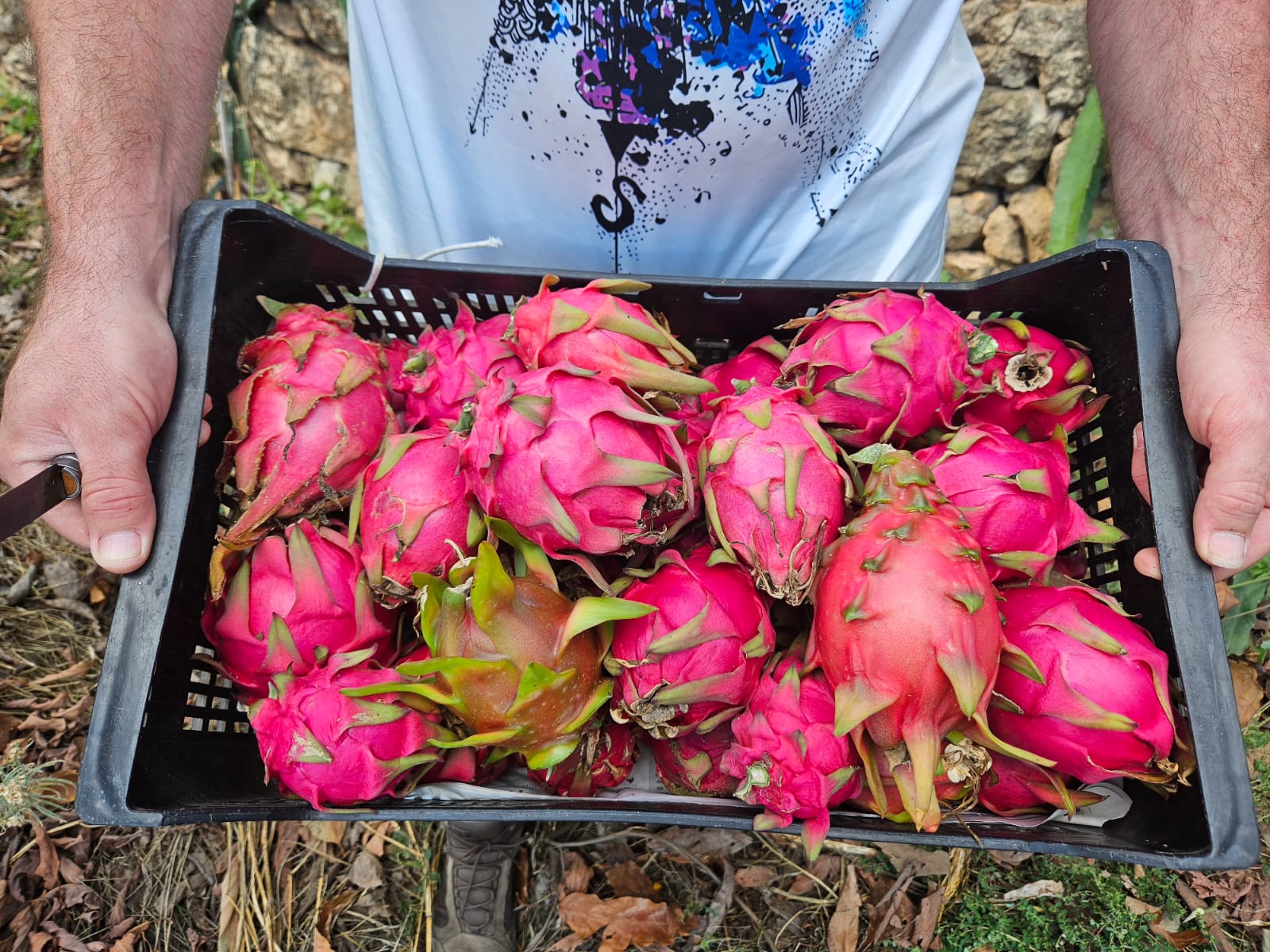
Dragon fruit, also known as pitaya or pitahaya, is an exotic tropical fruit that has found its home in Spanish lands. With its striking appearance and extraordinary health benefits, this fruit has become a true treasure for those seeking natural, nutritious, and uniquely flavored foods. At Campos del Abuelo, we are passionate about bringing this gem directly from our fields to your table in less than 24 hours.
What exactly is dragon fruit?
Dragon fruit (Hylocereus spp.) is native to Central and South America, although its cultivation has spread to various regions around the world. It belongs to the cactus family and is characterized by its spectacular appearance: a bright pink or yellow skin covered in green scales that resemble those of a mythological dragon, hence its name.
When cut open, it reveals a pulp that can be white or red (depending on the variety), speckled with small, edible black seeds. Its flavor is mild and sweet, similar to a cross between kiwi and pear, with a refreshing touch that makes it perfect for eating alone or combined with other fruits.
In Spain, the most cultivated varieties are Hylocereus undatus (with red skin and white pulp) and Hylocereus costaricensis (with red skin and pulp), adapting especially well to areas such as the Tropical Coast of Granada, Andalusia, and the Valencian Community.

How did dragon fruit come to be cultivated in Spain?
Although native to tropical regions, dragon fruit has shown a surprising ability to adapt to the Spanish Mediterranean climate. Its cultivation began as an experimental initiative just a few decades ago, but today it represents a sustainable and profitable agricultural alternative.
In regions such as Andalusia, Levante, and under greenhouses in the interior of the peninsula, this fruit has found favorable conditions for its development. Its drought tolerance and ability to thrive in diverse soils make it an ideal crop for areas such as Almería, Murcia, and Valencia.
Fran, a fellow farmer from Valencia with experience in pitaya cultivation, tells us: "The first thing I would tell other farmers is to be clear that Valencia's climate is not perfect for pitaya, but with certain adaptations, it can be grown successfully. The sun here is very strong, and that can easily burn the plants. That's why it's essential to use shade cloth or find some way to provide protection."
This adaptability, along with innovative cultivation techniques, has allowed Spain to position itself as an emerging producer of this exotic fruit, reducing reliance on imports and offering a fresher, tastier product.

The amazing health benefits of dragon fruit
Dragon fruit not only stands out for its appearance and flavor but also for being a true nutritional treasure. It is rich in antioxidants, vitamin C, and fiber, making it a superfood with multiple health benefits:
- Strengthens the immune system: Its high content of vitamin C (25 mg per 100 g) helps boost the body's natural defenses.
- Combats oxidative stress: It contains antioxidants such as phenols, betacyanins, and betalains that neutralize free radicals, reducing the risk of cardiovascular and degenerative diseases.
- Improves digestion: Its fiber content promotes intestinal transit and contributes to a healthy gut microbiota.
- Hydrates the body: With 84% water in its composition, it is a very hydrating fruit that helps combat fluid retention.
- Regulates sugar levels: Studies have shown its effectiveness in regulating blood glucose, making it beneficial for people with type 2 diabetes.
- Cares for cardiovascular health: It contains captin, a substance that helps regulate heart muscle contractions, preventing arrhythmias.
Furthermore, with only 54 kcal per 100 g, it is an ideal option for those looking to manage their weight without sacrificing flavor.
How is dragon fruit cultivated in Spain? Our farmers' experience
Pitaya cultivation in Spain represents an example of agricultural innovation and adaptation to local conditions. Unlike its natural tropical environment, specific techniques have been developed in our country to ensure its optimal growth.
Fran shares his experience from Valencia: "One of the keys to being able to grow pitaya here in Valencia has been protecting it from the strong sun we have. We use shade cloth and build small tunnels to protect the plants. Also, on our farm, we plant them near the avocados, which give them some natural shade. When the heat is extreme, we apply calcium to the leaves to 'whiten' them and protect them from the sun, like a sunscreen."
Ecological management is fundamental in our crops. We do not use aggressive chemical products, but rather focus on prevention and constant observation. As Fran, a farmer, explains to us: "For fungus control, we use ecological treatments, such as copper sulfate, which has worked very well for us so far. In addition, by maintaining general ecological management – with good fertilizers and sustainable practices – we ensure that the plant is healthier and has more natural defenses."
This sustainable approach not only benefits the environment but also results in a fruit of better quality and flavor, characteristics that our customers particularly value.

The difference in flavor: local vs. imported pitaya
One of the great advantages of consuming dragon fruit cultivated in Spain is the notable difference in flavor and freshness compared to imported fruit. Local fruit is harvested at its optimal point of ripeness, when it has developed its full flavor and nutritional properties.
According to Fran: "There are very clear differences in the flavor and texture between the pitaya we grow here in Valencia and the one that comes from abroad. Imported fruit usually arrives without flavor, because they harvest it green so it can withstand long journeys, and often it lacks the acidity or sweetness it should have. We, on the other hand, harvest it at just the right moment, when it's ready, and that makes a difference."
This difference is perceived and valued by consumers: "Customers tell us this continuously. Many have tried supermarket or imported pitaya and describe it as bland, expensive, and uninteresting. But when they try ours, they change their minds. Even people who said they didn't like pitaya have been surprised by ours."
At Campos del Abuelo, we are committed to delivering dragon fruit in less than 24 hours from harvest, thus ensuring that it reaches your table with all its freshness and properties intact.
How to choose and store the perfect dragon fruit
To fully enjoy this exotic fruit, it is important to know how to choose and store it properly:
How to choose a good pitaya:
- Look for fruits with bright, firm skin, free of dark spots or significant wrinkles.
- A ripe pitaya should yield slightly to pressure, similar to an avocado at its peak.
- The "scales" or green protrusions may be dry or brown; this is normal and does not affect the quality of the fruit.
- The skin color should be intense and uniform, whether pink, red, or yellow depending on the variety.
Proper storage:
- At room temperature, ripe pitaya can be stored in good condition for 3-5 days.
- In the refrigerator, it can be kept for up to 2 weeks. Place it in the vegetable drawer.
- If the fruit is green, let it ripen at room temperature until the skin acquires a more intense color.
- Once cut, store it in an airtight container in the refrigerator and consume within 1-2 days.
Dragon fruit is quite resilient thanks to its thick skin, which protects the pulp from external conditions, allowing it to stay in good condition longer than other tropical fruits.
Delicious ways to enjoy dragon fruit
The versatility of dragon fruit allows it to be enjoyed in many ways, from its simplest consumption to more sophisticated preparations:
Fresh consumption: The most traditional and simple way is to cut it in half and eat the pulp directly with a spoon, seeds included. You can also cut it into four wedges and separate the pulp from the skin like an orange.
In salads: Cut into cubes, it adds an exotic and colorful touch to fruit or vegetable salads. It combines especially well with avocado, mango, and red berries.
Smoothies and shakes: Its pulp adds a creamy texture and a spectacular color to smoothies. Try mixing it with banana, almond milk, and a touch of honey for an energetic breakfast.
Desserts: It is ideal for making mousses, ice creams, sorbets, or cold cakes. The red pulp variety can be used as a natural food coloring in baking.
Jams: Its natural pectin content makes it perfect for making homemade jams with an exotic touch.
Cocktails: Red pitaya pulp can be used to add color and flavor to cocktails, being especially popular in gin and tonics and daiquiris.
A simple and nutritious recipe is the "Pitaya Energy Bowl": mix the pulp of one pitaya with half a banana until you get a creamy texture. Serve in a bowl and decorate with kiwi slices, mango, chia seeds, and a handful of granola. A complete breakfast that provides 80% of the recommended daily dose of vitamin C!
The rise of dragon fruit in the Spanish market
The demand for pitaya in Spain has experienced exponential growth in recent years. What started as a niche exotic product has become an increasingly present fruit on Spanish tables.
Regarding this, our fellow farmer Fran tells us: "Local demand for pitaya has grown a lot in recent years. At first, we cultivated them as a whim, for home, and we even gave them away. But we began to notice that many people—especially older people—asked us about them, if we had any, that they wanted to buy. That's when we realized there was real interest."
This growth is due to several factors: greater awareness of its health benefits, the search for exotic and nutritious foods, and the preference for local and sustainable products. Many consumers incorporate it into their diet by medical recommendation, especially for digestive problems or to regulate blood sugar levels.
Although Spain imports about 1,500 tons of pitaya annually from countries like Colombia and Vietnam, local production is rapidly gaining ground. Projects like "Pitaya España" in Malaga or "Alta Native" in Levante are demonstrating the economic viability of this crop, with wholesale prices ranging between €4.32 and €7.25/kg for national production, compared to €2.80/kg for imports.
At Campos del Abuelo, we are committed to locally grown pitaya, guaranteeing a fresh, tasty product cultivated with sustainable practices.

Frequently asked questions about dragon fruit
Is dragon fruit good for diabetics?
Yes, pitaya has a medium-low glycemic index and contains compounds that help regulate blood sugar levels. Studies have shown that regular consumption of this fruit can improve insulin sensitivity. However, like any fruit, it should be consumed in moderation and as part of a meal plan supervised by health professionals.
Can you eat dragon fruit seeds?
Absolutely. The small black seeds of the pitaya are not only edible but also beneficial. They are rich in omega-3 and omega-9 fatty acids, in addition to providing extra fiber. Their texture is similar to kiwi seeds and they do not need to be removed to consume the fruit.
What is the best season to consume dragon fruit in Spain?
The main season for pitaya cultivated in Spain runs from late spring to early autumn, with its peak production between July and September. During these months, you will find the freshest, tastiest, and best-priced fruit. Out of season, most of the available pitaya is imported.
Why can dragon fruit stain urine reddish?
The red pulp variety contains natural pigments called betalains (the same ones that give color to beets). These pigments can cause a reddish coloration in the urine after consuming significant amounts of this fruit. This phenomenon, known as beturia, is completely harmless and disappears within 24-48 hours.
Is dragon fruit suitable for everyone?
Pitaya is generally safe for all ages and conditions. However, people with diverticulosis should consume it with caution, as its small seeds could become lodged in the diverticula. Also, although rare, some people may experience mild allergic reactions. As with any new food, it is recommended to introduce it gradually into the diet.
Conclusion: A tropical treasure within reach
Dragon fruit represents a wonderful fusion of the exotic and the local, a tropical treasure that has found its home in Spanish lands. Its adaptability to the Mediterranean climate, along with the sustainable cultivation techniques implemented by committed farmers, has allowed this nutritional jewel to be increasingly present on our tables.
Its extraordinary health benefits, gastronomic versatility, and spectacular appearance make it a perfect option for those seeking to incorporate nutritious, sustainable, and authentically flavored foods into their diet.
At Campos del Abuelo, we are proud to offer dragon fruit cultivated with passion and respect for the land, harvested at its optimal point of ripeness and delivered in less than 24 hours to guarantee all its freshness and properties. Because we believe that the best way to enjoy the treasures that nature offers us is by respecting its rhythms and processes.
Are you eager to discover the authentic flavor of dragon fruit cultivated in Spain? Visit our selection of seasonal fruits and let yourself be surprised by this tropical wonder that is already part of our agricultural heritage.


