
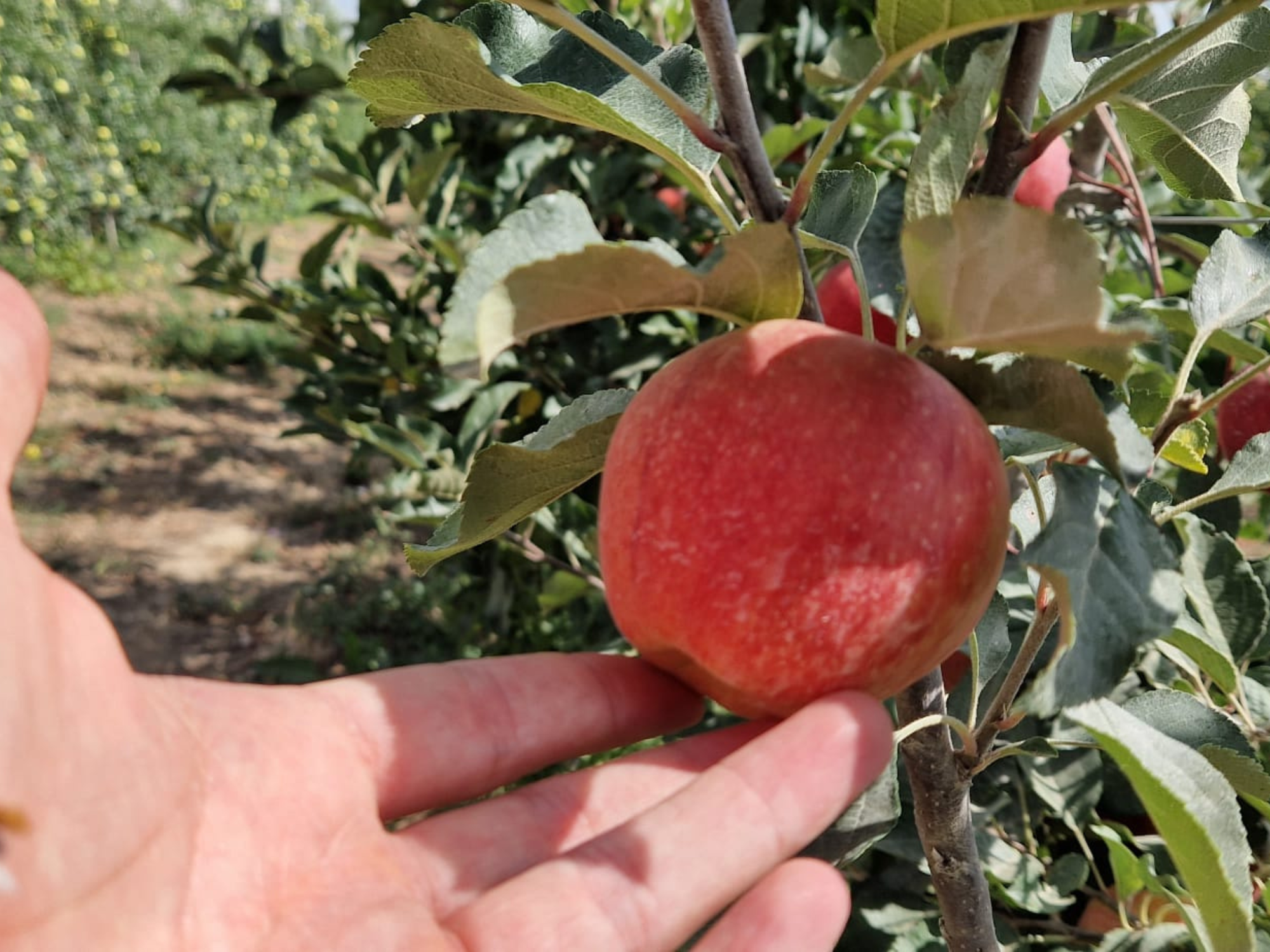
Apple cultivation in Spain combines centuries of tradition with the most modern techniques, producing some of the country's most cherished fruits. From the hillsides of Soria to the valleys of Catalonia, each apple tree tells a story of adaptation, care, and passion for the land.
Have you ever wondered how that crisp, juicy apple gets from the tree to your table? The process is fascinating and much more complex than you might imagine. At Campos del Abuelo, we work directly with farmers who know every secret of apple tree cultivation, and today we want to share all that generational knowledge with you.
Where are apples grown in Spain and what varieties can we find?
Spain produces more than 750,000 tons of apples annually, with regions that have made this crop their hallmark. Castile and León leads national production, especially in Soria, where 44,000 tons are expected to be harvested in 2025. This is followed by Catalonia (traditionally in Lleida), Aragon, and the Basque Country.
What makes each area special is its unique microclimate. As Luisa, an organic farmer we work with, tells us: "Local varieties, like Topat, have the advantage of already being adapted to the terrain and climate. They thrive here, producing the same amount every year, and have a tartness that is very popular in this area."

| Variety | Characteristics | Harvest Season | Main Region |
|---|---|---|---|
| Golden Delicious | Sweet, crisp flesh | August-December | Lleida, Soria |
| Royal Gala | Sweet-mild, red skin | August-December | Aragon, Catalonia |
| Reineta | Sweet with a tart touch | September-April | Asturias, Basque Country |
| Fuji | Very sweet, crisp | October-May | Soria, Lleida |
But not all apples are the same. Native varieties like Reineta or Esperiega de Ademuz are gaining prominence over international ones. The reason? Their greater resistance to climate change and their unique flavor that you won't find in any conventional supermarket.
How is the land prepared for planting apple trees?
Successful cultivation begins long before the first tree is planted. Apple trees are demanding when it comes to soil: they need a pH between 6.5 and 9, good depth (minimum 40 cm), and, above all, excellent drainage. Waterlogged soils are their worst enemy.
Soil preparation is fundamental. First, any remnants of previous crops must be removed and, most importantly, the soil must be disinfected. In organic farming, as practiced by many of our growers, solarization is used: covering the soil with clear plastic during the summer so that the heat naturally eliminates pathogens.
Luisa explains her method: "In organic farming, what we do is strengthen the health of the soil, which is the basis of everything. We use cover crops that help retain moisture and protect the roots from extreme temperatures."
What are the most effective planting techniques?
The choice of planting system makes the difference between mediocre and excellent production. Currently, three main systems coexist, each with its advantages:
- Intensive system: 2,000-3,000 trees/ha with spacing of 3.5 x 1 meter
- Semi-intensive: 800-1,500 trees/ha with spacing of 4 x 2 meters
- Traditional: 400-600 trees/ha with spacing of 5 x 4 meters
"Here we have intensive planting, with trees 1 meter apart and 3.5 meters between rows," Luisa tells us. "The advantage is that we make better use of space, each tree gets its sun, and we can hand-pick without the need for ladders or large machinery."
The rootstock is another crucial factor. M.9 is the most commonly used due to its dwarfing effect, allowing for more compact and manageable trees. But the choice depends on the soil: in calcareous soils, it is better to opt for more tolerant rootstocks.

How is a modern apple orchard irrigated and fertilized?
Water is life, but in apple cultivation, balance is key. Apple trees need between 700 and 800 mm annually, but intelligently distributed. Excess water near harvest can cause apples to crack or lose flavor.
Irrigation systems have evolved enormously. Subsurface drip irrigation is revolutionizing areas like Soria, where water efficiency is crucial. "What works for us on a daily basis is precisely adjusted drip irrigation, according to the type of soil and the tree's phase," explains our farmer.
As for fertilization, less is more. Excess nitrogen produces a lot of foliage but little quality fruit. Current recommendations for sustainable production are:
| Nutrient | Dose (kg/ha) | Application Period |
|---|---|---|
| Nitrogen (N) | 80-100 | Spring, fractionated |
| Phosphorus (P₂O₅) | 35-60 | Start of campaign |
| Potassium (K₂O) | 100-110 | Pre and post-harvest |
Catalonia has been a pioneer in limiting nitrogen to 80 kg/ha/year to protect aquifers. A measure that demonstrates that it is possible to produce profitably and sustainably.
Why is pruning so important for apple trees?
If there is one task that defines the final quality of apples, it is pruning. An unpruned apple tree produces many small, low-quality apples. A well-pruned one produces fewer but better apples.
Pruning is divided into three critical phases that determine the future of the tree:
- Formation (years 1-3): The basic structure of the tree is established
- Maintenance: Annual pruning to balance production and vigor
- Rejuvenation: Renewal of old branches in mature trees
"We prune them every year to about 3.20 meters so that they don't shade each other," the producer explains about her intensive system. This height allows for harvesting without ladders, reducing occupational risks and costs.
The ideal time to prune is between November and April, when the tree is dormant. Inadequate pruning can reduce fruit quality by up to 30% due to excessive shading.
What are the main apple pests and diseases?
Phytosanitary control is one of the biggest challenges of cultivation. Apple scab (Venturia inaequalis) remains the main threat, especially in humid years. But it is not the only concern.
"The most common problems here are codling moth, scab, woolly aphid, and red spider mite," Luisa lists. "Since we work organically, we don't use chemical treatments, so we rely heavily on beneficial insects and pheromone traps."
Integrated control strategies are proving their effectiveness:
- Cultural practices: Removing plant debris, aeration pruning
- Biological control: Specific viruses against codling moth, beneficial insects
- Technology: Satellite prediction systems with 80% accuracy
The key is prevention. "Biological solutions work, but you have to be very diligent and know the pest cycles well," our farmer warns.

How does climate change affect apple cultivation?
Climate change is not a future threat, it is a present reality in Spanish fields. "Springs are more irregular and summers are getting hotter," the producer confirms. "That affects us a lot, especially during flowering and how the apple develops afterwards."
Tropical nights in traditionally cool areas like Lleida are reducing the quality of varieties like Fuji, which needs cold nights to develop its characteristic color. For this reason, many producers are migrating to higher areas like Soria, where the altitude compensates for the warming.
Adaptation strategies include:
- Selection of heat-resistant varieties
- Installation of shade nets in critical areas
- Soil improvement with organic matter to retain moisture
- Smart irrigation systems that adjust water according to needs
When and how are apples harvested?
Harvesting is the moment of truth. Months of work culminate in a few weeks where every day counts. Apples do not all ripen at once, so several passes are needed.
The optimal time varies by variety:
- Early varieties (Gala): July-August
- Mid-season (Golden): September-October
- Late (Fuji): October-November
Harvesting is still mostly manual, accounting for up to 60% of total production costs. Each apple is carefully picked, gently twisting it to avoid damaging the stem or next year's buds.
"In the end, it's not about having many apples, but about each one being good," Luisa reflects. "That's why we thin them, so that the tree isn't overloaded and produces quality every year."
Frequently asked questions about apple cultivation
How long does it take for an apple tree to bear fruit after planting?
An apple tree grafted onto dwarfing rootstock begins to produce between the third and fourth year. Trees reach full production between 8 and 10 years. In contrast, an apple tree grown from seed can take up to 10-15 years to fruit, which is why grafted trees are always used in commercial production.
Can apples be grown organically in Spain?
Absolutely yes. More and more producers are opting for organic cultivation, using techniques such as cover crops, biological pest control, and resistant varieties. As our fellow farmer confirms: "The idea is not to go against the apple tree's natural rhythm, but to accompany it." The market increasingly values these chemical-free apples.
What is the difference between apples from intensive and traditional cultivation?
Intensive cultivation allows for higher production per hectare with smaller, more manageable trees, facilitating manual harvesting. Traditional cultivation uses fewer but larger trees, requiring less daily maintenance. Both can produce excellent quality apples if managed correctly, the choice depends on factors such as available labor and type of terrain.
Why do some apples taste better than others?
Flavor depends on multiple factors: the variety, the harvest time, sun hours, the thermal difference between day and night, and crop management. Apples that ripen slowly with cool nights develop more sugars and aromas. That's why mountain apples often have more intense flavors than those from warm areas.
How can I tell if an apple is really fresh?
A fresh apple has firm, shiny skin, is firm to the touch, and the stem is green and flexible. When bitten, it should be crisp and juicy. Apples stored for a long time lose firmness and develop a mealy texture. At Campos del Abuelo, we guarantee freshly harvested apples that reach your home in less than 24 hours.
The future of apple cultivation in Spain
Apple cultivation in Spain is undergoing a fascinating transformation. The combination of tradition and technology is creating unique opportunities for producers committed to quality and sustainability.
The challenges are evident: climate change, rising labor costs, international competition. But so are the opportunities: consumers who value local produce, technologies that optimize resources, and an ever-growing knowledge of organic farming.
As we have seen throughout this journey, growing apples is much more than planting trees and waiting. It is an art that requires knowledge, patience, and, above all, a passion for the land. Every apple that reaches your table is the result of decisions made throughout the year, from winter pruning to the exact moment of harvest.
Would you like to try apples grown with all this care and knowledge? At Campos del Abuelo, we work directly with farmers who apply these sustainable techniques, bringing the best apples from the field to your table in less than 24 hours. Because we believe that when you know how your food is grown, you enjoy it twice as much.


