

The blueberry harvest in Spain works when only what is ripe is picked, quickly cooled, and delivered without intermediaries. If you're looking for real flavor and safety, the key is to coordinate the right moment, hands, and cooling from the plant to your table.
I speak to you as a farmer. Here, berries don't "wait their turn" in a warehouse; they are sent out on demand, and that makes a difference in taste. If you're interested in following the seasons and receiving alerts when they start, subscribe to our newsletter. That way, we'll harvest your next box first thing in the morning so it arrives truly fresh.

Spain, European leader and why the blueberry harvest is decisive
Spain sustains the blueberry supply in Europe, and its season dictates prices and freshness. Andalusia, with Huelva as its epicenter, has accounted for almost a third of the European volume in recent seasons and sets the pace for the European spring, according to recent European production data and the 2024-25 MAPA report.
The challenge is not just to produce, but to pick at the right moment, respect traceability, and maintain the cold chain. When this is done well, the result is a blueberry with flavor, shine, and firmness that lasts in your fridge without any tricks. If you want to know our shortcut-free way of working, we recommend this read: when cheap gets expensive in the field.
When are blueberries harvested in Spain?
The window varies by region and variety, but in 2026 the pattern is clear: Huelva opens very early, and the north extends the summer. In Huelva, some farms harvest from autumn and continue until July with the help of macro-tunnels. In the north, the calendar starts in June and can run until October, as indicated by the maturation calendars.
In the intermediate Mediterranean strip, like Valencia, the realistic goal is to start in May and close in July to give breathing room to the southern campaign and serve fresh national produce during the peak European transition. Keep an eye on the June "gap" in the European market, which can be very opportune when Spain still has fruit and Poland is just starting, according to seasonal analyses in Europe.
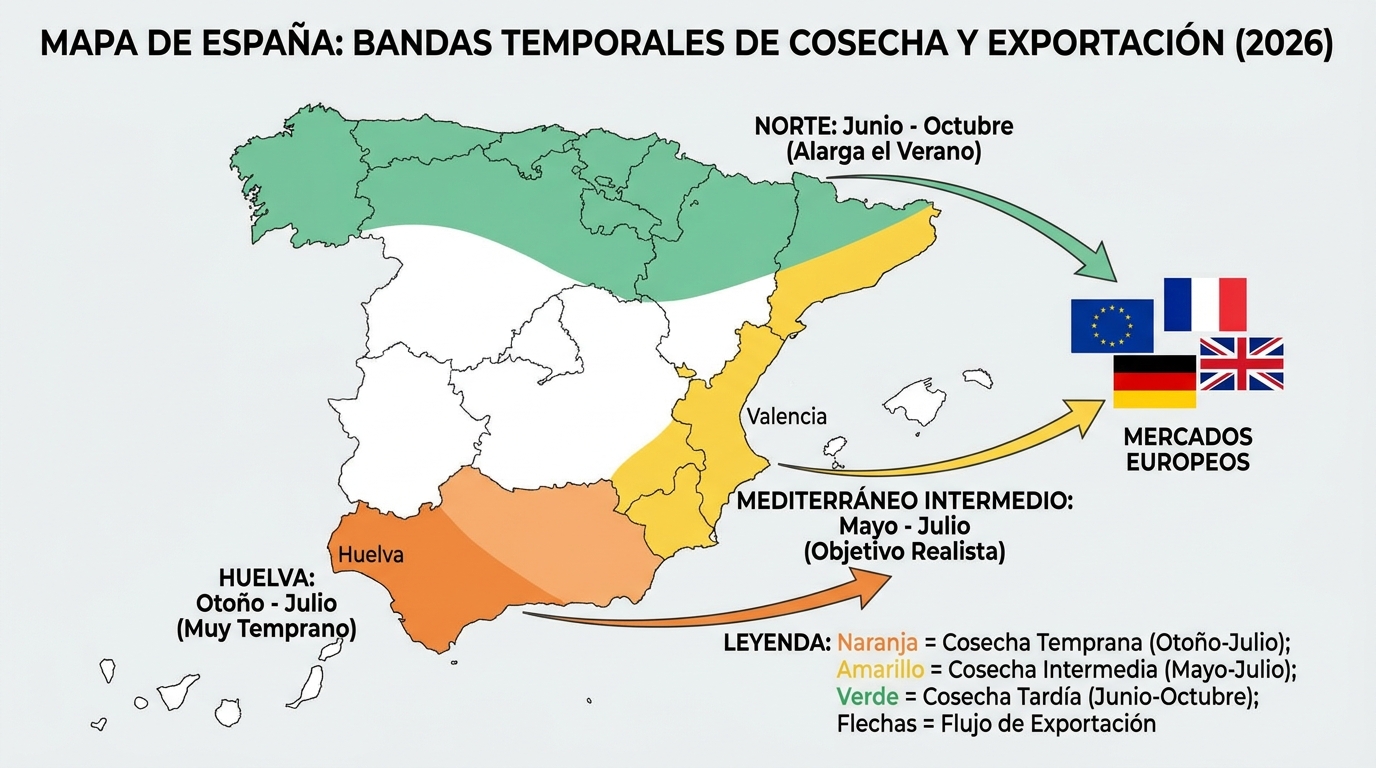 Comparative calendar by Spanish regions
| Region | Main harvest window | Key points |
|---|---|---|
| Huelva and Andalusia | Mid-October to late July | Very early varieties and protection with tunnels; key for early export. See impact of 2026 climate on Huelva campaign. |
| Northern Peninsula | Early June to October | High chilling requirement, staggered harvest, priority for dry harvest under covers. Calendars for northern varieties. |
| Valencia and Mediterranean coast | May to July | Link window. Dawn harvest and rapid shipping for national consumption. Alerts and early dates in our field news. |
Real ripeness in the field: the checklist we use to get it right
The number one criterion is a fully blue color, including on the "bottom" of the blueberry. If there's red or green, it's not picked. Firmness to the touch, ease of detachment, and the presence of intact bloom confirm the right stage. This aligns with the harvest and post-harvest guides from the University of Georgia.
Well, we mainly go by color. The blueberry tells you if it's green or ripe. When it has its full color, that's when we pick it. That's when it really holds up well and has the correct flavor. If picked earlier, it doesn't quite reach its prime.
In our case, experience also plays a big role. After all, when you've been working the crop for years, you see the fruit and know when it's ready. We harvest early in the morning, and the fruit goes practically directly to the consumer.
To standardize decisions within the crew, a simple rule works for us: 100% blue, firm to the touch, detaches with a gentle pinch, and maintains its natural wax. "Partially colored" fruit is left on the plant. This filter reduces losses and extends shelf life, as described by experienced growers in fresh storage.
Operational picking checklist
| Item to check | "Yes, pick" criterion | What to avoid |
|---|---|---|
| Color | Uniform blue across the entire surface | Visible reddish or greenish tones |
| Firmness | Hard to the touch, no softness | Soft or wrinkled texture |
| Detachment | Comes off with a gentle pinch from the cluster | Pulling or tearing the pedicel |
| Bloom | Intact wax on more than 90% | Washed fruit or with water droplets |
How do we organize blueberry harvesting to maintain quality?
Harvesting is done at dawn, in pairs per row and with successive passes. This way, we see clusters hidden by leaves and select only what is ripe within the same cluster, as it never ripens all at once. We avoid central hours of heat and always harvest dry, as recommended by good practices guides.
The biggest problems for blueberries are wind, rain, and excessive humidity. When there's too much humidity, fungi appear, and that's when you have to be careful. This year, for example, we've had quite a lot of rain here.
That's why we work very early. We start around seven in the morning, harvest, and by ten, it's already packed. This way, we avoid the strongest hours of heat, and the fruit arrives in better condition.
Our blueberries, being grown outdoors and more naturally, last longer. If it were grown under plastic, it would be more delicate to ship far without refrigeration.
The field plan we use, and that you can replicate if you grow: start first thing in the morning, light containers tied to the waist to work with both hands, transfer to ventilated boxes in the shade, weighing per person, and direct shipment to pre-cooling. If you like to know our day-to-day and receive harvest alerts on demand, check out our field news.

Before picking: water, soil, and nutrition that show in the harvest
A well-picked blueberry comes from acidic soil with good drainage and precise irrigation. The target pH is between 4.5 and 5.5, and drip irrigation with two lines per raised bed and frequent micro-applications stabilizes humidity and berry size, as summarized in the blueberry irrigation guide and the technical notice on water stress.
Fractionated fertigation with a preference for ammonium, potassium during fruit development, and chelated micronutrients helps with firmness and Brix. Avoid high salts and water with unbalanced pH. If you're looking for technical basis and management, here's a comprehensive reference on blueberry cultivation and a practical guide to blueberry fertilization.
Protection and health: macro-tunnels and always dry harvesting
Macro-tunnels act as umbrellas to allow dry harvesting and advance ripening without wetting the fruit. They are simple, robust structures that create a favorable microclimate for flowering and protect against rain, hail, and wind. Check out professional solutions in macro-tunnels and practical covers in greenhouse films.
Harvesting should never be done when the plant is wet from dew or rain. Surface moisture triggers Botrytis and marks the skin. Review alerts for common berry pests and diseases in the berry health guide and the Huelva pest monitor.
Well-done manual harvesting: ergonomics, hygiene, and zero damage
Blueberries are picked gently, without throwing the fruit into the container and without compacting. Harvesters work with baskets at the waist and make successive passes every few days to avoid accumulating overripe fruit. University operational references make it clear: low ambient temperature, clean hands, and pre-cooling as soon as possible, as indicated in this technical guide.
On our farm, what you pick from the plant goes directly into the same punnet it will travel in to your home to protect its natural wax. This way we avoid re-handling. And as we've always advocated, it's better directly from the field to shipping. If you share this way of understanding food, subscribe to our newsletter and receive harvest alerts on demand.
Mechanized harvesting: when it's convenient and how far to go
Mechanization reduces costs when the destination is frozen or industrial, and when the variety tolerates the impact. There are specific berry harvesters with shaking systems and careful reception, such as the lines from Oxbo or equipment listed in the agricultural directory.
For premium fresh produce, the limitation remains mechanical damage, which reduces shelf life. Universities recommend reserving machines for more resistant varieties and activating immediate cooling; see fundamentals in post-harvest. And pay attention to sustainability pioneers: operations like Cool Berries have reported organic and carbon-neutral production with ambitious goals for careful mechanization.

Blueberry harvest and post-harvest: from plant to cold room in 120 minutes
The clock starts ticking as soon as picking begins. The goal is to remove field heat as quickly as possible with forced air and maintain high relative humidity. Technical references agree that 0 degrees Celsius with 90-95% RH is the standard for short-term storage; see the post-harvest guide and review of the cold chain in cold chain application.
| Minute | Action | Critical detail |
|---|---|---|
| 0 to 30 | Shade and ventilation in the field | Ventilated containers, no stacking when hot |
| 30 to 90 | Transfer and pre-cooling by forced air | Rapid pulp temperature reduction without condensation |
| 90 to 120 | Sorting in a cool room | Work at 10 to 13 degrees, then back to 0 to 2 degrees |
| 120 onwards | Storage and refrigerated logistics | Maintain a stable temperature range |
How long do well-harvested blueberries last in your fridge?
If the blueberries are national, arrive quickly, and have been well-chilled, they will last 10 to 15 days in the fridge unwashed. Some producers state that they can be stored for two to three weeks with proper handling, as explained here: fresh shelf life. Avoid room temperature in summer, as they spoil in 24 to 48 hours.
Tip for demanding consumers: do not wash until you are ready to eat, use ventilated punnets, check that the fruit arrives dry and cold, and be wary of anyone selling "freshly picked" with several weeks of travel. Our philosophy is harvest on demand and immediate shipment. We often tell you about it in our newsletter.
Varieties and campaign planning
The variety dictates the pace of harvesting and the market you reach. In Huelva, Legacy and Camelia have been very successful due to their productivity, and Ventura for its earliness, as reflected in trials and sectoral analyses of leading varieties. In the north, highbush varieties with high chilling requirements dominate.
To coordinate a professional campaign well, you need a budget, a crew, and refrigeration. A good cost and time scheme will save your harvest. If you are a producer, this practical review of productive cycle budgeting and this reminder on efficient resource management during harvest will be useful.
Residues, traceability, and rules of the game
Exporting or selling to demanding chains implies complying with MRLs and maintaining impeccable traceability. The Rainforest Alliance platform for fresh fruits requires registering transactions and batches with defined frequency. Responsible residue analyses, such as those disseminated by pesticide controls in blueberries, are now standard.
If you are part of an PO or market at scale, review the framework that regulates producer organizations in Spain, key for financing cold storage and improvements: Royal Decree 532 2017. And if you are interested in how we advocate for fair prices and proximity, you will enjoy reading this reflection on our blog.
Climate 2026: rain, light, and the logistics of dry harvesting
The 2026 season has brought rain, wind, and less light in southern areas, forcing intensified use of covers, adjusting passes, and monitoring for fungi. The sector report in Huelva explains this well in this summary of campaign conditions. In our crew, we apply the same principle: if it gets wet, we stop. And we reorder the day to resume dry picking.
We work largely according to the ripening stage and the season. Here in Valencia, we normally start in May and finish in July, because our goal is to extend the season compared to southern Spain.
Harvesting is very quick once the fruit is ready. We start early, pick, and then quickly prepare for shipment. We work quite directly so that the consumer has it at home the next day.
Ultimately, in blueberries, daily observation of the crop and a good understanding of the plant and the fruit's stage are very influential.
Market, competition, and why buy local
Blueberry consumption continues to rise, and global supply now covers almost the entire year. Peru and Chile are pushing hard in European autumn and winter, which puts pressure on prices, as detailed in the global market summaries and the MAPA 2024-25 report.
As consumers in Spain, we have an advantage: we can eat locally-sourced produce, with days of transit, not weeks. Less travel, more flavor, and less risk of breaking the cold chain. If you want us to notify you when our campaign opens so you can try them freshly picked, subscribe to our newsletter.

Blueberry Harvest FAQ
What time of day is best for harvesting blueberries?
At dawn and late afternoon. With less heat, the firmness and bloom are better preserved, the staff is more productive, and the fruit enters the cold room chilled. Avoid midday hours and do not harvest if wet from dew or rain, as recommended by post-harvest technical guides.
How often do you revisit the same plant?
Ripening is staggered. It's practical to return every few days and make several passes through each plot to select only what is perfectly ripe. This reduces overripe fruit and maintains uniform quality in the packaging.
Is mechanization suitable for premium fresh fruit?
It can help if the variety tolerates impact and you activate an immediate cold chain, though high-end fresh produce is still hand-picked. Mechanization excels in frozen or industrial applications due to labor savings.
How do I store blueberries at home to make them last longer?
In the refrigerator, in a ventilated container, and do not wash until just before eating. Dry and cold, they last 10 to 15 days. At room temperature in summer, they spoil very quickly, so it's best to refrigerate them as soon as they arrive.
How do I know if what I'm buying is truly fresh?
Ask for the harvest date and origin. If there's on-demand shipping or same-day harvest, even better. Be wary of vague promises. We provide clear information every week in our newsletter, and if you're not satisfied, we'll refund your money.
Conclusion and Next Step
Blueberry harvesting is won on two fronts: picking only ripe fruit and rapid cooling. Spain has the advantage of being Europe's gateway, and if you buy local, you'll notice it in flavor and shelf life. In 2026, the climate demands dry harvesting and more precision, but with good organization and traceability, you'll get impeccable fruit.
If you value authenticity, support those who harvest for you that very morning. Visit our field news, sign up, and choose your box when we open the campaign. We harvest from 1 kilo, with fast shipping and a money-back guarantee if you don't love it. We look forward to your next order.


