

The Valencian orange crisis is real and can be seen in the trees and in our pockets: smaller harvests, below-cost prices, and fields left untended. In 2026, the sector is experiencing its shortest campaign in sixteen years, and farmers are looking to the sky, to Brussels, and to the scales with a knot in their stomachs.
I'm Eduardo, a farmer in La Ribera and part of a family that loves this land. I'm telling you this unvarnished, with verified data and with the hope that this reading will help you better decide which fruit to take home and which fields you want to support. When you choose well, it shows in the taste and it shows in the land.

What is happening with the Valencian orange crisis in 2026?
In two clear sentences: there are fewer oranges, and they are being paid for at prices lower than the cost to produce them. The 2025-2026 citrus campaign arrived with the lowest forecast in sixteen years and an 8% drop compared to the previous one, exceeding 2.5 million tons in the Comunitat but well below normal, as Intercitrus itself summarized.
Spain is hovering around 5.44 million tons when the normal amount would be quite a bit more, and the difference cannot be explained by climate alone. There are structural factors that we all repeat in the fields: soaring costs, competition from countries with different regulations, and tight margins in the chain that don't reach the producer. It's a vicious cycle that needs to be broken.
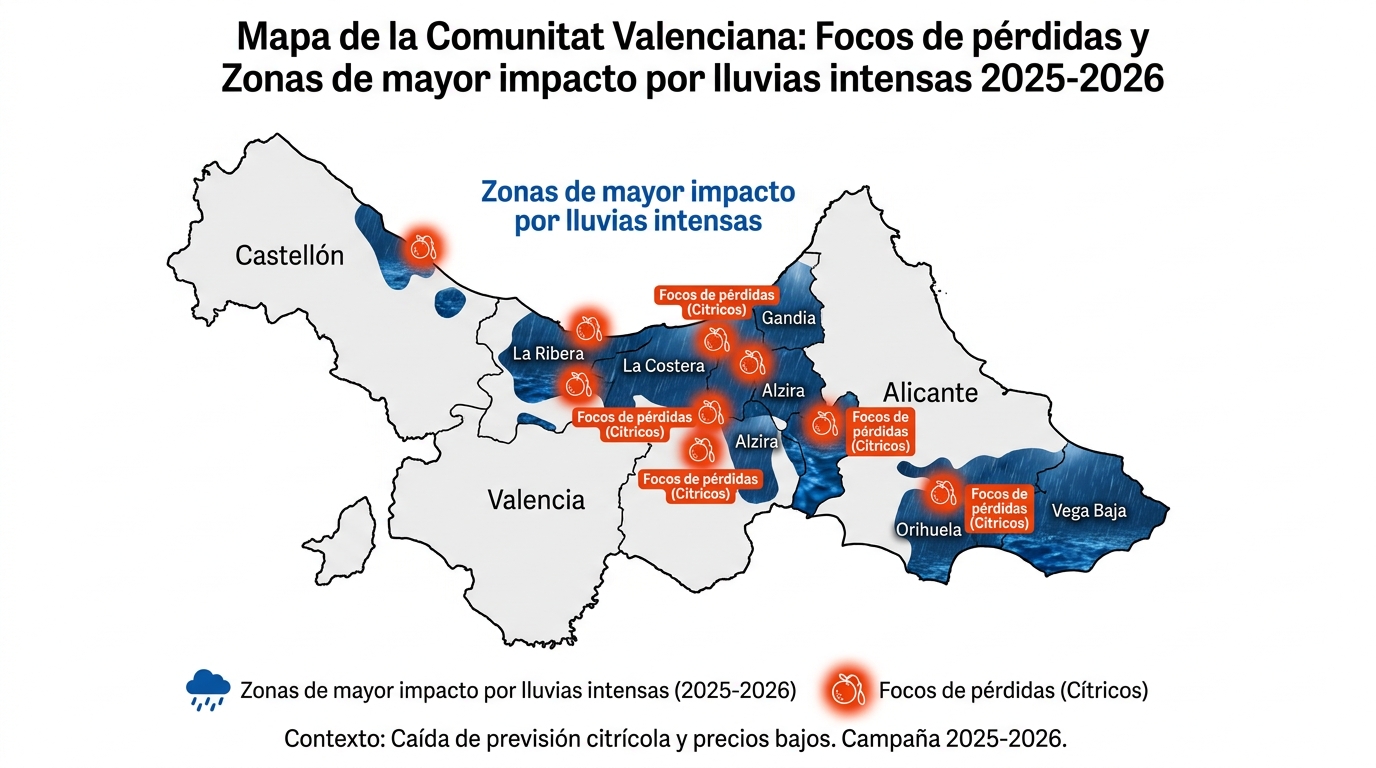
2026 Snapshot: production, prices, and margins
If you like to look at things head-on, this chart helps you understand the Valencian orange crisis at a glance. These are recent and public data, with open and easily verifiable sources. The conclusion is simple: with these numbers, the small farmer cannot cover costs.
| Indicator | Approximate value | Source |
|---|---|---|
| Valencian Community Production 2025 - 2026 | Slightly more than 2.5 million tons, 8 percent less than the previous campaign | Intercitrus |
| Spain Production 2025 - 2026 | 5.44 million tons, lowest in 16 years | Campaign analysis |
| Producer price during bad periods | 0.09 to 0.12 euros per kg | Field report |
| Average production cost | Around 0.30 euros per kg | Supply chain observatory |
| Losses due to autumn humidity | More than 75,000 tons due to rot | Damage assessment |
| Mercosur imports at the start of the campaign | 58,004 tons, 18 percent more year-on-year | Market data |
The picture is tough, but it's honest. When a kilo sells for less than 0.30 euros, every box sold creates a deficit. That explains why some fruit isn't even harvested and why every year there are more "for sale" signs in plots that, not long ago, were a treasure.
External competition and regulatory asymmetries
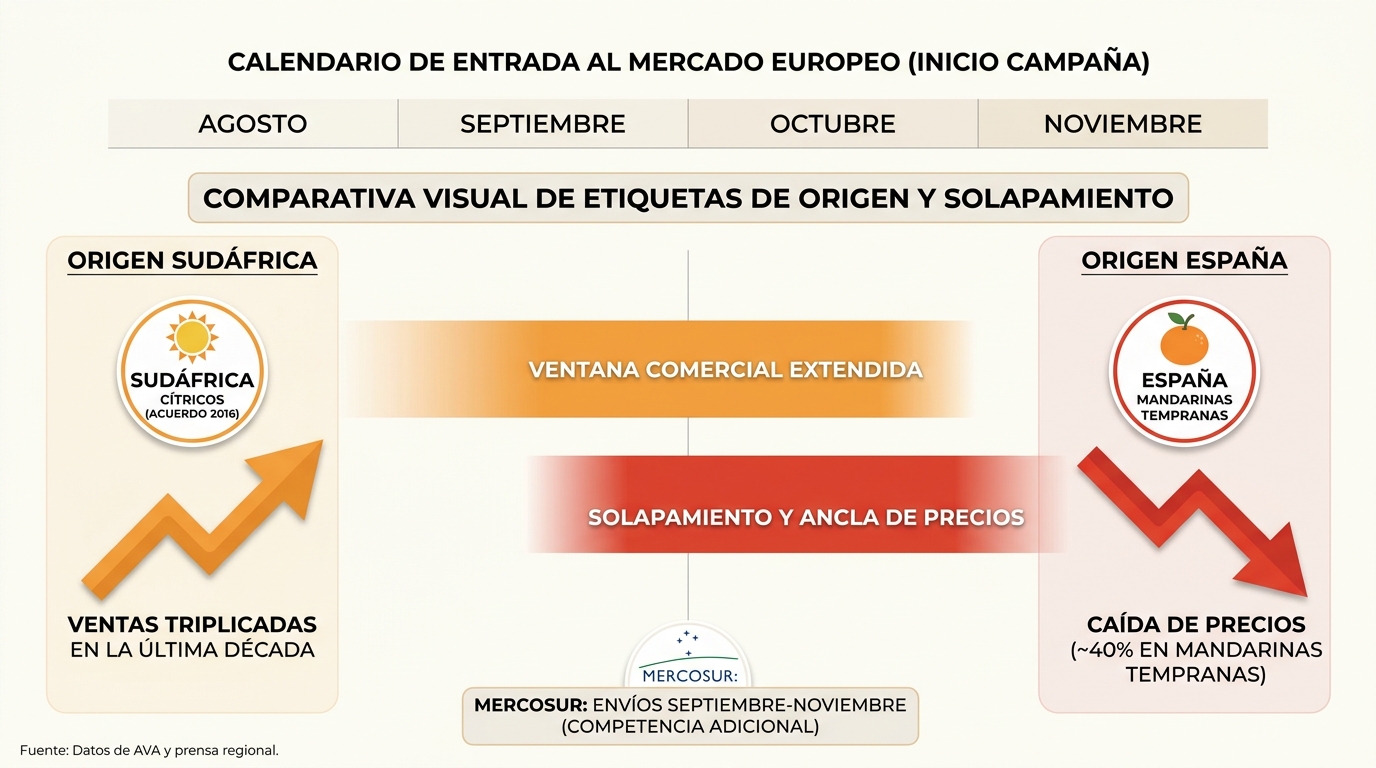
The overlap with South African citrus at the start of our mandarin campaign has become a price anchor. Since the 2016 agreement, the Valencian Farmers' Association (AVA-ASAJA) and other entities have measured a drop of nearly 40 percent in early mandarins. This is directly related to the coincidence of marketing windows, with South African sales more than tripling in the last decade, as explained by the farmers themselves and reported by regional press.
Then there's Mercosur. Between September and November, citrus shipments to the European Union (EU) grew by 18 percent, arriving just as we begin harvesting here. This steady trickle puts pressure on the retail price. And as a final touch, Brussels reduced pesticide controls on some imported fruits despite these countries having many recent alerts, as reported by this analysis. With different rules at origin and destination, the competition is not fair. To put it more simply:
- True reciprocity: the same active substances allowed or prohibited on both sides.
- Clear windows: avoid overlaps that drive down initial prices.
- Effective controls: inspections consistent with the history of alerts.
Have climate and pests changed the game?
Yes. The climate is no longer as favorable as before, and damages are multiplying at critical times. Between September and December, there was untimely rain, heat during delicate phases, and over 75,000 tons were lost due to rot, according to technical estimates. These losses are not always covered by insurance, and irrigation costs rose during drier summers. All of this adds to the sense of fragility.
In plant health, the landscape is also shifting. The Asian citrus psyllid, a vector of Huanglongbing or citrus greening (HLB), the most feared citrus disease in the world, was detected in the Mediterranean. The Valencian Institute of Agricultural Research (IVIA) has successfully identified a natural parasitoid with control potential, as reported in this scientific note. At the same time, six of the eight most impactful pests are already in the EU or its vicinity, according to recent compilations. Fewer phytosanitary tools and more pests make for an expensive and complicated equation.
And let's not forget the footprint of very long journeys. Bringing fruit in refrigerated ships and trucks has carbon costs and quality risks. Literature on climate and transport emphasizes this. It's not just a price decision; it's also a decision of consistency with what we want to eat and protect.

The food chain and the squeeze from distribution
For too many weeks, farmers have been paid below cost, while retail prices barely budge. Public observation confirms that intermediate links capture most of the value and that transparency in the chain is still insufficient. The supply chain observatory details this. And if you're wondering about margins, 2023 already brought record supermarket profits. At the source, meanwhile, there are days when 13 kilos are paid for at 2 euros, as a journalistic team reported. This way, there is no future.
Solutions? Apply the Supply Chain Law without exception, enforce that no one buys below cost, and ensure that the juice industry stops being the sector's garbage truck. There is room here to do things right, and everyone knows it.
Land, abandonment, and succession: what we already see on the roads
There's a silent, heavy reality: many farmers are over 65 and can't find successors. Simultaneously, accumulated abandonment far exceeds 30,000 hectares in the Comunitat, and this is noticeable in pests, fires, and the landscape. That's why the sector is calling for a comprehensive modernization plan, as highlighted by this sectorial approach, and policies that truly incentivize young people, in line with the generational succession package announced.
We also see crop changes. In the Ribera del Xúquer, the persimmon kaki has gained ground, and some call it the new alternative when oranges are struggling. Its good prices in recent years encouraged conversions, although no one forgets that every crop has its cycle and its risks. The key is to diversify wisely and not lose sight of what we do best.
Innovate to stay: varieties, smart irrigation, and biological control
Emerging from the Valencian orange crisis requires modernization. New protected varieties, like the Mina mandarin, developed in the Valencian Community, are demonstrating better adaptation to climate change and a longer commercial life, as indicated by field trials and the Valencian innovative sector itself. It's not a magic wand, but it helps recover profitability.
Irrigation has also changed. With sensors and programming based on actual needs, water and energy are saved. Precision agriculture is no longer a thing of the future; it exists and makes things cheaper, as explained in guides on smart farming and technical notes on citrus sensors. And if it is also combined with the Valencian Irrigation Strategy 2020-2040, which establishes a modernization framework, efficiency becomes the norm.
In pest control, we continue to follow the path of the Valencian Institute of Agricultural Research (IVIA) with natural enemies of the Huanglongbing (HLB) vector and other biological solutions. Fewer active ingredients and more well-managed integrated control. It's slow, but it's the way. And please, let's not forget to reinforce surveillance at ports. The Uberization of the chain cannot undermine the plant health of an entire region.
What is heard in the furrow: Villanueva de Castellón, 2026
Here's what a neighboring farmer with several years of experience, whom we interviewed this week, said. When asked about the Navelina campaign during 2025 and 2026, he responded:
For several years now, no one knows why, there has been a significant drop in production. This past year, 2025, was along the same lines; we don't know if it was a problem with pests or fungi. Because I am very, very on top of things, I had a harvest in the higher-than-average range compared to other farmers. This year, 2026, due to the rains and sudden weather changes, there is practically no production; it's very scarce, it's widespread. So, we've been taking hits for several years, and farmers are completely disheartened.
Many farmers are giving up. You see more abandoned plots. A small number, some who have their own jobs and consider farming secondary, have been encouraged to pull up trees and replant, of the same Navelina variety, but these are small plots. This year, there have been removals and replantings. But what there is more of, in greater quantity, is abandonment.
When we read the big headlines and then step into the mud, everything fits. The lack of profitability, the successive climate impacts, and commercial uncertainty are taking their toll. The way out demands courageous decisions at all levels.
But while we look for a solution, we keep talking among ourselves, and the truth is that when asked about varieties, two continue to stand out: Navelina and Salustiana.
Navelinas and Salustianas are, in my experience, the two that normally perform well. Generally, they produce more or less, and tend to be quite consistent, except in years like this. The Navelina is not like the second-season orange, the one that starts in January, like the Lane Late, which are much more volatile. And they are more complicated to get good juice from and yield good kilos.
Conscious consumption: how to support without overpaying
There's a detail that doesn't appear on the label. Oranges that come from very far away usually have cheaper labor, different controls, and weeks in cold storage to withstand the journey. It works for the price, but someone pays for it: the flavor pays for it, the land pays for it, and the local farmer pays for it. If you want to support local produce, look for proximity, seasonality, and direct dealings.
- Choose fruit direct from the producer, 24 hours after picking. Here you can see our seasonal products and our table oranges.
- Ask about cultivation practices and harvesting dates. In our newsletter, we report weekly on what we are harvesting.
- Appreciate tree-ripened fruit. Our new Summer Powell orange arrived to extend enjoyment when others finish.
- If you like top-quality mandarins, check out the Orri during its peak season. And follow us to read more stories from the field.

What the sector and administration propose
Agricultural organizations are calling for a Marshall Plan-style shock plan, and the regional government will launch reconversion measures to replace aging plantations, improve irrigation, and recover abandoned plots. This is the right direction and needs to be executed well, focusing on young people and professionals, as outlined in these plans. If we add consumption promotion, orderly commercial windows, and real commercial reciprocity, the Valencian orange will shine again.
Frequently asked questions
Why is there so little Valencian orange this season?
Intense rains during flowering and fruit set, heat at key moments, and humidity episodes that led to widespread rot, with over 75,000 tons lost according to technical estimates. Additionally, the national harvest is the shortest in sixteen years, and this is noticeable in every region.
Who sets the price you get paid in the field?
Buyers, the entry of fruit from third countries at the start of the campaign, and large retailers all have an influence. The Supply Chain Law prohibits buying below cost, but its actual application remains irregular despite having the Supply Chain Observatory as a reference.
Is imported orange unsafe?
You can't generalize. What we ask for is reciprocity: the same standards for phytosanitary products and controls as here. Recent reports even point to reductions in controls for countries with many alerts, and that is a concern for transparency and unfair competition.
Does changing varieties really help?
It helps when the variety adapts better to the climate, maintains size, and holds up well post-harvest. There are new materials like Mina that are yielding results, along with precision irrigation and better management. It's not instantaneous, but it adds to profitability.
What can I do as a consumer today?
Buy seasonal, local, and with clear traceability. If you can, choose fruit directly from the producer and avoid impossible promises. We harvest to order and ship in less than 24 hours from the tree. You can taste it in the juice and in the skin.
Sources and Recommended Readings
If you want to delve deeper, here are some links about campaigns, markets, and plant health: 2025-2026 citrus campaign, Mercosur imports, losses due to humidity, natural enemies of HLB, and analysis on the supply chain and platform.
Conclusion: a way out with quality, transparency, and unity
The Valencian Orange Crisis is not a temporary setback. It is the result of lower harvests, unfair prices, and competition with different rules. The good news is that there are clear levers: commercial reciprocity, modernization of the fields, biological control, and informed consumption.
If you like oranges that taste like oranges, we're still here, with our hands in the soil and our heads focused on what matters. You can support us by buying directly, without intermediaries, and with harvest on demand. Take a look at our oranges direct from the tree and subscribe to our newsletter to find out what we're harvesting each week.
Thanks for being on the other side. Your trust is noticeable even in the orange's peel.


