
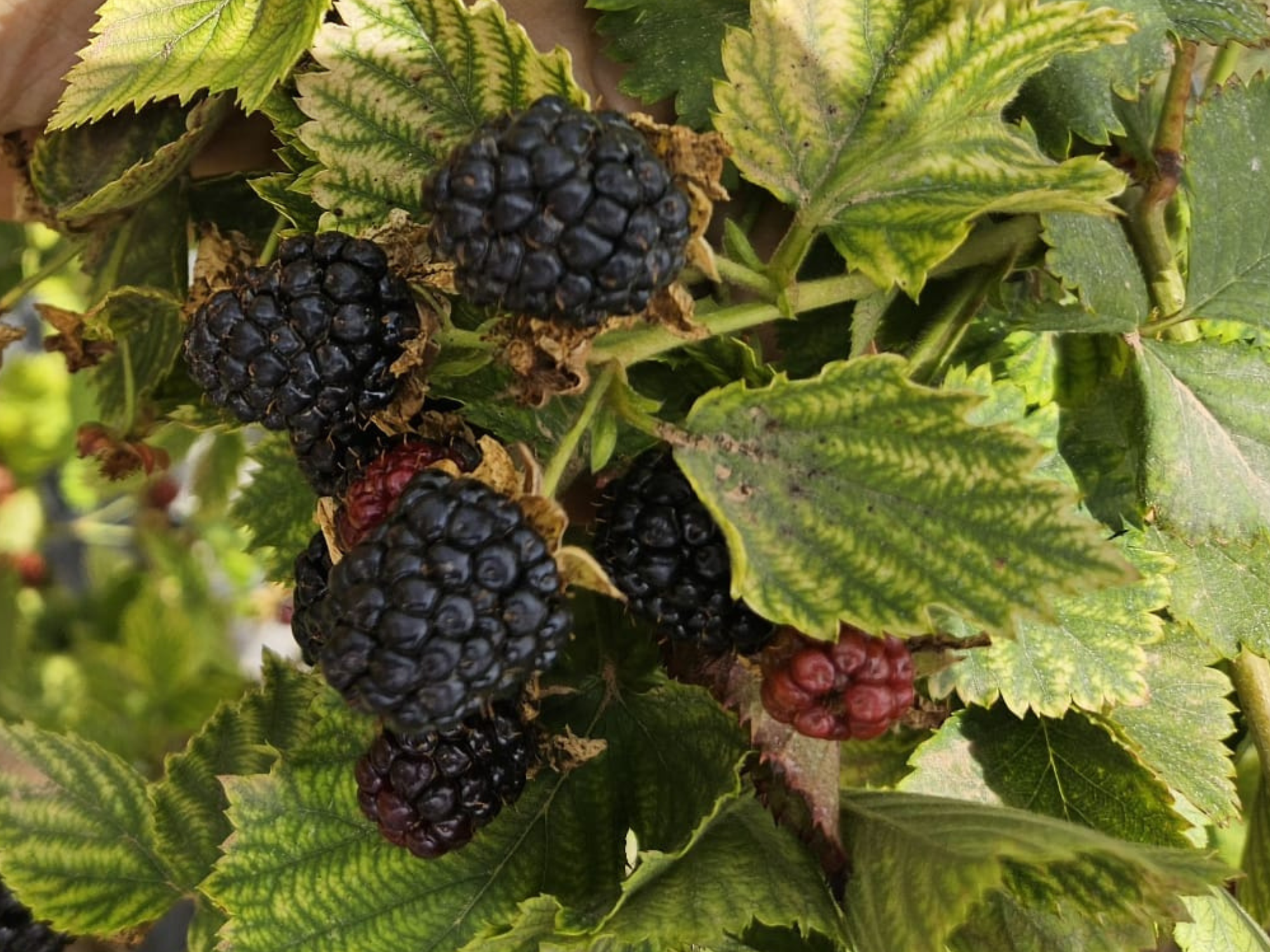
Blackberry cultivation in Spain represents an extraordinary opportunity for farmers looking to diversify their production with a high-demand and highly profitable fruit. This comprehensive guide will accompany you step-by-step into the fascinating world of blackberries, from selecting the land to harvesting these small black treasures that are winning over more and more palates.
Did you know that Spain has increased its blackberry cultivation area by 7.5% in the last season? With 153 hectares dedicated mainly to Huelva, our country is positioning itself as an emerging producer in the competitive European berry market. And best of all: the climatic conditions of regions like Valencia, Andalusia, and the Cantabrian coast offer exceptional potential for this crop.
What do blackberries need to grow optimally in Spain?
The blackberry (*Rubus* spp.) is a surprisingly adaptable plant that, according to Antonio, a Valencian farmer with years of experience, "is a very wild plant, and in general, it adapts very well to the climate we have here in Valencia. It doesn't need special care except in case of rain." This natural resistance makes it an ideal option for farmers looking for sustainable crops with less dependence on phytosanitary treatments.
Ideal conditions for blackberry cultivation include temperatures between 11 and 18°C, although it tolerates a wider range. Optimal relative humidity ranges between 70-80%, while the ideal annual precipitation is between 1,500-2,500 mm. However, as we will see later, with the right techniques, it is possible to successfully grow blackberries even in areas with less rainfall.

The ideal soil for blackberries should be loamy-clay, at least 50 cm deep, and have excellent drainage. The optimal pH ranges between 6.5 and 7.5, slightly acidic to neutral. A critical aspect that many farmers overlook is the importance of organic matter content, which should exceed 3% to ensure good water retention and nutrient availability.
What are the best blackberry varieties to grow in Spain?
Selecting the correct variety makes the difference between a successful and a mediocre plantation. In Spain, the most popular varieties respond to the specific characteristics of each region:
| Variety | Characteristics | Recommended area | Production |
|---|---|---|---|
| Tupy | Semi-erect, low chilling requirement (400-600 h) | Huelva, Valencia, warm areas | 12-15 kg/plant |
| Marymar | Exclusive to Huelva, extended production | Western Andalusia | 10-12 kg/plant |
| Brazos | Erect, large and firm fruit | Inland areas | 8-10 kg/plant |
| ARK-45 | Primocane-fruiting, ideal for urban cultivation | All of Spain | 6-8 kg/plant |
New primocane-fruiting and dwarf varieties open fascinating possibilities for container cultivation, similar to what is already done with blueberries. This technique allows for greater control over growing conditions and facilitates production in areas with problematic soils.
How to prepare the ground for planting blackberries?
Proper land preparation is fundamental for the long-term success of your plantation. Start with a complete soil analysis that includes pH, available nutrients, and the presence of nematodes. This step, while it may seem costly initially, will save you problems and expenses in the future.
Antonio shares his experience: "Before planting, you have to put a good layer of manure in the soil. I use cow or horse manure, never chicken manure, because here in Valencia, we already have an excess of lime in the soil." This practical wisdom is especially valuable in Mediterranean areas where calcareous soils can cause iron chlorosis.
Essential preparation steps include:
- Deep subsoiling to break up compacted layers
- Incorporation of 1-2 kg of compost per planting hole
- Creation of ridges in areas at risk of waterlogging
- Installation of a drip irrigation system before planting
- Placement of organic or plastic mulch for weed control
What is the best planting system for blackberries?
The planting density varies according to the chosen training system. For commercial plantations, a distance of 1.2-3.0 m between rows and 0.3-0.5 m between plants is recommended, achieving densities of 8,000-13,000 plants per hectare. On sloped terrain, contour planting significantly reduces erosion, while on plains, east-west orientation maximizes sunlight utilization.
*Insert image of trellising system for blackberries here*
The trellis training system with 4 wires at different heights (0.4, 0.8, 1.2, and 1.6 m) is indispensable for semi-erect varieties. This system not only reduces fruit contact with the ground—decreasing losses from *Botrytis* to less than 2%—but also increases photosynthetic efficiency by 30% and greatly facilitates pruning and harvesting tasks.

How to manage irrigation and nutrition in blackberry cultivation?
Irrigation represents one of the most critical aspects of cultivation, especially in the current context of water scarcity affecting many Spanish regions. The drip irrigation system with 2 L/h emitters every 0.5 m is the most efficient, applying between 25-38 mm weekly depending on the soil texture and the phenological stage of the crop.
During flowering (May-June) and fruit sizing (July-August), water deficit can reduce fruit size by 15-20%. Conversely, excess water after harvest favors the development of root diseases such as *Pythium* spp. The installation of humidity sensors that maintain values between -30 and -50 kPa optimizes irrigation cycles, reducing water consumption by up to 25%.
Regarding nutrition, blackberries have specific requirements that must be met through a fractional fertilization program:
| Timing | Nitrogen | Phosphorus | Potassium |
|---|---|---|---|
| Post-pruning | 165 kg/ha (50%) | 60 kg P₂O₅/ha (100%) | - |
| Fruit set | 82.5 kg/ha (25%) | - | 300 kg K₂O/ha (50%) |
| Fruit sizing | 82.5 kg/ha (25%) | - | 150 kg K₂O/ha (50%) |
What pests and diseases affect blackberry cultivation in Spain?
Integrated pest and disease management is essential to maintain crop productivity and quality. Among the most problematic pests is *Drosophila suzukii*, which can cause losses exceeding 60% if not adequately controlled. Apple cider vinegar baited traps combined with insect netting have proven effective in reducing infestations.
Other important pests include the red mite (*Acalitus essigi*), which causes leaf curling and is controlled with winter applications of abamectin, and the cane borer (*Anthonomus rubi*), whose larvae perforate the canes causing general weakening of the plant.
As for diseases, gray mold caused by *Botrytis cinerea* is particularly problematic in high humidity conditions. Antonio warns us: "In case of rain, botrytis can appear, a fungus that affects the fruit, especially after harvesting." Prevention through contact fungicides in pre-flowering and maintaining good aeration in the crop are fundamental.
How to optimize blackberry harvesting and post-harvest?
Harvesting represents the culmination of the productive cycle and must be carried out with extreme care. Blackberries reach their optimal harvesting point when they exhibit a uniform intense black color and detach easily from the receptacle. Harvesting should preferably be done in the early morning hours, avoiding temperatures above 28°C.

A critical aspect that many producers underestimate is the speed of post-harvest cooling. Every hour blackberries remain at 20°C is equivalent to losing one day of shelf life at 0°C. Therefore, it is essential to transport the fruit to the refrigerated warehouse within 4 hours of harvesting.
Quality grading follows established standards:
- Extra: fruits larger than 5 cm
- First class: fruits 2.5-3.5 cm
- Second class: fruits smaller than 2.2 cm
Is blackberry cultivation profitable in Spain?
With average yields of 12-18 tons per hectare under intensive management and FOB prices ranging between 3.5-5.2 €/kg, blackberry cultivation presents an attractive profitability. However, it is important to consider that the initial investment can be considerable, including plants, training systems, irrigation, and protective netting.
The trend towards seedless varieties and high sugar content (>12° Brix) responds to the demands of the premium market, especially in exports to Northern European and Asian countries. Spain exported 5,460 tons of blackberries in 2022, with the Netherlands, Germany, and the United Kingdom being the main destinations.
What innovations are transforming blackberry cultivation?
Antonio shares an innovative technique that is revolutionizing his production: "I am experimenting with blackberries planted in 40-liter bags with coconut fiber, as I do with blueberries, and they are yielding very good results: they reach a spectacular size, and a first-year plant can give you a kilo."
This container cultivation technique offers multiple advantages:
- Total control over substrate and nutrition
- Elimination of soil problems (nematodes, fungi)
- Higher planting density
- Ease of automating irrigation
- Possibility of production in urban areas or with unsuitable soils
Furthermore, Agriculture 4.0 is reaching blackberry cultivation with technologies such as multispectral drones to detect early water stress and sap flow sensors that optimize irrigation in real time. Biostimulants based on marine algae are showing increases of 19% in post-harvest firmness, a key factor for export.

Frequently asked questions about blackberry cultivation
How long does a blackberry plant take to produce fruit?
Blackberry plants begin to fruit 6 to 8 months after transplanting, although full commercial production is achieved in the second or third year. With proper management, a plantation can maintain its productivity for 10 years or more, with documented cases of productive plantations up to 15 years.
Can blackberries be grown organically in Spain?
Absolutely yes. In fact, the blackberry is one of the fruits most adapted to organic cultivation due to its natural hardiness. As Antonio points out: "In my case, I have been cultivating sustainably for many years. It's the way I've always cultivated." The key is prevention through good cultural practices and the use of natural enemies for pest control.
What is the difference between growing blackberries in northern and southern Spain?
The main differences lie in the varieties used and the production calendar. In the north, with more chilling hours, late varieties that produce in summer-autumn are preferred. In the south, especially in Huelva, early varieties with low chilling requirements allow for winter-spring production, taking advantage of market windows with better prices.
Is it necessary to use shade nets in blackberry cultivation?
In areas with hot summers like Valencia or Andalusia, 20-30% shade nets are highly recommended. Antonio confirms: "We grow blackberries under nets, which is a way to protect them from heat and hail." These nets reduce thermal stress, prevent fruit scalding, and protect against hail, significantly improving harvest quality.
How much water does one hectare of blackberries need per year?
Water consumption varies according to planting density and climatic conditions, ranging from 2,500 m³/ha for traditional plantations (500 plants/ha) to 5,000 m³/ha in intensive systems (800 plants/ha). The implementation of humidity sensors and controlled deficit irrigation can reduce these consumptions by up to 25% without affecting productivity.

The promising future of blackberry cultivation in Spain
Blackberry cultivation in Spain is in a moment of expansion and technological transformation. The combination of adapted varieties, innovative cultivation techniques such as the use of containers with coconut fiber, and the growing demand for quality berries position this crop as a profitable and sustainable alternative for Spanish farmers.
The challenges of climate change, with more frequent droughts and extreme temperatures, are being successfully addressed through protected cultivation systems, technical irrigation, and varietal selection. The experience of farmers like Antonio demonstrates that, with knowledge and local adaptation, it is possible to produce excellent quality blackberries even in seemingly unfavorable conditions.
If you are considering starting blackberry cultivation or are already a producer and are looking to improve your techniques, remember that success lies in the combination of technical knowledge, constant observation, and adaptation to local conditions. And if you want to enjoy the authentic flavor of blackberries grown with passion and respect for the environment, at Campos del Abuelo you will find fruits direct from the farmer, harvested at their optimal ripeness, and sent to your home in less than 24 hours.


