
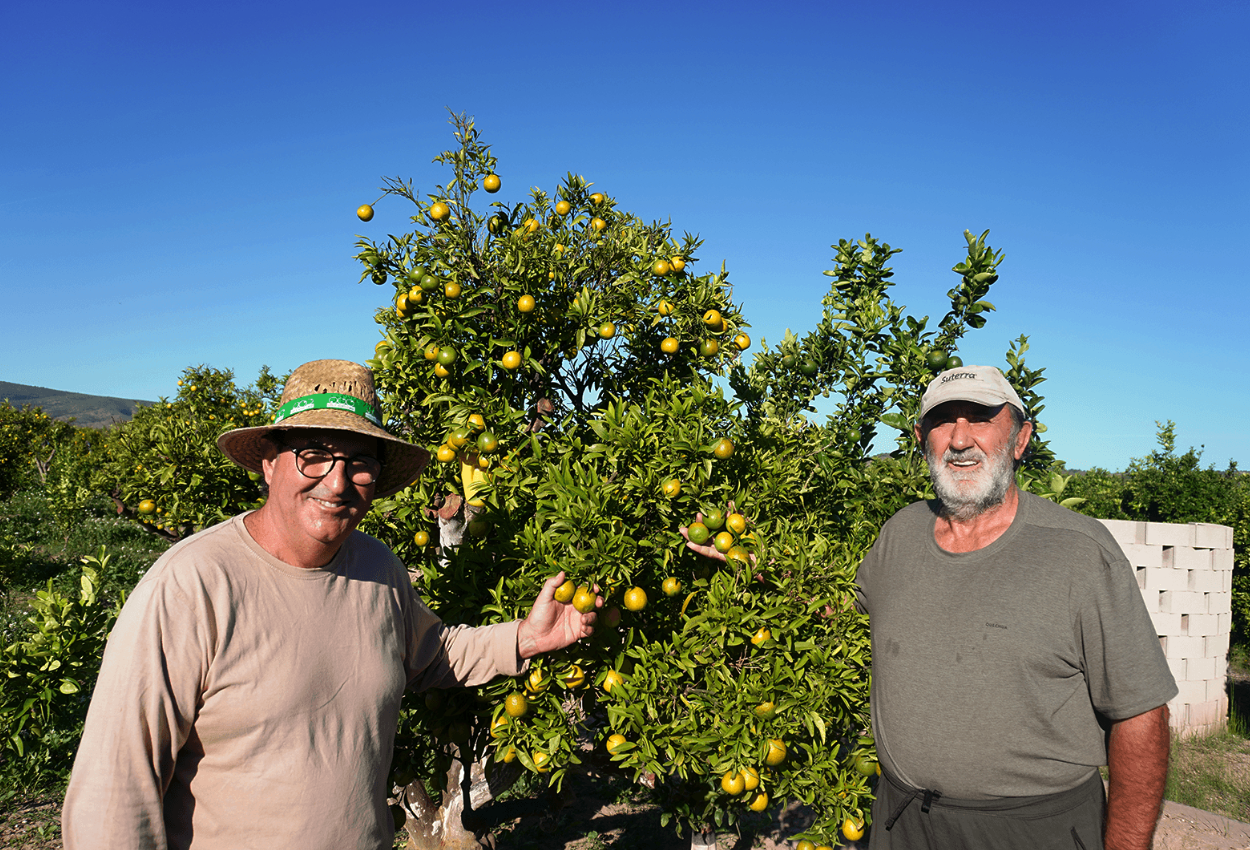
Organic fruits are grown without synthetic pesticides, chemical fertilizers, or genetic modifications, while conventional fruits may use these elements to maximize production. This fundamental difference affects not only flavor and nutritional value but also the environmental impact and the health of those who consume them.
Have you ever wondered why that orange at the supermarket shines so much but tastes like cardboard? Or why your grandfather's strawberries, though smaller and less perfect, had that flavor that transported you directly to summer? At Campos del Abuelo, where we have been cultivating in the Valencian garden for generations, we know these differences well. And today, with Eduardo, one of our founding farmers, we are going to reveal all the secrets that separate organic fruit from conventional fruit.
What really makes a fruit organic?
For a fruit to be considered organic according to Regulation (EU) 2018/848, it must meet strict requirements that go far beyond not using chemicals. Fundamental requirements include the total prohibition of synthetic pesticides, the exclusive use of organic fertilizers, the implementation of multi-year rotations with legumes, and the use of biological pest control techniques.
But here's the paradox that Eduardo points out: "There are farmers who meet all organic requirements, but without paying for that seal, they cannot call themselves 'organic'. You can be organic, but if you don't have money to get certified, in the end, you can't say you grow organically."
Organic certification in Spain is managed by the Organic Agriculture Committees of each autonomous community, which carry out annual controls. However, as Eduardo tells us, these controls are often more bureaucratic than effective, and private certification companies "continue to set complicated prices for small producers."

The cultivation techniques that make the difference
Conventional agriculture seeks maximum productivity through synthetic NPK fertilizers that accelerate growth and pesticides like – pay attention to how difficult this word is – neonicotinoids to control pests. This model generates higher yields per hectare, but Eduardo reveals the hidden price: "If you protect the orange with a fungicide to store it for 3 or 4 months, then when you take it out it will be edible, but the taste will never be the same as an orange freshly picked from the tree."
In contrast, organic agriculture employs methods that Eduardo and his colleagues at Campos del Abuelo have been practicing for generations: "We cultivate with ancestral techniques: crop rotation, fallow, letting the land rest... There are also some farmers who introduce beneficial insects, for example, putting ladybugs in the garden because they feed on aphids."
| Technique | Conventional Agriculture | Organic Agriculture |
|---|---|---|
| Pest control | Synthetic pesticides (neonicotinoids, organophosphates) | Biological control, traps, beneficial insects |
| Fertilization | High-solubility synthetic NPK | Compost, manure, green manures |
| Soil management | Intensive monoculture | Rotations with legumes, fallow |
| Post-harvest preservation | Fungicides, synthetic waxes | Natural refrigeration, direct sale |
A specific example Eduardo shares is the management of sooty mold in oranges: "The 'eco' regulations would force us to use expensive and ineffective products. We choose to clean each orange by hand, but that's not viable on large farms." This artisanal dedication partly explains why Valencian oranges from small producers maintain that authentic flavor many remember from their childhood.
Are there really nutritional differences between organic and conventional fruit?
Science backs what many consumers intuit. A meta-analysis from the University of Newcastle that analyzed 343 studies found that organic fruits contain up to 60% more antioxidants, significantly lower levels of cadmium (-48%) and nitrates (-30%), and higher concentrations of vitamin C (+12%) in citrus fruits.
Dr. Mª Dolores Raigón, professor at the Polytechnic University of Valencia, explains that these differences are due to "the controlled stress conditions in organic crops stimulating the synthesis of defensive phytochemicals." These compounds, which the plant produces to defend itself naturally, turn out to be precisely those that provide greater benefits for our health.
However, it is important to maintain perspective. As the EFSA points out, these differences do not imply that conventional products are nutritionally deficient when consumed in adequate amounts. The key is regular consumption of fruits and vegetables, regardless of their origin.

The invisible problem: pesticide residues in conventional fruit
The latest data is concerning. According to the EFSA's 2023 monitoring program, although 99% of Spanish samples comply with Maximum Residue Limits (MRLs), 65% of pears and 64% of oranges contained residues of multiple pesticides. Even more alarming: PFAS (per- and polyfluoroalkyl substances) increased by 534% in Spanish strawberries since 2011.
The Environmental Working Group's "Dirty Dozen List 2024" identifies the most contaminated Spanish fruits:
- Strawberries: 37% with multiple residues
- Peaches: 35% with traces of 5 or more pesticides
- Apples: up to 19 different pesticides detected in single samples
Eduardo reflects on this reality: "For us, an organic product must be the result of a sustainable and transparent production philosophy. The most important thing is to know who you are buying from and how it is produced, beyond a label." This transparency is fundamental when we talk about substances like paraquat (an herbicide that damages the gastrointestinal tract and kidneys) or methyl azinphos (highly toxic to aquatic life), found in imports but banned in the EU.
Does it really taste different?
Eduardo is honest about this much-debated topic: "At first glance, an organic orange isn't as pretty as a conventional one because pests affect the skin more. But that doesn't matter, because you don't eat the skin. As for the taste of oranges, there's no difference just because they're organic."
However, he qualifies a crucial point: "What does influence a lot is the harvesting time and subsequent treatments. If you apply phytosanitary treatments after harvesting to make it last longer in storage... the taste will never be the same as an orange freshly picked from the tree."
Sensory studies partially support this experience. In double-blind tests conducted at the Polytechnic University of Valencia, 73% of consumers correctly identified organic peaches by their greater sweetness and aroma. The differences are attributed to:
- Natural ripening on the tree vs. premature harvesting and ripening in chambers
- Native varieties adapted to the local terroir vs. high-productivity hybrids
- Short distribution chains (24-72 hours) vs. prolonged storage with preservatives
Eduardo adds concrete examples: "Many people say they never tasted potatoes like those grown by our colleague Vicent. The same happens with Alex's organic cherries or Antonio's blueberries. In those cases, you can tell they were grown without strange products, you notice it as soon as you bite into them."

The environmental impact: beyond your plate
Conventional agriculture contributes significantly to environmental problems affecting all of Spain. According to MAPA data, 30% of Spanish groundwater exceeds 50 mg/L of nitrates, mainly due to the excessive use of synthetic fertilizers. Insecticides such as imidacloprid have reduced bee populations by 40% in some areas of Andalusia.
In contrast, the organic model shows measurable advantages:
| Environmental indicator | Organic Agriculture | Conventional Agriculture |
|---|---|---|
| Water footprint | -45% according to IRTA | Baseline reference |
| Pollinator species | +30% in crop margins | 40% loss due to insecticides |
| Carbon sequestration | 3.5 tons/ha/year | 1.2 tons/ha/year |
| Soil organic carbon | +15% in 12 years | Accelerated erosion |
As Eduardo explains about sustainable water management in his crops: "We irrigate with water from the Júcar and, of course, if it rains, we turn off the tap to save water." This responsible management, combined with techniques such as drip irrigation, demonstrates that it is possible to produce quality food while respecting natural resources.
Why is organic fruit more expensive? The economic reality
The OCU's 2023 report revealed that the organic shopping basket costs 62% more in Spain, with particularly marked differences in seasonal fruits (+76%). There are at least three main factors behind these prices:
First, labor: cleaning pests manually or plowing manually or with animals costs three times more than using chemicals. Second, losses: if strong products are not used, sometimes up to 30% of the harvest can be lost. And third, certification, which although not all farmers have it, others do pay for it and that gives them an advantage in the market.
This economic reality creates a cruel paradox: Spain leads Europe in organic surface area with 2.6 million hectares, but only 4% of production is consumed domestically. The rest is exported to countries where consumers can afford premium prices.
To address this situation, initiatives such as direct sales from farmer to consumer eliminate intermediaries and reduce costs. "To compete, we sell directly online and avoid intermediaries, but not everyone can do that," explains Eduardo.

How to choose the best fruit for your health and the planet
After learning all these differences, how do you make the best decision? Eduardo is clear: "The work is about people valuing local produce more, caring for those who work the land, which is such important work since the beginning of humanity. And also learning to consume seasonal fruits and vegetables."
Here are some practical recommendations based on evidence and field experience:
- Prioritize local and seasonal: A seasonal fruit grown nearby, even if conventional, can have a lower environmental impact than an imported organic one.
- Know your farmer: As Eduardo says, "the most important thing is to know who you are buying from and how it is produced."
- If buying conventional, wash thoroughly: Especially strawberries, peaches, and apples, which accumulate more residues.
- Value beyond appearance: "It's better for it to be healthy, fresh, and of good quality than for it to look perfect," Eduardo reflects.
- Support sustainable models: Consumer groups and direct purchasing strengthen local agriculture.

Frequently asked questions about organic vs. conventional fruit
Is conventional fruit safe to eat if I wash it well?
According to EFSA data, 99% of conventional fruits comply with legal residue limits, making them safe for consumption after proper washing. However, washing only removes surface residues, not systemic ones that penetrate the fruit. As Eduardo points out, "the real difference lies in the residues one or the other might have, but that is not perceptible by sight or taste."
Are imported organic fruits better than local conventional ones?
Not necessarily. Long-distance transportation generates a significant carbon footprint and products lose freshness. Eduardo emphasizes that "consuming seasonal fruits and vegetables" and supporting "those who work the land" locally can be more beneficial than choosing imported organic produce. Proximity ensures freshness and reduces the environmental impact of transport.
Why don't some organic fruits taste better than conventional ones?
As Eduardo explains with oranges: "There's no way to appreciate if an orange tastes different just because it's organic." The taste depends more on the variety, the ripeness at harvest, and the time elapsed until consumption. Organic fruits from short commercial circuits usually taste better because they are harvested ripe and reach the consumer fresh.
Is it worth paying the premium for organic fruit if my budget is limited?
The most important thing is to consume fruits and vegetables regularly, whether organic or not. If your budget is tight, prioritize buying organic fruits that accumulate more pesticides (strawberries, peaches, apples) and opt for conventional ones that have fewer residues (avocados, pineapples, melons). You can also look for seasonal produce directly from the farmer, which is usually more economical.
How can I know if a farmer grows sustainably without organic certification?
Eduardo gives us the key: "We believe the most important thing is to know who you are buying from and how it is produced, beyond a label." Look for farmers who practice transparency, visit their fields if possible, ask about their cultivation methods. At Campos del Abuelo, for example, they regularly share information about their agricultural practices and the challenges they face in the field.

Conclusion
The differences between organic and conventional fruit go far beyond a simple label. As we have seen from Eduardo and scientific data, they involve nutritional, environmental, economic, and health aspects that we must consider holistically. Organic fruit offers clear advantages in antioxidant content, absence of chemical residues, and environmental sustainability, while conventional fruit guarantees availability and more accessible prices.
The key is to make informed decisions that balance health, budget, and personal values. As Eduardo reflects: "We do not rule out having a certification in the future, especially if it opens up new sales channels for us. But it will always be under the premise of maintaining our philosophy: to offer clean and honest products, respecting the consumer and the environment."
At Campos del Abuelo, we believe that the future of food involves reconnecting with those who grow our food, valuing the work of the land, and opting for models that care for both our health and that of the planet. Do you dare to discover the authentic taste of fruits and vegetables grown with love and respect? Your palate and your health will thank you.


