
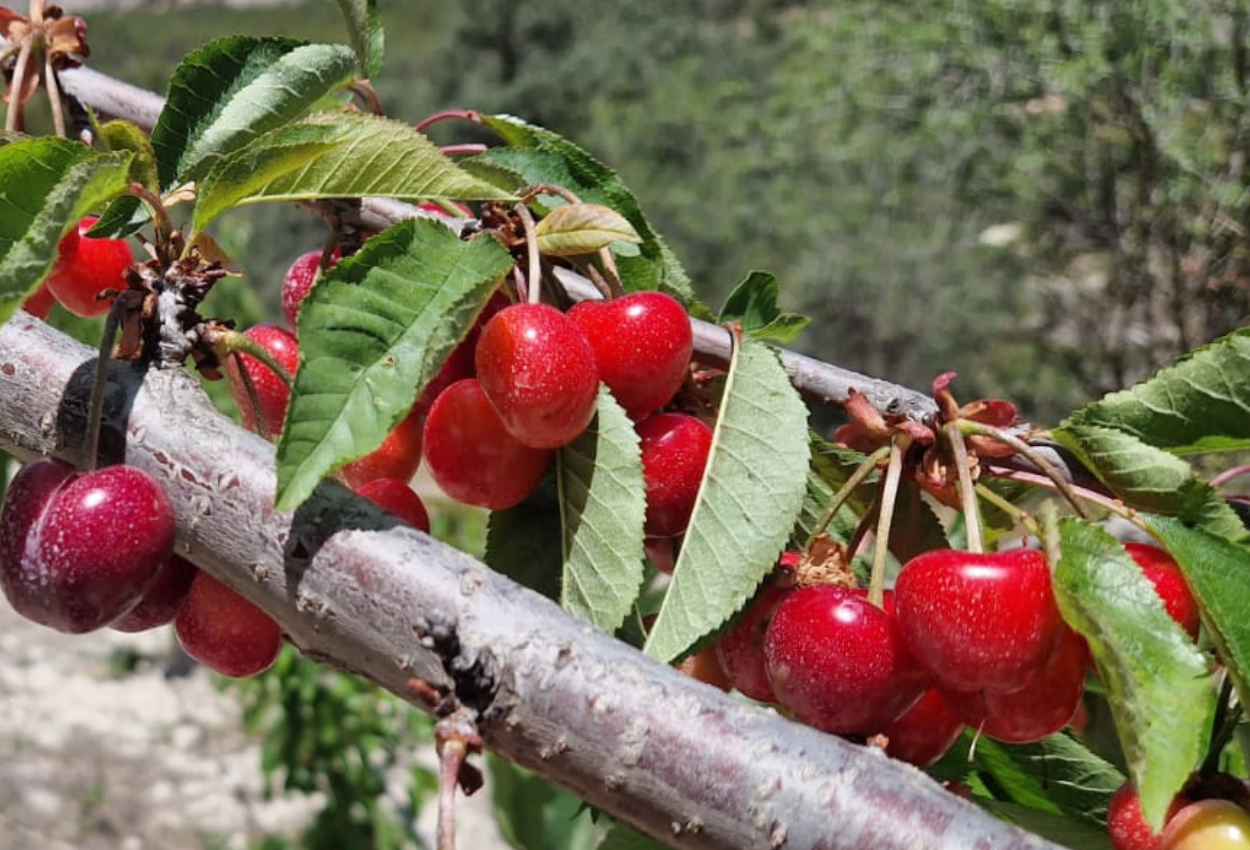
Cherry cultivation in Spain represents an agricultural tradition with deep roots and a promising future. With an annual production ranging between 118,000 and 126,000 tons, this fruit tree stands out not only for its commercial value but also for the passion it evokes among farmers and consumers. In this comprehensive guide, we will explore all the fundamental aspects for successful cultivation, from selecting the land to the most innovative management and commercialization techniques.
What makes cherry cultivation in Spain special?
Spain has positioned itself as a benchmark in high-quality cherry production, with Aragón and Extremadura leading national production (over 70%), followed by the Valencian Community with its prestigious PGI "Cerezas Montaña de Alicante." What distinguishes Spanish cherries is their extraordinary flavor and quality, a result of privileged microclimates and cultivation techniques that prioritize excellence over quantity.
As a producer from the Alicante area tells us: "If there's one thing that stands out in our PGI, it's precisely the flavor. It might be due to the dry, mountainous climate, but the flavor is non-negotiable."

Climatic requirements: The key to success in cherry cultivation
The cherry tree (Prunus avium) is demanding in terms of climatic conditions, a decisive factor for the success of its cultivation.
Chilling requirements: The challenge of climate change
Cherry trees require between 300 and 1,000 chilling hours (temperatures below 7°C) during winter, depending on the variety. This accumulation is essential to break dormancy and ensure uniform and abundant flowering in spring.
Alexander, an experienced farmer, shares his experience: "Climate change has led to clear climatic irregularity, and that's evident in the reduction of chilling hours. Some varieties, like Burlat, which is French, have stopped performing well precisely because of that. In general, efforts are being made to move cultivation to colder or later areas, where cherries develop better."
This adaptation is crucial, as varieties like Burlat need approximately 600 chilling hours, while others like Cristobalina can flower with barely 314 hours, allowing their cultivation in warmer areas like Murcia, provided they are above 360 meters above sea level.
Temperature and rainfall
Cherry trees thrive in temperate climates with cold winters and warm summers. They are particularly sensitive to late frosts during flowering, which can destroy the year's crop. On the other hand, rain during fruit ripening can cause the dreaded "cracking" of cherries, one of the main problems in this crop.
Ideal rainfall is around 600 mm annually, although with adequate irrigation systems, it can adapt to drier areas. The fundamental thing is to avoid excessive humidity during fruit ripening and harvesting.
The ideal soil for cherry trees: Characteristics and preparation
Cherry trees are quite demanding regarding soil conditions, a factor that can determine the success or failure of the plantation.
Physical and chemical characteristics
The ideal soils for cherry cultivation are:
- Loamy-sandy texture, with good drainage
- Deep, as the cherry tree's root system can reach several meters
- Optimal pH between 6 and 6.5, although it can adapt to soils with pH up to 8
- Well-aerated and with good porosity
Cherry trees are extremely sensitive to waterlogging and root asphyxia, so we must avoid clay soils with poor drainage. In sloping terrains, like those in the Montaña de Alicante, the natural water runoff favors cultivation, although it complicates agricultural tasks.
Soil preparation
Before establishing a cherry plantation, it is essential to:
- Perform a complete soil analysis to determine its physical-chemical characteristics
- Remove roots and remains of previous crops
- Disinfect the soil to prevent pathogens, preferably using ecological methods like solarization
- Incorporate organic matter (30 t/ha of well-composted manure)
- Carry out deep tillage to improve soil structure
In soils prone to waterlogging, it may be necessary to install drainage systems or create raised beds to elevate the planting area.
Cherry varieties: Choosing the best option for each situation
The choice of the appropriate variety is one of the most determining factors for the success of the crop. In Spain, more than 100 cherry varieties are cultivated, each with specific characteristics regarding ripening time, fruit size, flavor, cracking resistance, and pollination needs.
Classification by ripening time
Cherry varieties are usually classified using the Burlat variety as a reference, which marks the beginning of the season:
| Type | Ripening period | Featured varieties |
|---|---|---|
| Early | Late May to early June | Burlat, Early Bigi, Nimba, Early Lory, Cristobalina |
| Mid-season | 12-19 days after Burlat | Summit, Van, Starking, Bing, Frisco, Chelan, Brooks, Giant Red, Santina, Celeste |
| Late | 20-27 days after Burlat | Lapins, Skeena, Sunburst, Sonata, Sweet Heart, Staccato, Napoleón |
Self-fertile vs. non-self-fertile varieties
A crucial aspect to consider is whether the variety is self-fertile (capable of pollinating itself) or requires pollinators:
- Self-fertile varieties: Lapins, Sweet Heart, Skeena, Sunburst, Celeste, Santina, Cristobalina, Compact Stella
- Non-self-fertile varieties: Burlat, Summit, Van, Starking, Picota, Napoleón
Non-self-fertile varieties require the presence of compatible pollinator trees (approximately 30% of the plantation) and the installation of beehives (12 per hectare) during flowering to ensure good pollination.
Resistance to cracking
Cracking resistance is a highly valued characteristic, especially in areas with a risk of rain during ripening:
- High resistance: Lapins, Sweet Heart, Picota, Skeena
- Medium resistance: Sunburst, Summit, Starking, Napoleón
- Low resistance: Burlat
Rootstocks: The foundation of success
The rootstock on which the variety is grafted decisively influences the tree's vigor, its adaptation to the soil, precocity of entry into production, and longevity.
The most commonly used rootstocks in Spain are:
- SL-64 (Prunus mahaleb): Traditionally the most used, it provides good vigor and adaptation to calcareous soils, but is sensitive to root asphyxia and soil fungi.
- Adara: Currently the most planted, it offers good compatibility with all varieties, tolerance to heavy soils, and nematode resistance.
- CAB 6: Imparts medium vigor, good productivity, and is less sensitive to root asphyxia.
- Gisela: A series of dwarfing rootstocks that allow high-density plantings.
- MaxMA: Good results in heavy soils with drainage problems.
The choice of rootstock should be based on soil characteristics, the planned cultivation system, and the variety to be grafted.

Establishing the plantation: Design and spacing
The plantation design must consider multiple factors such as the vigor of the variety-rootstock combination, the chosen training system, terrain conditions, and planned mechanization.
Planting frames
Traditional spacing for cherry cultivation in Spain has been relatively wide, but the current trend is towards more intensive plantings:
- Traditional cultivation: 5x5 m or 6x6 m (280-400 trees/ha)
- Semi-intensive cultivation: 5x3 m or 4x3 m (500-800 trees/ha)
- Intensive cultivation: 4x2 m or 3.5x1.5 m (1,000-1,900 trees/ha)
- Pedestrian systems: 2.5x1 m or 2x0.5 m (4,000-10,000 trees/ha)
Intensive systems require lower vigor rootstocks and specific training systems.
Orientation and layout
The ideal row orientation is north-south to maximize light interception. In sloping terrain, rows should follow contour lines to facilitate work and prevent erosion.
It is important to provide sufficient space for machinery maneuvers and access to all parts of the plantation.
Irrigation and nutrition: Fundamental pillars of cultivation
Although the cherry tree is considered one of the least demanding fruit trees in terms of water, proper irrigation and nutrition management are essential to obtain quality productions.
Irrigation systems and strategies
The most recommended irrigation system for cherry trees is localized drip irrigation, which allows for efficient water use and facilitates fertigation. The usual configuration includes two drip lines per row with 2 l/h emitters.
Water needs vary according to the development stage:
- Pre-bloom: 75% of Field Capacity (FC)
- Flowering: 75% FC
- Fruit set: 50-75% FC
- Pit hardening: 75% FC
- Ripening: 100% FC
- Post-harvest: 80% FC
- Leaf drop: 50% FC
Quantitatively, annual needs range from 2,500 m³/ha in traditional plantations to 5,000 m³/ha in intensive systems.
Alexander explains his strategy: "What we do is significant thinning: a lot of cleaning, less fruit per tree, and therefore, less production. As the irrigation level increases, quality also improves: the fruit has more flavor and a better appearance. We are precisely looking for that balance between size and quality."
Balanced fertilization
Cherry trees have specific nutritional requirements, with low nitrogen consumption and high needs for potassium, calcium, and magnesium:
| Nutrient | Needs (UF/ha/ton of cherry) | Main function |
|---|---|---|
| Nitrogen (N) | 6 | Vegetative growth |
| Phosphorus (P₂O₅) | 2.5 | Root development and flowering |
| Potassium (K₂O) | 5.5 | Fruit size, color, and sweetness |
| Magnesium (MgO) | 30 UF/ha/year | Photosynthesis and fruit quality |
| Calcium (Ca) | Root and foliar applications | Fruit firmness |
A typical fertilization plan would include:
- Base fertilization: 30 t/ha of well-composted manure, 50 UF of P₂O₅, and 200 UF of K₂O
- Top dressing: Nitrogen distributed in three applications (1/3 before flowering, 1/3 after harvest, 1/3 for reserves)
- Micronutrients: Foliar applications of zinc, boron, and iron as needed
It is essential to perform foliar analyses after harvest to adjust the fertilization program for the following year.
Pruning and training techniques: Shaping the tree for productivity
Pruning cherry trees is a delicate task, as they respond poorly to severe interventions and tend to produce gum from large wounds.
Training systems
The main training systems used for cherry trees are:
- Spanish/Catalan vase: Traditional system with 3-4 main branches, suitable for vigorous rootstocks like SL-64 and wide spacing (5x3 m).
- Low vase (Spanish bush): Adaptation of the traditional vase with a maximum height of 2.5 m to facilitate harvesting.
- Central leader: A single main trunk with tiers of branches, suitable for semi-intensive plantings (4x2 m).
- KGB (Kym Green Bush): Multi-leader system with numerous low-vigor axes.
- UFO (Upright Fruiting Offshoots): Two-dimensional training system for high-density plantings.
Training and production pruning
During the first few years, pruning should be light, limited to removing poorly placed branches and favoring the desired structure. Green pruning during the summer is especially useful at this stage.
In adult trees, pruning focuses on:
- Maintaining the balance between vegetative growth and production
- Removing aged, poorly placed, or diseased branches
- Promoting light penetration to all parts of the tree
- Limiting height to facilitate harvesting (maximum 2.5 m)
Green pruning in August, removing suckers and shortening shoots to 15 cm, significantly reduces Monilia infections and improves floral induction for the following year.

Integrated pest and disease management: Protecting the harvest
The cherry tree is susceptible to various pests and diseases that can seriously compromise production if not managed properly.
Main pests
The most problematic pests in cherry cultivation in Spain are:
- Mediterranean fruit fly (Ceratitis capitata): Primarily affects late varieties.
- Spotted-wing drosophila (Drosophila suzukii): An emerging pest that is difficult to control.
- Black cherry aphid (Myzus cerasi): Causes leaf curling and weakening.
- Flathead borer (Capnodis tenebrionis): Larvae damage the root system.
Alexander shares his experience: "The most worrying pests right now are Ceratitis capitata and Drosophila suzukii, and the serious thing is that they don't have effective chemical control. For Ceratitis, we use traps, but they are not enough for late varieties. Drosophila suzukii has arrived recently, and we apply products that are permitted in organic farming."
Most frequent diseases
Among the diseases that affect cherry trees are:
- Brown rot (Monilinia spp.): Causes fruit rot and branch dieback.
- Cherry leaf spot (Blumeriella jaapii): Causes spots and premature leaf drop.
- Shot-hole disease (Stigmina carpophila): Produces perforations in leaves and lesions on fruits.
- Bacterial canker (Pseudomonas syringae): Causes gummy exudates and branch dieback.
Integrated control strategies
Integrated management combines various techniques to minimize the use of plant protection products:
- Cultural measures: Aeration pruning, removal of pruning debris, proper irrigation management.
- Biological control: Use of natural enemies and beneficial microorganisms like Beauveria bassiana.
- Mass trapping: Especially effective for fruit flies (90 traps/ha).
- Cover crops: "We work with fields covered with grass and legumes, which helps us maintain good plant health. This plant cover provides nitrogen to the soil and contributes to the ecosystem's balance," explains a producer.
- Rational chemical control: As a last resort, using selective products and respecting safety periods.
Predictive models based on climatic conditions allow for more precise and effective applications, reducing the number of necessary treatments.
Harvest and post-harvest: The decisive moment
Harvesting is one of the most critical and costly phases of cherry cultivation, representing up to 60% of total production costs.
Optimal harvest time
Cherries should be harvested at their optimal ripeness, as they do not ripen after being separated from the tree. Indicators of ripeness include:
- Characteristic color of the variety
- Adequate firmness (>70 Durafel)
- Sugar content (>14 °Brix)
- Commercial size (minimum 26 mm, ideal >30 mm)
Harvesting Techniques
Harvesting is done manually, with care not to damage the fruit or remove the stem (except for picota cherries). It should be carried out during the coolest hours of the day (temperature <28°C) and the fruits should be transported to the warehouse within 4 hours.
Every hour a cherry remains at ambient temperature after harvesting is equivalent to losing one day of cold storage life.
Post-harvest Management
Once in the warehouse, cherries should be:
- Quickly pre-cooled to 0-2°C
- Selected and classified by size and quality
- Packaged appropriately (2-5 kg boxes or 250-500 g punnets)
- Stored at 0°C with 90-95% relative humidity
Under these conditions, shelf life can extend up to 2-3 weeks, depending on the variety.

Commercialization and Added Value: From Field to Table
Successful cherry commercialization requires strategies that highlight their differential characteristics and meet market demands.
Quality Seals and Geographical Indications
Quality certifications such as the PGI "Cerezas Montaña de Alicante" or the PDO "Cerezas del Jerte" add value and recognition to the product. These seals guarantee specific characteristics such as origin, varieties, cultivation practices, and minimum quality.
Regarding the importance of these seals, a producer from the Alicante PGI comments: "We use quality material for sales and commercialization, although Alicante cherries are not yet widely known as a PGI. This mountain fruit has unique characteristics: there are areas where fruit is grown that has hardly any flavor when cut, but ours does."
Commercialization Channels
The main channels for Spanish cherries include:
- National market: Through wholesalers, supermarket chains, and specialized stores
- Export: Mainly to EU countries such as Germany, the United Kingdom, and France
- Direct sales: Increasingly relevant, especially for small and medium-sized producers
- E-commerce: A growing channel that allows direct reach to the final consumer
Premium quality cherries, with sizes greater than 30 mm, can achieve prices up to 30% higher than standard products.
Challenges and Future Prospects for Cherry Cultivation
The cherry sector in Spain faces various challenges but also has significant opportunities for its future development.
Main Challenges
- Climate change: Reduction of chill hours, extreme weather events, and alteration of rainfall patterns
- Emerging pests: Especially Drosophila suzukii, which is difficult to control
- Production costs: Particularly those associated with manual harvesting
- International competition: From countries with lower production costs
- Market demands: Regarding size, appearance, and pesticide residues
Opportunities and Trends
Among the most promising trends are:
- New varieties: Self-fertile, larger size, and crack-resistant
- Intensive cultivation systems: With greater productive efficiency and ease of management
- Technification: Use of sensors, decision support systems, and automation
- Organic production: Growing demand for residue-free products
- Differentiation: Through quality seals, exclusive varieties, or sustainable production systems
Adapting to these trends will be key to maintaining the sector's competitiveness in the coming years.
Frequently Asked Questions about Cherry Cultivation
What are the most recommended cherry tree varieties for beginners?
For growers with little experience, self-fertile varieties such as Lapins, Sweet Heart, or Sunburst are recommended, as they do not require pollinators and are easier to manage. It is also advisable to choose varieties with good crack resistance and adapted to local climatic conditions.
How can I protect my cherry crop from late frosts?
The most effective strategies include selecting late-flowering varieties, locating the plantation in areas with lower frost risk, using protection systems such as anti-frost towers, overhead sprinklers, or heaters, and applying products that delay flowering or increase bud resistance to cold.
Is it currently profitable to establish a cherry plantation in Spain?
Profitability depends on multiple factors such as location, varieties, cultivation system, and commercialization channels. In general, modern plantations with quality varieties and good size can be very profitable, especially if they are oriented towards premium or export markets. However, they require a considerable initial investment (15,000-30,000 €/ha) and do not begin to produce significantly until the 3rd-4th year.
What is the difference between cherries and picotas?
Picotas are a specific type of cherry characterized by naturally detaching from the stem during harvesting. They are typical of the Jerte Valley area (Extremadura) and have a Protected Designation of Origin. They are usually late-ripening, considerable in size, rounded in shape, and sweeter in taste than conventional cherries.
How does climate change affect cherry cultivation and what adaptation measures exist?
Climate change is causing a reduction in chill hours, irregular flowering, a higher incidence of extreme events, and alteration of pest cycles. The main adaptation measures include selecting varieties with lower chilling requirements, relocating cultivation to higher or colder areas, using products to compensate for the lack of chill, protection systems against extreme weather events, and adjustments in crop management practices.
Conclusion: The Promising Future of Cherry Cultivation in Spain
Cherry cultivation in Spain represents an agricultural activity with deep traditional roots but with a clear future projection. The combination of privileged climatic conditions, high-quality varieties, and advanced cultivation techniques positions Spanish cherries as an excellent product in national and international markets.
The challenges are significant, especially those related to climate change and global competition, but the opportunities are equally important. Varietal innovation, technification of cultivation, differentiation through quality and sustainability, and the opening of new commercialization channels mark the path towards a more competitive and profitable sector.
At Campos del Abuelo, we are committed to offering the best cherries, cultivated with passion and respect for nature, directly from the farmer to your table in less than 24 hours. We invite you to discover our seasonal cherries and enjoy all their flavor and properties.


Comments
Muy interesante la información técnica compartida sabemos que toda guía aplicada correctamente favorece la factibilidad en la producción