
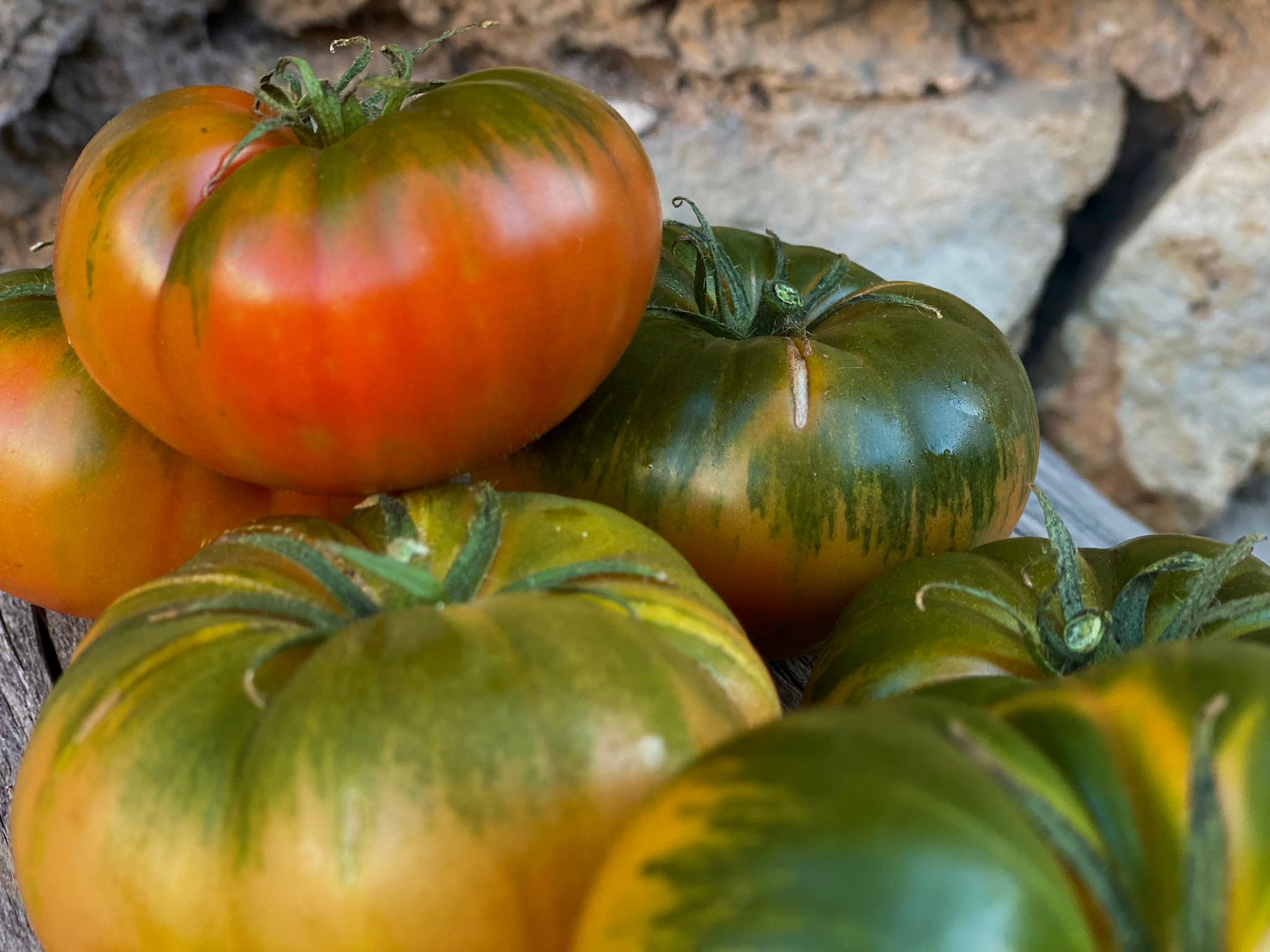
The best tomato in the world is one that perfectly balances sweetness and acidity, with a juicy texture, intense aroma, and authentic flavor that transports us directly to the garden. There is no single definitive answer, as various varieties like the Perón de Zaragoza, the RAF tomato, the Valencian, or the ox heart tomato compete for this title, each with unique characteristics that make them extraordinary depending on each person's palate and preferences.
In a world where supermarket tomatoes have lost much of their original flavor, discovering an authentic tomato with intense flavor has become almost a revelatory experience. As passionate advocates for sustainable agriculture at Campos del Abuelo, we want to take you on a journey through the most extraordinary tomato varieties, those gems that have survived industrialization and still retain the authentic flavor we remember from our childhood.

The most awarded tomato varieties in Spain
Spain is a paradise for good tomato lovers, with local varieties that have been carefully selected over generations. Among the most outstanding, we find some that have received official recognition for their exceptional quality.
The Perón de Zaragoza: national champion for the second consecutive year
The Perón de Zaragoza tomato has been crowned the best tomato in Spain in 2024 for the second consecutive year at the VI National Fair of Ancient Tomatoes in Polanco. Grown by the Huerto es Vida society in Cogullada (Aragon), this tomato represents the perfect combination of tradition and ecological innovation.
What makes the Perón special is its thin skin and juicy flesh, with a perfect balance of malic acid and natural sugars. Its cultivation respects the natural ripening cycle, without forcing its growth with chemicals, which enhances its organoleptic qualities and its lycopene content, a powerful antioxidant.
This tomato has been rescued from seeds recovered in Alto Aragón, where it was historically grown in family gardens. Its revaluation has not only boosted agro-ecological tourism in the region but has also allowed small farmers to double their income compared to hybrid crops.
The Aretxabaleta: the Basque treasure that captivates palates
Awarded in 2021 and 2022, the Aretxabaleta tomato owes its survival to Koldo Zubizarreta, who rescued it from extinction by collaborating with the last producers in Guipúzcoa. Pinkish in hue and medium-sized, it stands out for its firm flesh and few seeds, characteristics that make it ideal for gazpachos and sauces.
Its cultivation on ventilated slopes in the Basque Country prevents fungal diseases, reducing the need for chemical treatments. This variety perfectly represents how the microclimate of a region can decisively influence the characteristics of a tomato.
The Aretxabaleta is a perfect example of how the passion for recovering traditional varieties can result in very high-quality products that successfully compete in the current market, despite their lower productive yield.
The Rosa de Sumbilla: the Navarrese jewel
Originating from gardens in the town of Sumbilla, this Navarrese variety came in second place in the 2024 competition. With a slightly more acidic flavor than the Perón, it is especially appreciated in pickles and game dishes.
The Santos Losua cooperative combines traditional techniques with gravity irrigation, taking advantage of the waters of the Bidasoa river to intensify its mineral character. This cultivation method demonstrates how ancestral techniques remain relevant and effective in modern agriculture.
The Rosa de Sumbilla represents the pride of a region for keeping its agricultural tradition alive, adapting it to current times without losing its essence.
The Valencian tomato: the jewel of the Mediterranean
When we talk about exceptional tomatoes, the Valencian tomato deserves a separate chapter. This tomato, grown in the sandy and saline lands near the Mediterranean Sea, possesses unique characteristics that make it one of the best in the world according to many experts and local farmers.
As Eduardo, a Valencian farmer with decades of experience and founder of Campos del Abuelo, explains: "Of all the tomatoes I have tasted throughout my life, the best is the Valencian. It is the one that meets all the conditions to be a good tomato: ripe, picked from the vine at the right moment, and eaten when it's due. That is the spectacular tomato."

The Valencian tomato is characterized by its thin and delicate skin, which gives it an incomparable texture but also makes it extremely sensitive to transport. This fragility explains why it is difficult to find it outside its production area and why it maintains such a strong local character.
The Valencian terroir, with its sandy and saline soil, along with a mild climate that is neither too hot nor too cold, creates the perfect conditions for the development of this exceptional tomato. As our expert Eduardo points out: "The Valencian tomato needs a sandy and saline type of soil, which is very common in areas near the sea."
Despite its excellence, the Valencian tomato faces significant challenges. As the farmer comments: "The biggest challenge is that the Valencian tomato is very localized here, in this area. It is not a tomato that can compete with other more productive ones grown in large farms." This reality reflects the tension between quality and productivity that affects many traditional varieties.
If you have the opportunity to try an authentic Valencian tomato, don't miss it. It is a gastronomic experience that will connect you with the very essence of the Mediterranean garden.
The RAF tomato: the "pata negra" of tomatoes
The RAF tomato (Resistente Al Fusarium, Fusarium Resistant) has rightfully earned the nickname "pata negra" (black hoof, referring to premium Iberian ham) of tomatoes. Originating from Almería, this tomato was born from the need of Almerían farmers to find solutions to the fungal plagues that threatened their crops in the 1960s.
What makes the RAF unique are the specific conditions of its cultivation. It is mainly sown in Cabo de Gata, La Cañada, and El Alquián, areas that meet the ideal conditions: soil salinity and a mild winter climate. This salinity of the water used for irrigation is one of the secrets of its flavor, as it helps the fruit generate sugars that turn it into a true delight.
Visually, the RAF is distinguished by its furrowed and irregular shape. In a market dominated by perfectly rounded tomatoes, the RAF stands out for its imperfect but characterful appearance. You will recognize it by its greenish color, with dark veins in the shape of a crown on its upper part and its firm flesh.
In addition to its extraordinary flavor, the RAF is rich in vitamins A and C, and contains antioxidants and beneficial carotenoids for the heart. Its optimal season is between January and February, although it can be found from late October to mid-May.
The higher price of the RAF tomato is justified by its low production: where normal tomato plants produce around 20 kilos, this variety only yields about 4. However, as they say, the experience of trying it is worth every penny invested.

The ox heart tomato: unique shape, incomparable flavor
The ox heart tomato gets its name from its characteristic shape, reminiscent of an animal's heart. It is an ancient variety that has withstood the test of time thanks to its extraordinary organoleptic qualities and the passion of farmers who have kept this tradition alive.
Among the most outstanding versions are the OX Tomatoes, which according to chef José Andrés represent "when a tomato becomes fruit." As Álvaro Martín, one of the shareholders of the company that cultivates them, explains: "The main difference of this tomato is its flavor, and that is because, being a product that has not been genetically altered, it will only taste like real tomato."
The cultivation of the ox heart tomato requires specific techniques and a lot of dedication. As Eduardo explains from Valencian lands: "The tomato is a plant that requires a lot of labor. You have to tie it as it grows, remove the 'arms' or 'eyes' that sprout from the sides so that the tomato grows upwards on a single stem."
This variety is characterized by its large size, irregular and ribbed shape, and its meaty pulp with few seeds. Its flavor is intense, sweet, and with a perfect balance of acidity. It is ideal for eating raw, in salads, or simply with a little salt and extra virgin olive oil.
The ox heart is also one of the most versatile tomatoes in the kitchen, although many purists consider cooking it almost a sacrilege, given the intensity of its natural flavor.
The Russian yellow tomato: the international surprise
The Russian yellow tomato has stood out as a leading international variety, praised for its balanced sweetness and climatic adaptability. Introduced to Spain at the beginning of the 21st century, it comes from the Krasnodar region, where it has been cultivated since the 19th century.
Its success in Spanish competitions lies in its adaptation to cold climates: in Cantabria and Asturias, it bears fruit even in humid summers, thanks to its resistance to mildew. Farmers like David Aguirre (awarded in 2024) use unheated greenhouses to simulate Russian conditions, obtaining fruits weighing up to 600 grams with shiny skin and dense pulp.
With a prominent sweetness and citrus notes, this tomato is versatile in cooking: from salads where it contrasts with blue cheeses, to balanced jams with balsamic vinegar. Nutritionally, its high beta-carotene content —responsible for the yellow color— positions it as an ally for eye health.
Despite its exceptional quality, its production is limited to specialized circuits due to its short post-harvest life, which makes it an exclusive and coveted product.
The revolution of ancient varieties: flavor vs. productivity
In recent years, we have been witnessing a true revolution in the world of tomatoes, with growing interest in recovering ancient varieties that had been displaced by more productive but less flavorful commercial hybrids.
Seed banks: guardians of biodiversity
The Municipal Seed Bank of Bezana, a pioneer in Spain, stores more than 500 ancient varieties, including all the winners of the national fair. According to Pablo Gómez, its president: "Each seed is a living history book; preserving them is protecting our agricultural identity."
These entities collaborate with universities for genetic studies, identifying markers of pest resistance that could cross with modern varieties. Their work is fundamental to keeping agricultural heritage alive and ensuring the genetic diversity of our crops.
At Campos del Abuelo, we greatly value this conservation work, as we understand that biodiversity is essential for a sustainable and resilient food system.

Organic farming: myths and realities
Organic farming is often criticized for its lower yield, but reality demonstrates its viability in ancient tomatoes: the Perón de Zaragoza yields 8 kg/m² compared to 12 kg for hybrids, but it sells for triple the price.
Furthermore, techniques such as straw mulching or association with basil reduce water consumption by 30%, which is fundamental in arid regions like Aragon. These sustainable practices not only benefit the environment but also contribute to obtaining better-tasting and healthier products.
As Eduardo explains: "I don't believe that the value of local Valencian varieties is being lost; what is really being lost is agriculture in general. There are fewer and fewer farmers, and that affects all crops." This reality invites us to reflect on the importance of supporting small local producers who keep these traditions alive.
The role of fairs in raising awareness
Events like the Polanco Fair include seed extraction and food waste cooking workshops, educating thousands of annual students in food sovereignty. In 2024, 500 kg of tomatoes were distributed in comparative tastings, illustrating the differences between industrial and ancient varieties.
These fairs are not only showcases for the best products but also meeting and learning spaces where consumers and producers can share knowledge and experiences. They are fundamental for creating a food culture based on the appreciation of quality products and knowledge of their origin.
What makes a tomato the best in the world?
Determining which is the best tomato in the world is a subjective task that depends on multiple factors. However, there are some criteria that experts consider fundamental for evaluating the quality of a tomato.
The perfect balance: sweetness, acidity, and umami
A great tomato must present a perfect balance between sweetness and acidity, with umami notes that enhance its flavor. As Álvaro Martín describes about OX tomatoes: "It is a very umami tomato, it tastes of earth, it tastes of tradition, it has a perfect balance between sweet, sour, salty... in the mouth it lingers, it lingers, it is very addictive."
This balance is not achieved artificially, but rather is the result of careful cultivation and the selection of varieties that naturally possess these characteristics. The sugar content (measured in Brix degrees) is an important indicator, but it must be in harmony with the acidity to achieve that complex and satisfying flavor.
Texture and juiciness: the complete sensory experience
Texture is another determining factor. A good tomato should be firm yet juicy, with skin that offers some resistance when bitten but is not tough or leathery. The pulp should be fleshy and melting, releasing its juices generously but without being watery.
The number of seeds and their distribution also influence the sensory experience. Varieties with few seeds, like the ox heart, are often more appreciated for their more homogeneous and pleasant texture.
Aroma and persistence: the lasting memory
Aroma is an essential component of the experience. A great tomato should smell intensely of the garden, of damp earth, of sun. This aroma should be persistent and transfer to the palate, leaving a lasting memory after tasting.
As Eduardo, farmer and founder of Campos del Abuelo, points out: "A tomato that transports us to the garden, to a time when tomatoes tasted like real tomatoes." This evocative capacity is perhaps one of the most valued aspects by true tomato lovers.

How to fully enjoy an exceptional tomato
To fully appreciate a high-quality tomato, it is important to know how to consume and store it properly.
Simplicity as the best ally
The best tomatoes shine brightest when consumed simply. A little flaky salt and a drizzle of extra virgin olive oil are enough to enhance their natural qualities. As is often said about the RAF tomato: "Its unique organoleptic characteristics do not require too many accompaniments to get the most out of it."
Simple salads, where the tomato is the star, are an excellent option. They can also be combined with soft cheeses, anchovies, or simply with a little bread to soak up their juices.
Proper storage to maintain its qualities
To preserve a quality tomato, it is advisable to keep it out of the refrigerator until it reaches its optimal ripening point. Once ripe, it can be refrigerated to extend its shelf life, but we should always take it out of the fridge about 15-20 minutes before consuming it so that it regains all its aroma and flavor.
It is important to store tomatoes with the stem end down to prevent them from losing juices and to keep them separate from other fruits that produce ethylene, such as bananas or apples, as they would accelerate their ripening.
The optimal time for consumption
Each variety has its optimal season. For example, the RAF reaches its peak between January and February, while the Perón de Zaragoza is at its best in late summer. Respecting these natural cycles allows us to enjoy each variety at its fullest.
As the Valencian farmer reminds us: "A good tomato must be ripe, picked from the vine at the right moment, and eaten when it's due." This simple formula is key to enjoying an exceptional gastronomic experience.
At Campos del Abuelo, we strive to offer each variety at its optimal moment, respecting natural cycles and ensuring that our customers receive products at their perfect point of ripeness.
Frequently asked questions about the world's best tomatoes
Why do heirloom tomatoes have more flavor than commercial ones?
Heirloom or traditional tomatoes have been selected for generations primarily for their flavor, while modern commercial varieties have been developed prioritizing characteristics such as productivity, transport resistance, and uniform appearance, sacrificing some flavor and aroma in the process.
Furthermore, heirloom varieties are usually grown under more natural conditions, with less use of chemical fertilizers and allowing full ripening on the plant, which enhances their aroma and flavor development. As Álvaro Martín explains about OX tomatoes: "Being a product that has not been genetically altered, it will only taste like real tomato."
How can I distinguish a high-quality tomato in the market?
To identify a quality tomato, look for these aspects:
- Intense, characteristic tomato aroma
- Firm but not hard skin, with a uniform and shiny color
- Considerable weight relative to its size (indicates density and juiciness)
- Green and fresh stem (if it still has it)
- Absence of spots, bruises, or soft areas
Remember that aesthetic perfection is not always synonymous with quality. Many exceptional varieties, like RAF, have irregular shapes or non-uniform colors.
Is it better to buy organic or conventional tomatoes?
Organic tomatoes often offer better flavor and greater health and environmental benefits, as they are grown without chemical pesticides and with methods that respect natural cycles. As a study cited in our research indicates, organic tomatoes like the Perón de Zaragoza accumulate higher levels of lycopene—an antioxidant linked to cardiovascular health—compared to conventional varieties.
However, the most important factors are the variety and the cultivation method. A traditional variety tomato, grown with respect for its natural cycles and harvested at its optimal point of ripeness, will offer a superior experience regardless of whether it has official organic certification.
At Campos del Abuelo, we are committed to sustainable cultivation methods that respect both the product and the environment in which it is grown.
Can I grow high-quality tomatoes in my own garden or on my terrace?
Absolutely. Growing your own tomatoes can be a very rewarding experience and will allow you to enjoy varieties that are hard to find in conventional commerce. For good results:
- Choose traditional varieties adapted to your local climate
- Use quality seeds, preferably from local producers or seed banks
- Provide at least 6-8 hours of direct sunlight daily
- Maintain regular but not excessive watering
- Use supports for plants to grow vertically
- Regularly remove lateral shoots to promote the development of the main stem
As the Valencian farmer reminds us: "You have to tie it as it grows, remove the 'arms' or 'eyes' that grow on the sides so that the tomato grows upwards on a single stem." These types of manual care are essential for obtaining quality fruits.
What health benefits do high-quality tomatoes offer?
High-quality tomatoes, especially those grown with traditional or organic methods, offer numerous health benefits:
- They are rich in lycopene, a powerful antioxidant linked to the prevention of cardiovascular diseases and some types of cancer
- They contain vitamins A, C, and E, essential for the immune system
- They provide minerals such as potassium, magnesium, and phosphorus
- They are low in calories and rich in fiber, which promotes digestion
- They have natural anti-inflammatory properties
Furthermore, varieties like the yellow Russian tomato have a high beta-carotene content, beneficial for eye health, while red-fleshed varieties are especially rich in lycopene.

Conclusion: The best tomato is the one that connects you to the land
After this journey through the most extraordinary varieties of tomatoes, we can conclude that there isn't a single "best tomato in the world," but rather different expressions of excellence adapted to various terroirs, traditions, and personal preferences.
What we can affirm is that the best tomato will always be one that has been cultivated with respect for its natural cycles, harvested at its optimal point of ripeness, and consumed fresh, allowing us to reconnect with the authentic flavors of the land.
As Chef Antonio Vicente said during the Polanco fair: "An exceptional tomato needs no embellishment; it speaks for itself of the land that gave it birth." This phrase perfectly summarizes the philosophy we uphold at Campos del Abuelo: honest products, cultivated with passion and respect, that retain all their flavor and connect us with our roots.
We invite you to explore our seasonal vegetables and discover for yourself the difference that a product cultivated with love and respect for the land makes. Because in the end, the best tomato in the world could be waiting for you in your next Campos del Abuelo basket.


Comments
He disfrutado mucho con lo que he leído. Partiendo de la base que desconozco bastante el tema, reconozco que me ha ilustrado en un tema tan importante de la alimentación. Muchas gracias.