
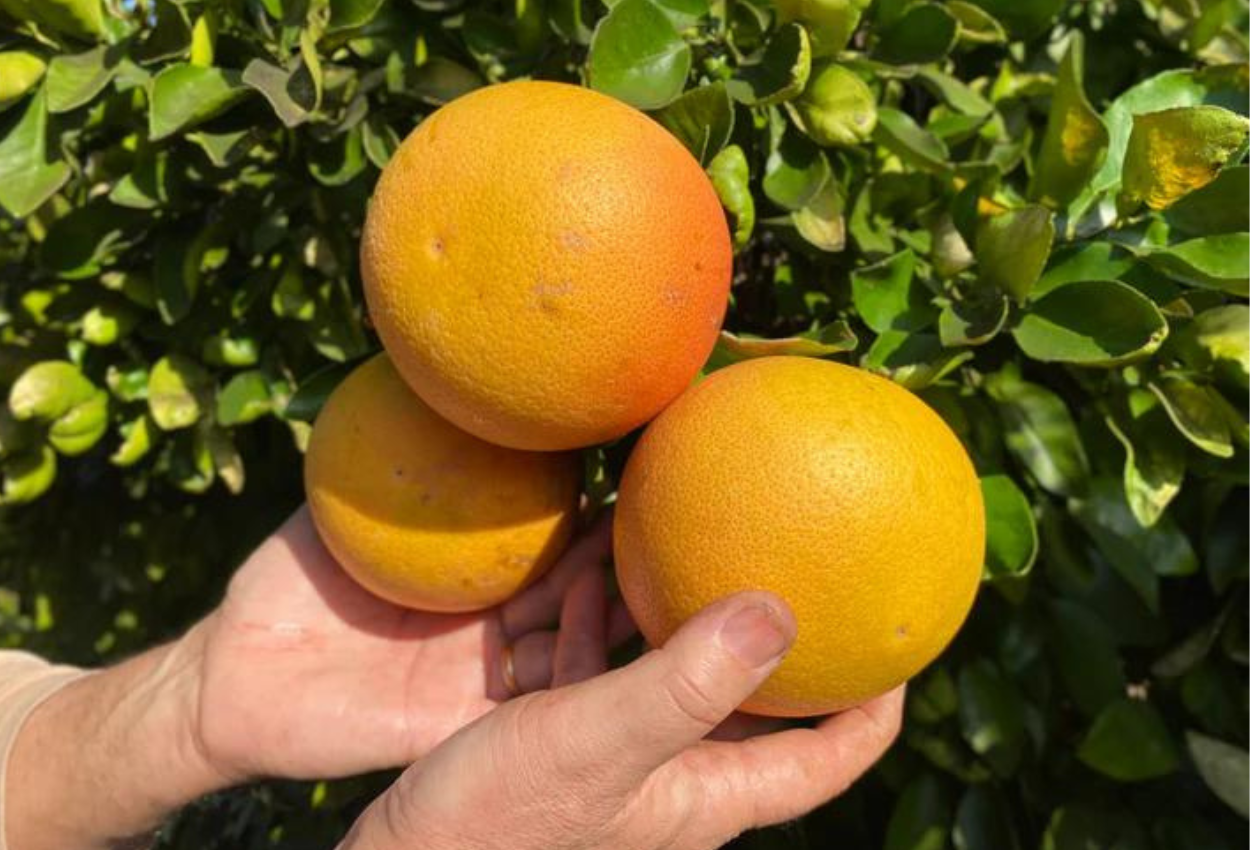
Like many fruits and vegetables we eat daily, grapefruit has a history that spans continents. Apparently, throughout time, it has been common for humanity to travel and move the delicacies they found from one place to another. How many anonymous adventurers do we owe the pleasure of knowing certain essential fruits and vegetables on our table? A great mystery.
In this article, from Campos del Abuelo, we are going to learn about the origin of grapefruit because it is truly curious. We will also talk about the cultivation of this citrus fruit. For this, we will feature the words of Eduardo, farmer, citrus grower, and founder of Campos del Abuelo.

Where does the only citrus fruit not from Asia come from?
Grapefruit is born from a natural hybridization, specifically, between a species of giant citrus from China known as Citrus Maxima or Pummelo and the sweet orange. Some sources point to Pummelo as a kind of mother of many of the citrus fruits we consume today. But for now, we are not going to reconstruct the grapefruit's family tree; let's rather see how it curiously arrived in Europe.
Let's clarify first that there is much mystery surrounding the origin of grapefruit. But the strongest theory says that it was the Dutch who spread it, first across the American continent and then through Europe and Asia.
Its name is formed by the words pompelmoes, which means pumpkin, and limao , which means lemon, which makes a lot of sense. Another theory says that the Tamils, an ethnic group from India, named it, but we will stick to the first one.
The mysterious grapefruit, before embarking on a journey in Dutch ships, was settled in the Caribbean, specifically in Barbados. What a place to grow! Could it be why when it's red inside, it seems to imitate the color of a sunset? Anyway, it's not well known why it grew there, since all citrus fruits are of Asian origin.

Apparently, the grapefruit tree likes white sandy beaches and crystal-clear water, because in the 20th century, it arrived in Florida, United States, where it transformed the area into the largest producer of this citrus fruit, as sweet as it is acidic. Then the Dutch brought grapefruit to Europe and then took it to Asia. Once there, China ended up becoming the largest producer worldwide by the 2000s, a position it still holds today.
How is grapefruit cultivated?
As Eduardo tells us, grapefruit is a citrus fruit and, as such, has characteristics practically identical to oranges and tangerines. The only difference is in the fruit and the shape of the leaf.
Let's start at the beginning: how grapefruit trees arrive at the farm. Eduardo tells us:
It can come bare-root or in a pot. This will depend mainly on the planting time and also on the nursery where the fruit is acquired. If it is bare-root, it is always cheaper than in a pot and easier to transport because they can be stacked in packs of 5, whereas in a pot, it weighs much more.
It can be planted in a pot because, if it is done outside the ideal season, which is usually spring or autumn, looking for it not to be too hot or too cold, it does not cause problems when planting. But if we want to plant on a different date and with more risk, then it is planted in a pot, and this way, we ensure that the plant does not suffer as much.

As we were saying, grapefruit is originally - in a very enigmatic way - from the Barbados Islands in the Caribbean. Therefore, it is clear that it likes warm climates; the heat directly influences its color - inside and outside the fruit - and its flavor. Eduardo reinforces this by telling us about his grapefruit trees:
They primarily like the Mediterranean climate, where it doesn't get colder than 1-2 ºC, because otherwise, we have frost problems, as with oranges or mandarins. They are not very demanding in terms of water quality; they need a normal amount of water, just like any orange; it differs in nothing more than the type of fruit.
The soil and nutrients are the same: a soil that does not need to be excessively rich; it adapts quite well to any terrain, and the nutrients are the usual ones for any plant.
A curious fact is that if the tree is located in humid areas, the shape of the fruit will be, let's say, flatter; whereas if the place where it has grown is somewhat more arid, it will be spherical.
In the case of Spain, according to figures from the Ministry of Agriculture, Fisheries and Food, and until two years ago, the hectares of grapefruit crops reached approximately 3300. This is 74% more than what was cultivated ten years ago.
We can infer that it is not the most growing citrus fruit in the country, but even so, there are farmers who are committed to this citrus fruit.

As Eduardo says, they are very productive trees; they do not need excessive care in that sense, and simply with adequate pruning each year is enough.
Grapefruit trees reach a height of about 5 or 6 meters and are very robust. Otherwise, imagine how they would hold full clusters and clusters of this large fruit. Eduardo already said that, like oranges and tangerines, frosts affect them. Also, like other citrus fruits and stone fruits, grapefruits must be grafted with a variety to produce quality fruits.
When the cold passes and spring arrives, the first shoots appear. And with them, the imperative need for the nascent flowers to receive sun. The small grapefruit flowers are fragrant, so much so that their aroma is used in perfumery, as is the aroma of the fruit.
They are white or purplish and have a geometry that can be described as perfect. They are hermaphroditic, so the presence of pollinators ensures that fruits grow from the flowers.
Once the beautiful flower falls and the fruits set, they will ripen better if they get more sun. Throughout the process, special care must be taken with pests and fungi; about this, Eduardo comments:
As for pests, they are affected by exactly the same ones as any citrus fruit; at this moment, we have quite a few problems, especially with whiteflies, because we have no means to combat this pest. As for fungi, excess moisture can cause phytophthora, which is a fungus that affects the roots and can kill the tree; but, in any case, depending on the type of skin the fruit has, they are usually quite resistant.
We always say that working in the field is not at all easy, but it is always a great satisfaction when harvest time comes.

As you probably already know, citrus fruits are excellent fruits for strengthening your immune system. But that's just one of the benefits of grapefruit. Do we know the others?
Why should I add grapefruit to my diet?
Citrus fruits are the kings of Vitamin C and have a high content of water and fiber. In the case of grapefruit, it also provides the following:
- Grapefruit, being large (it can weigh more than 300 gr), contains significant amounts of Vitamin C, a powerful antioxidant. Nutrition professionals state that in 100 gr of grapefruit, we find up to 41% of the daily recommended value of this vitamin.
- The famous Vitamin A, responsible for caring for sight and skin, abounds in this fruit.
- It has minerals necessary for the maintenance and functioning of muscles and the heart, such as magnesium and potassium, and also for strong bones, such as calcium.
- Just like avocado, another fruit that enjoys a subtropical climate, grapefruit helps reduce cholesterol, as it inhibits an enzyme related to its development.

Many people may not fully appreciate grapefruit due to its taste, which oscillates between bitter, sweet, and sour. Who hasn't had their face wrinkle a little from a grapefruit segment?
The ideal thing, and what I recommend as a great citrus consumer, is to mix it with orange juice. Not only will it be less bitter, but you'll add the benefits of oranges to those of grapefruit. You can also add sugar or honey.
We have reached the end for now. The questions we had about grapefruit have found their answers. However, bearing in mind that grapefruit is enveloped in an enigmatic aura, we will leave some questions unanswered.
But it's hard not to have the image of crates full of grapefruits traveling by ship through the Caribbean imprinted on your mind.
Remember that at Campos del Abuelo, you can buy freshly harvested grapefruits, as well as a wide variety of fruits and vegetables directly from the farmer. Keep in mind that none of our products have post-harvest chemicals, and you can purchase them starting from 1 kg.
Until next time, and thanks for reading!


Comments
Todos los productos de Campos del Abuelo son excelentes pero para mi gusto los mejores son las naranjas, los pomelos y los limones…. Cuando es su época de descanso natural , los echo mucho de menos !!!!