
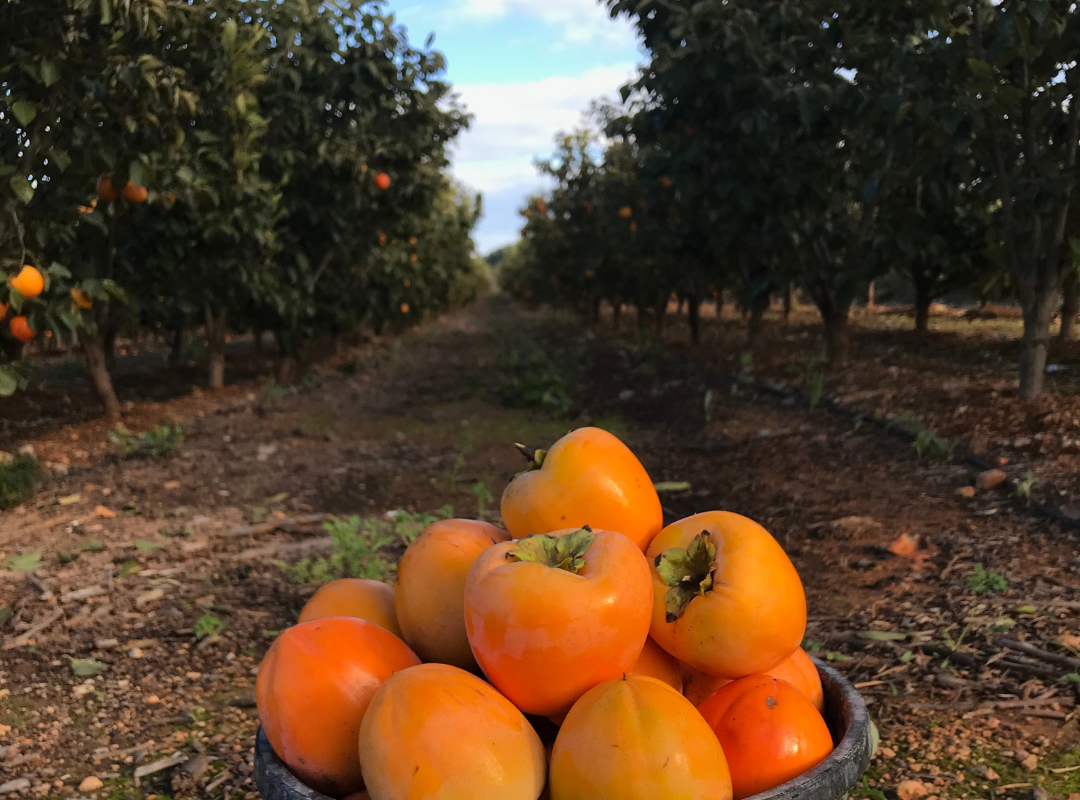
Only a few are capable of appreciating the subtle nuances of the different types of persimmons that exist, considering there are thousands of them. But there is a unique persimmon in the world and we have it in Valencia and, of course, we produce it here at Campos Del Abuelo.

Generally, we can say that persimmons are divided into two groups: astringent and non-astringent. The varieties within each group are very numerous.
Astringent Persimmons
These fruits fully ripen on the tree, and then must undergo a process to remove their astringency.
- Rojo Brillante (Bright Red): This comes from a unique variety that is only produced in our community, the Valencian Community. It has delicate skin and firm pulp. In fact, this is the variety we have been producing and that is available on our website. You can purchase our Rojo Brillante persimmon here.
- Eureka: Eureka persimmons come from a smaller tree that tolerates drought and cold very well. It has high productivity.
- Hachiya: In this case, they come from a large tree that produces a large quantity of fruit. They are among the most astringent, and their flesh is eaten like a pudding.
- Koushu-Hyakume: This fruit is one of the Japanese persimmon varieties. It is also very popular and is often used for drying.
Non-Astringent Persimmons
All persimmons belonging to this species can be consumed after harvesting, as they do not require any subsequent treatment. They are harvested in late autumn and throughout winter.
- Fuyu: Its fruits are a strong orange color on the outside and somewhat paler on the inside. Its pulp is dense and crunchy.
- Honan Red: It is very similar to the previous variety, with the difference that the fruits are very sweet and reddish-orange in color.
- Jiro: It is the smallest variety. It produces yellow fruits that are very sweet and are harvested in early autumn.
- Sharon: Also known as Triumph. Its fruits are soft and have little flavor, and can be eaten even when firm.
Persimmon varieties from which astringency has been removed are known in the market as Persimon. This is why, if you see "caqui" or "kaki persimon," it means it no longer has astringency and you can eat it directly.
The variety we have at Campos Del Abuelo is the Rojo Brillante (Bright Red) variety, the authentic one from Valencia, and although it is originally astringent, ours have already had their astringency naturally removed, so you can eat them without having to do anything else.
Since their season is short, you might want to preserve them for later. For proper storage, we recommend keeping them in the refrigerator and handling them sparingly.
We have mentioned before that persimmons can be astringent or not. Those that are require a process through which their astringency is removed, and this doesn't take too long. This makes them ready for consumption. So you'll probably want to know how to remove astringency from persimmons.
In conclusion, in recent years, the Mediterranean basin has become a reference point for persimmon production in Europe. Specifically in Valencia, where we have the best persimmons.
Remember that at Campos Del Abuelo you have seasonal fruit directly from the farmer to your table and without post-harvest chemicals.

