
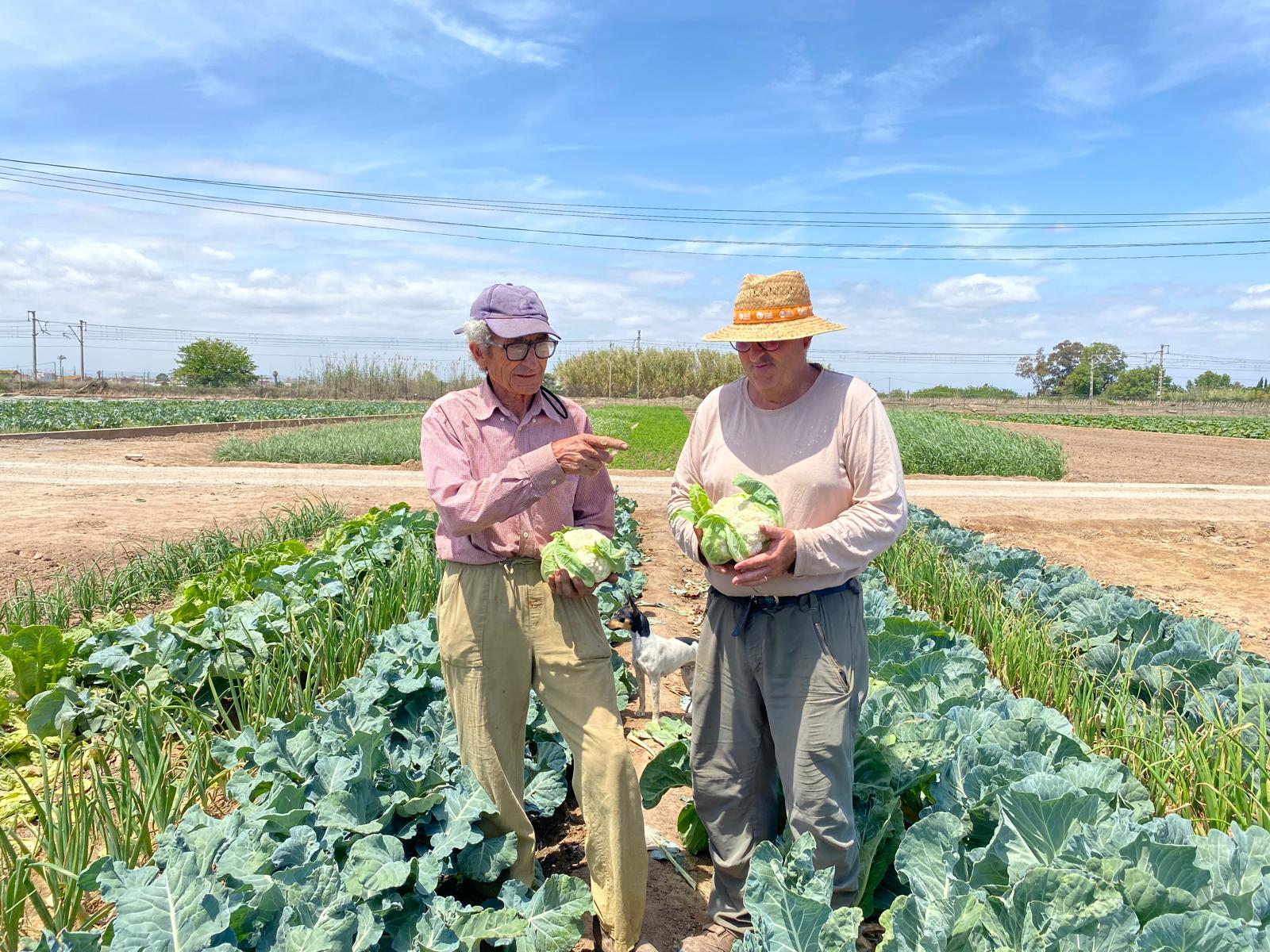
Agriculture is part of human history. Not only has it allowed us to have food in our homes, but it also changed the way we produce and live.
Currently, the role of agriculture and those dedicated to it is vital for us to continue receiving food in our homes.
Its history, as you can imagine, has been marked by various events along the way. In this article, we will learn about some milestones in agriculture, and then we will discover how organic products are grown.
But first, let's learn some general notions…
Brief history of agriculture
In the beginning, humans lived by gathering plants and hunting. Over time and thanks to observation, we realized that seeds were found inside fruits and vegetables. Then came the great discovery: the plant cycle and the possibility of agriculture was born.

In the beginning, agriculture was linked to the natural environment. Not only was the land important, but also the lunar cycles, climate changes, rains, everything that surrounded humans and gave them the possibility or impossibility of cultivating.
Over time, agriculture allowed people to settle in a specific place, build their homes and crops there, providing the opportunity to build a home. It also served to separate certain tasks within the community, thus allowing them to dedicate themselves to other activities.
The ability to grow one's own food was one of humanity's greatest leaps. This happened approximately 12,000 years ago, during the Neolithic period. If you want to know more about the history of agriculture, we recommend this article on how agriculture has advanced in society.
What is agriculture?
In addition to being one of the most important discoveries in human history, it is a human activity. In it, techniques and knowledge are combined to obtain plant-based food production from the land. These can be vegetables, fruits, cereals, and more.
It is also an economic activity within the primary sector. These have been developed by humans since the beginning of history and are very important as they supply the population with food and raw materials.
As human history has progressed, agriculture has undergone changes. In this article, we will focus on organic agriculture. But to better understand how this type of production came about, we need to talk about another type of agricultural production.

Conventional agriculture or organic agriculture?
What is conventional agriculture?
To discuss traditional agriculture, we must mention the Green Revolution. In the 1960s in the United States, this revolution erupted, leading to the use of new technologies to achieve greater agricultural production.
The use of genetically modified seeds to make them more resistant to various climates began, and the concept of monoculture also became popular. This involves prioritizing the cultivation of a single species for one or more seasons. Herbicides and agrochemicals also began to be used. In addition, the use of water resources was maximized.
Initially, the Green Revolution aimed for increased food production for the world, which it achieved. But at the cost of a negative impact on the environment.
Vicent, a fellow farmer from Campos del Abuelo, tells about his experience with traditional agriculture in his interview about potatoes.
He says that in the time his grandparents cultivated, traditional farming was organic farming, but everything changed after the Green Revolution. Vicent tried cultivating with the methods of this type of agriculture, until he was poisoned twice and knew that something was wrong. So, he decided to go back to basics and farm as his ancestors did.
As we said, the type of agriculture that boomed with the Green Revolution, focused on productivity, has a huge environmental impact. For this reason, the quality and fertility of soils decrease. In detriment of these types of cultivation techniques, there is ecological and sustainable agriculture.
What is organic farming?
The Food and Agriculture Organization of the United Nations (FAO) defines organic farming as a cultivation method that involves ecosystem management instead of using agricultural inputs.
It is carried out in an alternative way. The processes follow ecological principles and ancestral knowledge is rescued, while new knowledge is built. That is why, by definition, the ecosystem is managed respecting nature's processes. In addition, available resources are used rationally and working methods are respectful of nature and people.
To make this type of agriculture sustainable, nature-friendly techniques are used. We will learn about them from our fellow farmers at Campos del Abuelo.

Organic farming techniques
The farmers of Campos del Abuelo use sustainable and environmentally friendly agricultural methods.
Clara and Lola will tell us about some of them from their farm in Xàtiva. There they grow zucchini, beans, carrots, and many more vegetables. Let's learn about some of the techniques they use…
Fallow or resting the land
It's a beautiful sunny day. Summer arrived a few days ago, and the heat has begun to be felt. We walk behind Clara through her farm; she is taking us to see some of her advanced crops. She stops right next to a row of yellow flowers and begins to tell us about her farm.
She talks to us about the importance of working the land, keeping in mind that it is alive. Under the Xàtiva sun, we will have the opportunity to learn about the tasks she performs on her farm. So we continue attentively, with Clara, to learn firsthand how organic products are grown.
Clara explains: the earth is a living being. Therefore, it needs to rest and cyclically host crops with different nutritional needs and different interactions with the land. What we achieve by taking these breaks is not to deplete the soil.

These rests that Clara mentions refer to what is called "fallow", an agricultural technique that consists of not sowing the land for one or more periods. This allows the land to rest, as she says.
Crop rotation to take advantage of nutrients
Crop rotation consists of alternating the cultivation of different types and families of plants. It means not repeating the same crop or a crop of the same family always. This helps soil fertility and promotes biodiversity.
Clara tells us about crop rotation with an example: for example, if we plant chard, a vegetable with shallow roots and large aerial development, we will not repeat another crop with similar characteristics in the same plot.
Lola, Clara's mother, gives us a more extensive example to better understand crop rotation. Lola has been working the land for over 40 years. She undoubtedly knows:
Each person has their method, but the one I use for crop rotation is like this. For example, I apply organic fertilizer and start with a crop that has high nutrient needs, such as a tomato or a cauliflower.

Then, once the tomato has finished its cultivation cycle, I pull it up, and then I plant another plant from a different botanical family and with different nutrient needs. Following the example, after tomatoes, I can plant a cabbage. Once the cabbage cycle is finished, I plant another different family, such as Romaine lettuce.
And then after the lettuce, it's time to plant vegetables that have low nutrient needs. This is because the previous three plants have already eaten enough; we have given them good food with organic water.
I can also put sweet potatoes as the penultimate crop in the rotation. And at the end of the rotation, I can plant peanuts. That is a five-crop rotation. Then I start the cycle again, I reincorporate organic fertilizer, and I don't start with a tomato, but, for example, I start with melon or watermelon.

When asked Lola how long this cycle lasts, she replies…
More than a year and a half. Because, for example, a carrot needs four months from when you sow it until you harvest it. After harvesting it, you have to wait, you have to water… You have to work the land more or less superficially, and then, perhaps a month passes between removing one crop and starting another.
And between the five crops, a year and a half surely passes. A cauliflower, for example, also has a very long cycle. It depends, some are ready in 90 days, but others take 100, 120, 150. Cauliflowers have different cycles.
Then tomatoes, for example, I start picking now, I buy the seedlings at the beginning of March. March, April, and May have passed, three months. If I'm lucky and the temperature doesn't rise much, I can harvest those tomatoes for two months. And then I remove them, and while I prepare the land, another month passes.
The cycles are quite long. And a sweet potato, for example, I plant it in June and harvest it almost in December.

If you do crop rotation, you don't need to incorporate organic fertilizer as often, because what you do is incorporate the fertilizer at the beginning. Afterwards, I always do superficial work on the land so as not to disturb the microorganisms, fungi, bacteria, protozoa, so that they stay more or less in place and can work and fulfill their function.
As Lola tells us from the field, it is essential to rotate crops from one season to the next to achieve good pest and disease control. It also helps to improve soil fertility, reduce erosion, and increase biodiversity.
To add to the information Lola provides, in this article about potatoes, we spoke with Vicent, an organic farmer for over 40 years. In it, there is another excellent example of crop rotation with potatoes, beetles, and the solanaceae family.
Manual soil plowing
Additionally, Clara and Lola plow the land manually and enrich the soil with natural manure. The word "plowing" refers to the process of moving and turning over clods of earth on the surface of the land to be cultivated.
These clods are then turned over and over again to return the soil to its initial state. This promotes the passage of organic nutrients and provides space for new crops.
Regarding manual plowing, Clara tells us: these methods are used to accompany the natural cycle of crops, to achieve balance. This type of plowing favors integration into the soil where we are going to cultivate. In turn, if we keep the soil fertile, spongy, and provide quality organic matter, we will facilitate this balance.
During our visit to Lola and Clara's farm, we saw Clara performing shallow tillage of the soil with this adapted bicycle called a "scratching bicycle." It's not as deep as plowing, but it's an example we can see directly from the field:
Crop association for mutual benefit
Crop association involves planting one or more plant species together so that one or more benefit. One of these benefits can be, for example, greater nutrient absorption, improved productivity, pest control, disease prevention, and even better flavor.
Lola also tells us about this technique and how they use it in Latin America.
In South America, there is a crop association called "Milpa." In Milpa, they associate pumpkins with corn and beans. They grow all three crops together. And it's a very good association, because they plant the pumpkins, then they plant the corn, and then they plant the beans, which climb up the corn.

It's a good association; the roots of these three plants also combine very well and produce quite a lot. It's for people who have little land, as these associations work quite well for them. Here, it used to be used a lot; that is, they planted corn and then sowed beans. And the beans would climb up the corn and produce well.
Lola tells us why she no longer uses this type of association and how she solved what seemed like a problem...
But we don't do that anymore, because the wind usually knocks down the corn plants, and then everything falls to the ground. I usually use canes; I make the typical barracada from my town, Alboraya, because each place has its own barracas or staking system for plants. Here there's one way to stake, and in the Valencia area, there's another way. And if you go to Aragon, they do it differently. Always adapted to the climate, to the water, shade, light conditions, everything.
What Lola tells us is one of the characteristics of organic farming: recovering ancestral knowledge and adapting it. From her village, she brought the method of staking with canes.
In this video, we see how Eduardo, from Campos del Abuelo, stakes a tomato with a cane structure:
Beneficial fauna to create a balanced ecosystem
In addition to these techniques, Clara emphasizes the importance of the cultivation environment. She highlights something key: what we plant around the crop will improve symbiosis. She explains that planting and caring for aromatic herbs and a diversity of trees and other complementary crops helps maintain beneficial fauna and reduce pests.
This creates a balanced ecosystem that benefits crop growth and protects naturally and ecologically.
Something to consider when growing organically and without chemicals are potential problems with pests and fungi. Having beneficial fauna, Clara tells us, helps combat fungi such as powdery mildew or downy mildew in zucchini cultivation, for example.
Biological control with ladybugs and aphids
Biological pest control, in turn, controls the presence of aphids. Clara says that to combat aphids, it is essential to have ladybugs in her fields, as they can feed on up to seventy aphids per day. By having a diversity of crops and other plants, ladybugs naturally abound on Clara and Lola's farm.
Clara provides an excellent example of biological pest control. It's a whole process that begins with molasses and ants, she tells us:
Molasses, which is sweet, is watered, and it attracts ants. The ants go to the molasses, the aphids climb onto the ants, and they transport them; there's a mutual interest here. The ants transport the aphids to elevated areas, to the tops of trees or plants that they can't reach on their own because they are small, and there they create their colonies, lay eggs, and develop.
Then the ladybugs come and lay eggs, the first stage emerges, the chrysalis, and then the ladybug is born, which is yellow, its spots appear, and it completes its life cycle. A single ladybug can eat forty or fifty aphids in a day; they do a great job. There are companies that cultivate them, they make insect farms that they then send to farms for biological control.
Here, since we have a lot of flora that we have introduced to maintain them naturally all year round, ladybugs already exist naturally here.

Use of natural soil nutrients
This technique involves the use of natural fertilizers, such as compost, green manures, and animal manure, instead of synthetic fertilizers. Organic fertilizers improve soil quality, reduce erosion, and promote the growth of healthier and disease-resistant plants.
Clara, in the cultivation of cucurbit family (the family to which zucchini belongs), uses a mineral called Slice or Silica. She tells us about the benefits of using it in her crops:
Silica is a mineral that plants absorb and use for support. It is a structural element that reinforces cell walls, helps the plant stay upright, and protects it from temperature fluctuations and other external factors. For example, in zucchini, as in the rest of cucurbits, it plays a very important structural role due to their rapid growth.

So: What products do we consider organic?
The products we consider organic are those cultivated following the principles of organic agriculture. That is, efforts are made to grow plants and trees, taking into account the importance of the ecosystem in the process.
Furthermore, the techniques are based on ancestral knowledge, but also on new knowledge. No agrochemicals or post-harvest chemicals are used.
At Campos del Abuelo, we are proud to be part of the history of agriculture and to support growers who choose it as a way of life and livelihood. Not only are we part of the process of every crop, but we also consume the same fruits and vegetables we offer.
The guarantee that you are acquiring healthy products is that we can harvest them directly from the tree or plant, pack them in boxes, and send them to your home.
By visiting our online fruit and vegetable store, you can customize your box as you wish and receive it in less than 24 hours.
Until next time, and thanks for reading!


