
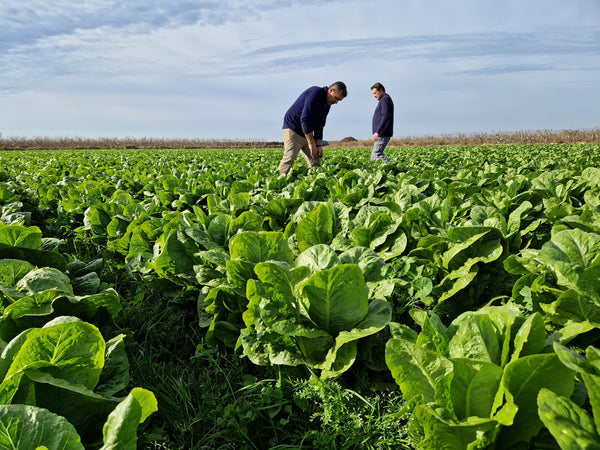

Driving up towards our fellow farmer Antonio's land, the landscape suddenly changes past a certain height. The hillsides fill with round, dark green crowns, mixed in with oaks, and in autumn they turn yellow and gold. They're chestnut trees. And at one point in the conversation Antonio points uphill and explains something everyone in the valley knows:
“Up to here, and in another little village further up, there are chestnuts. Then, in the rest of the villages, no. It grows up to a certain height, up to about 900 or so.”
Why does the chestnut tree live on some hillsides and not others? Why don't we see it in the orchards next to the orange trees? In this article we'll tell you what this tree needs to give good chestnuts, why it sprouts in the most unexpected places and what happens when nobody looks after it.

A mid-mountain tree
The European chestnut, Castanea sativa, is a tree of temperate, fairly humid climates. According to the Spanish Ministry of Agriculture, its ideal range is between 500 and 1,200 metres above sea level, and it prefers sheltered, cool spots. In Spain it's common in the humid northern strip, from Galicia to Catalonia, and in the mountain ranges of the west and south, such as the Sierra de Huelva or the Serranía de Ronda, where chestnut groves sit between 400 and 1,000 metres.
The limit Antonio points out, around 900 metres in his valley, matches what's seen in other chestnut-growing areas. In Galicia, for example, on north- or west-facing slopes the chestnut can give poor fruit above 900 or 1,000 metres, while on south-facing slopes it reaches up to 1,100. Every valley has its own line, depending on orientation, wind and how the cold settles.
Cold winters, hot summers and water
This is how Antonio describes the climate in his valley:
“In winter it's very cold and in summer it gets pretty hot too.”
That's exactly what the chestnut tree loves. Winter cold gives it the rest it needs, like many deciduous fruit trees. Summer heat ripens the wood and fills out the chestnut. But that heat has to come with water. The chestnut is demanding when it comes to moisture, and Galician guides recommend a minimum rainfall of around 700 mm a year. When it doesn't rain at the end of summer, the chestnuts stay small or the burrs drop too early. So when we asked whether the chestnut needs a lot of water, Antonio's answer was quick: “Yes, yes, it wants water.”
What it can't stand is standing water. In soils that waterlog, its roots suffocate and diseases like ink disease appear, which rots the roots.
Acidic, loose soil
The other big reason the chestnut lives where it does is the soil. It prefers siliceous soils, granite or slate, loose, deep and well drained, with an acidic pH of roughly 4.5 to 6.5. On limestone ground, which covers much of the peninsula, it barely thrives. That's why there are whole districts where chestnuts define the landscape and others, just a few kilometres away, without a single one.
Antonio sums it up his own way: “it's a plant that's tied to the land.” In other words, the land rules. If the soil and altitude are right, the chestnut is tough and long-lived. If not, however well you look after it, it won't give good chestnuts.
Why chestnut trees pop up anywhere
Walking through the hills, you notice young chestnut trees in places nobody planted them: in the middle of an oak wood, at the edge of a path or in a crack between rocks. Antonio explains it with a very vivid image:
“All it takes is a little animal that grabs the chestnut and carries it somewhere else, and there it comes up.”
It's what ecologists call animal dispersal. Birds like the jay and small rodents like the wood mouse collect large fruits such as acorns and chestnuts, carry them off and bury them as a winter larder. Many forget them or never get round to eating them, and that buried seed is what germinates. Studies on holm oak and oak acorns, which work in a very similar way, have seen wood mice carry fruits up to 130 metres. Chestnuts rolling downhill with the rain do the rest.
A huge tree that needs space
A mature chestnut can grow over 20 metres tall, with a very wide crown, and live for several centuries. That's why, when planting, the spacing between trees is a long-term decision:
“It's a tree that grows enormously. On a small plot you can't put many either, because otherwise they eat each other up.”
Trees planted too close compete for light, grow upwards instead of spreading their crowns and give less fruit. New chestnut plantations for fruit use wide spacing, and each owner adjusts the number of trees to the size and slope of their land. In Antonio's valley there's a bit of everything: old inherited chestnut groves, like the one Laura's grandmother planted, and newer, tidier plantations with young trees in rows.

Chestnuts for fruit and chestnuts for timber
Not every chestnut tree that's planted is meant for chestnuts. Chestnut wood is highly valued for its strength and durability, and it's used for beams, furniture, joinery and barrel-making. Some plantations use varieties or clones bred for timber, which grow straight and fast and give little or no fruit. Antonio pointed out a few of these plots to us: trees to be felled in a few years, not for gathering burrs.
The chestnut tree nobody looks after
During the walk, Antonio also mentioned something that happens in many chestnut areas. Lots of plots belong to families who no longer make a living from the land. The trees are still there, but nobody prunes them, nobody clears the ground and nobody watches their wounds. Over time, an abandoned chestnut grove builds up dead branches, undergrowth and disease, and stops producing. In the Sierra de Aracena, for example, it's estimated that between 30 and 50 % of chestnut groves have been abandoned.

A well-tended chestnut tree, on the other hand, can give chestnuts for generations. For that, you have to watch out for two threats we cover separately: the chestnut gall wasp, a pest that arrived from Asia just over a decade ago, and chestnut blight, a fungus that gets in through wounds.
Frequently asked questions
Can I plant a chestnut tree in my garden?
If you live somewhere with acidic soil, cold winters, some humidity and plenty of space, yes. In limestone soils or very dry, hot areas it'll struggle. Bear in mind that a mature tree is very big.
How long does a chestnut tree take to produce chestnuts?
A grafted chestnut starts giving some fruit within a few years, but serious production comes once the tree is fairly old and has a well-formed crown.
Is the horse chestnut the same tree?
No. The horse chestnut (Aesculus hippocastanum), the one in many parks and avenues, is a different species, and its fruits aren't edible. The chestnut you eat comes from the European chestnut, Castanea sativa.
Why do some chestnut trees have hollow trunks?
Very old chestnut trees often hollow out over the centuries without dying, because the living part of the tree is just under the bark. Many centuries-old chestnuts keep fruiting with an empty trunk.
From the chestnut grove to your table
The chestnut is a tree of patience: it needs its altitude, its soil and someone to care for it over the years. We're working with Antonio on a way to bring his freshly picked chestnuts to your home. In the meantime, in Reserve your harvest you'll find the autumn fruit we pick the same day it ships. From the field to the box, and from the box to your home. That simple, that authentic.
Sources
- Ministerio de Agricultura. El castaño, árbol frutal (Hojas Divulgadoras 23-24/78)
- MITECO. Ficha de Castanea sativa Mill.
- Pereira-Lorenzo et al. El cultivo del castaño en Andalucía (Sociedad Española de Ciencias Forestales)
- Campo Galego. Guía completa sobre plantaciones de castaño
- Castaños Urquijo. El castaño
- Museo Nacional de Ciencias Naturales (CSIC). Dispersión de bellotas por ratones
- Revista Ecosistemas. El arrendajo como dispersor de bellotas
- Hifas Foresta. El agusanado de las castañas (abandonment of chestnut groves in the Sierra de Aracena)

