

There's no denying that for some years now Spain has been witnessing a boom in avocado consumption. At Campos del Abuelo we've seen this from the inside, since some of our fellow farmers have started planting avocados far more intensively.
The truth is, in particular, we love avocados. Especially when they're grown in a traditional, sustainable way. In other words, when they're grown just like our ancestors did it. The thing is, even though we farm with environmentally friendly techniques, there always seems to be something more missing to be 100% kind to our planet.
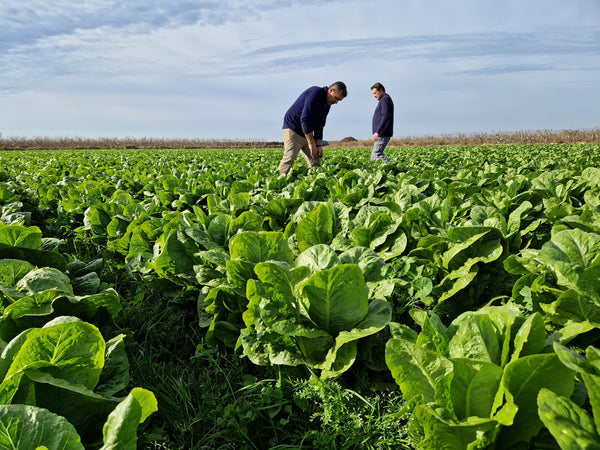
One of the issues linked to avocados is their water footprint. And that's what we'll talk about, straight from the field. Today we were lucky enough to find in the same place Eduardo, farmer and founder of Campos del Abuelo, and Salvador, a Valencian farmer.
Here you can see them holding their favourite crops:

So we won't have just one voice but two, to dig deep into avocado water use. But so we're all on the same page, first things first…
What is the water footprint?
The water footprint is an environmental indicator that measures the volume of water used throughout the entire production of a consumer good or service. What we mean is that the trousers you're wearing, the milk you drink at breakfast and, of course, the avocados you eat all have a water footprint.
Everything in the world takes water to produce. In our case, it's vital for farming. Without water, our trees and plants couldn't get the nutrients they need to bear fruit. That's why we take irrigation seriously and use drip irrigation.
What's more, as Eduardo explains next to one of his new avocado trees: the water for our fields comes from the Júcar river this municipality has been one of the five holders of Júcar water rights since around the year fifteen hundred and ten, thanks to a privilege granted to this town by Philip II.
The black pipes you can see in this picture carry the drip irrigation Eduardo talks about:

That irrigation privilege really is old, isn't it? Rainwater is also taken into account, as Eduardo explains: we irrigate with water from the Júcar and, of course, if it rains, we turn off the tap so we don't waste water. When it doesn't rain, then we water. That's in winter. In summer, even if it rains, we water anyway, because there's never enough water. And of course, by farming organically, we keep chemicals from seeping into the water and we improve the environment.
How much water do avocados use?
We have to bear in mind that the avocado comes from tropical regions so the avocado tree needs certain care and above all, it needs water and humidity. According to Eduardo: in years that aren't as dry as this one, it rains enough, so the rain the avocado gets in winter is enough to water it.
As well as being a farmer, Eduardo grows citrus, so he makes a comparison with orange trees: in summer, it gets watered about the same as an orange tree, there's no difference. The only possible difference is that during the orange tree's dormant season it doesn't need watering if there's a normal rain cycle, while the avocado may always need a bit of watering, but not much more.
It all depends on the climate, whether it's more or less humid, whether it rains more or less. We water with the drip system. That system doesn't change because it's always the best way to make sure the plant has the moisture it needs.

For his part, Salvador, who has fields planted with avocados, tells us about irrigation with another comparison: comparing a citrus, or the persimmon, with the avocado, water use is similar. The avocado might use a little more, but if we're talking about a little more, it's around 15% or 20% more.
Salvador also brings up a point that's no small thing: the nutritional potential of the avocado: you also have to consider that they don't have the same nutritional potential: an avocado, a kilo of avocado, for example, versus a kilo of oranges, doesn't have anywhere near the same calories, or the same properties.
The avocado is much more nutritious, it has more fat and a much higher calorie content. So if you compare water use against nutritional potential, I'm sure the avocado could even come out ahead on that front.
Eduardo and Salvador each take their time and space to answer, but you can tell they're both keen to keep talking about this. For those of us who love the countryside, it's a privilege to listen to them as they share their wisdom.

Salvador carries on and tells us about how what he calls “the irrigation pattern” changes depending on each tree's roots. The avocado needs the top layer of soil to be moist almost all the time, while citrus has deeper roots and can be watered at longer intervals, that is, longer but less frequent watering. The avocado, on the other hand, needs shorter but more frequent watering.
Just as Eduardo told us it needs watering more often in summer, Salvador adds the following:
Then, in summer, it's true that being a tropical plant it faces a bigger challenge than citrus and persimmon, which are subtropical, because the avocado is tropical. What it needs is more constant humidity and temperature. With very high temperatures and very low humidity, the plant gets very stressed and loses productive potential.
At those times, you have to keep the wet bulb from drying out during the midday hours. Lots of people split up the watering to keep moisture high in the top layer of soil, not in the deeper layers.
At Campos del Abuelo, because we farm organically, we always have to keep an eye on the nutrients and minerals the tree or plant needs. And, as Salvador explains, this matters so as not to waste water.
Leaving plenty of zinc and adding organic matter is essential for the water footprint, as it greatly reduces water use. And leaving a mulch, a layer of weeds, helps cut down evaporation. If it's very tall, it can be harmful because it uses water. But if it's low, the plant cover is better because the sun doesn't hit the soil directly and less evaporates.
About weeds (which, in the end, aren't so bad after all) Eduardo also adds his take from another angle. Salvador's avocado trees are already several years old, while those in Eduardo's field are only a few months old. And caring for avocado plants is a delicate matter. So Eduardo tells us how he handles them with his avocado trees that are still babies:
What we do is clear the weeds with brush cutters. We cut back the weeds so they don't take over the area around the avocado too much and compete with it.
This keeps moisture in the soil, but it's also true that these plants use water and can compete with the tree when moisture is short. Especially in the first years, since the tree is small, more sunlight reaches the soil, so you need to control the weeds and keep them from growing too much.
Eduardo and Salvador look at each other, satisfied. They've explained from their perspective how water is managed when growing avocados in their fields. But before wrapping up, Salvador once again stresses the importance of considering the avocado's nutritional potential:
What we should compare is the nutritional value of the avocado against other crops. I'm sure the avocado would turn out to be a crop that uses a normal amount of water, or less than other plants.

At the end of the day, a kilo of avocados has lots of calories and fats, while an orange mainly has sugars and vitamins. They're nothing alike. Sure, more kilos of oranges get produced, fine. But you can eat two half-kilo oranges a day. You're not going to eat a kilo of avocado in one day.
Personally, I have no plans to try eating a kilo of avocados in a day, I don't think it would agree with me. I doubt you're planning to eat a kilo in one sitting either, but if you want to try the best avocados, you can get Campos del Abuelo's. They're grown with traditional techniques and harvested at just the right fat content.
Right, to expand a bit more on the avocado's water footprint, we've gathered some facts about growing this tropical fruit in our country.
Avocado growing in Spain and the water footprint
These facts about avocado growing in Spain were made public in 2022 in the Spanish Congress:
- In Spain, the avocado is the main tropical crop
- Spain is the largest avocado producer in the European Union, with 77% of total production, and also the region's top avocado exporter, making it Europe's main avocado supplier.
- Its cultivation is mostly concentrated in Andalusia, with 75%. Málaga alone accounts for more than 50% of production, followed by Granada, Cádiz and Huelva.
- The rest of Spain's avocado area is in the Canary Islands, with 12.7%, and then in our own region, Valencia, with the remaining 12%.
It's important to keep this in mind because, according to Salvador, the controversy over the avocado's water footprint has to do with these four points. Salvador says:
The controversy over avocado water use has come about because in the main growing area, which is Andalusia, in the eastern part, including all of Málaga, Granada and so on, it used to be all rain-fed olive groves.
So the farmers there have speculated and turned rain-fed estates, which weren't worth much, into avocado plantations, which are trendy now and worth quite a lot of money. So what happens? That it isn't sustainable, that is, there isn't enough water there for irrigated farming.

Here Salvador uses two terms that are everyday words for those of us who work the land, but aren't actually that well known. He talks about “rain-fed estates” on the one hand and “irrigated farming” on the other.
Rain-fed farming is found in semi-arid areas, where the roots shouldn't be flooded when watering. Whereas “irrigated farming” is where water resources are used through different irrigation methods to meet the crops' water needs.
What Salvador explains is that when irrigated crops are grown in places where it isn't natural, they become unsustainable.
How can you help?
At Campos del Abuelo we're a network of farmers who grow the traditional way, respecting nature's timing. Supporting our project means helping build a better planet, looking after not just the environment but your health too.
The flavour, aroma and nutrients of organically grown produce are better preserved than in produce grown in greenhouses or kept in cold storage.
Globalisation has, in a way, made the world smaller, so you can get almost any fruit and vegetable anywhere, any time, but that's, let's say, anti-ecological.
Picture it: first those products are grown in greenhouses that use huge amounts of energy, then they're picked green and kept in warehouses that also involve huge energy costs, and only then are they sent to a supermarket.

The transport and distribution also burns a lot of fuel and emits loads and loads of CO2. At Campos del Abuelo we know this. That's why, in our case, our fruit and veg travel fewer kilometres, going straight from the field to your home.
When you buy seasonal produce that's been grown following nature's cycles, raised respectfully, close to you and without chemicals, well… your shopping does the planet good.
Buying local supports farming families like ours. Plus, you help keep biodiversity alive in our fields, beyond the monoculture pushed by big corporations.
The water footprint isn't just our responsibility as farmers, it's the consumer's responsibility too. Together we can make this a better planet.
Remember to visit our website for seasonal produce. You can build your own box of fruit and vegetables in our online shop.


