
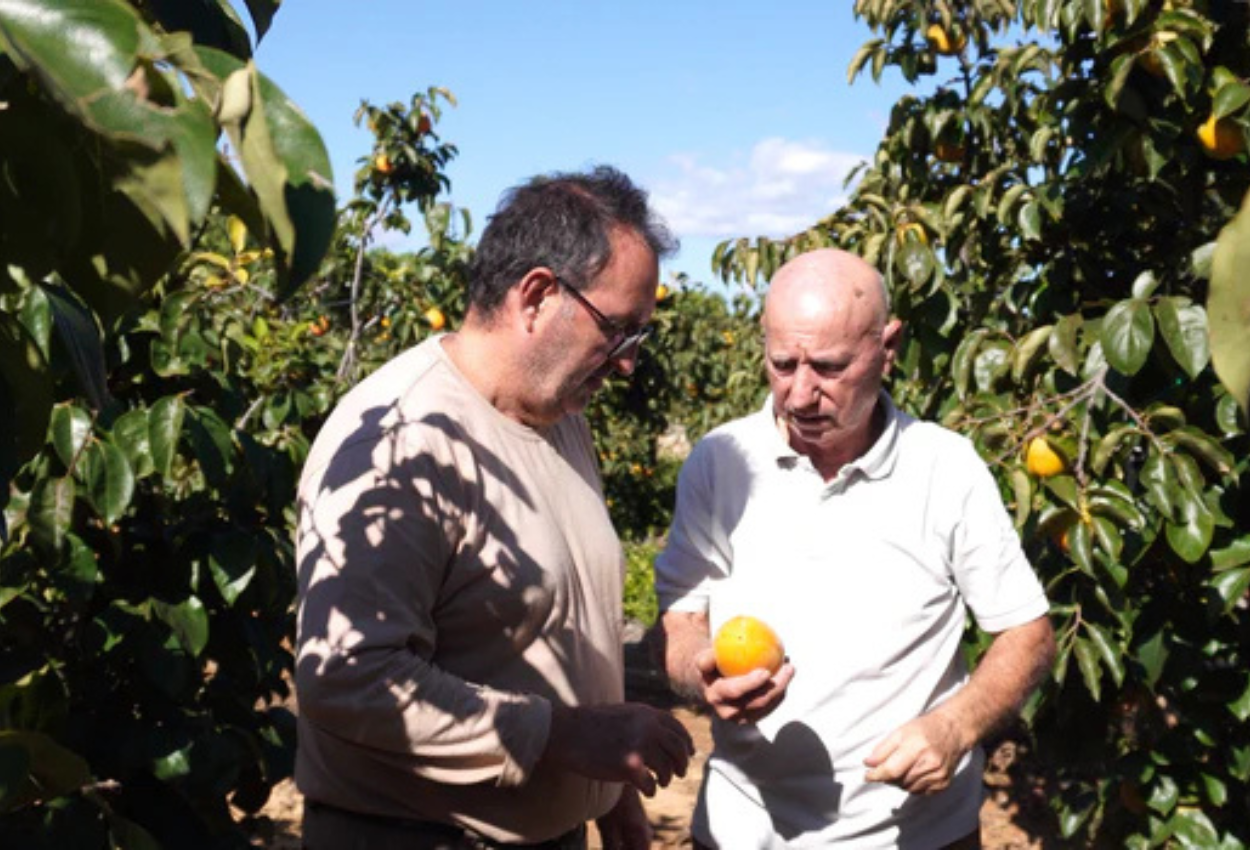
In this blog, we've talked about persimmons before… And that's because at Campos del Abuelo, we not only think it's a spectacular fruit, but we are also producers.
And it's a very curious thing, because even though persimmon cultivation gets more complicated year after year, our trees keep producing. That's why, through this article, we're going to unravel the challenges of growing persimmons in Spain.
We will hear from Eduardo, farmer and founder of Campos del Abuelo. He will tell us about the challenges they face as farmers when growing persimmons.
Eduardo has taken us through his persimmon tree plots. In his fields, he has planted the variety born in Valencia called Rojo Brillante persimmon. His trees are not very large, but he tells us that they have been planted for eight years now and are very productive. Eduardo tells us:
When this tree was first cultivated, it had no pests whatsoever. You simply pruned and watered it, and you already had production.

But with time, everything changes, and over the years, persimmon trees have developed pests and fungi, which complicate their cultivation. And not only because you have to take much more care of them, but also because you have to deal with costly treatments. With Eduardo's help, we will learn about a fungus and four pests that persimmon producers must face:
1- Mycosphaerella fungus
Eduardo anticipates, before explaining, that this fungus is terrible: The main problem with the Mycosphaerella fungus is that it is not detected until harvest time. It is precisely then that round spots begin to appear on the leaves, causing the leaves to fall to the ground.
This has repercussions because it causes the fruit to ripen very quickly, and the harvest can be lost. Sometimes, the farmer explains, the entire crop can be lost. Nature-friendly treatments have appeared to combat this fungus, but each tree must be treated three times a year. This is done during spring when the fungus is susceptible.
But, as we said, not only fungi are a challenge when growing persimmons, but also pests. Until recently, Eduardo says, there were two that posed a great challenge. Let's get to know them:
2- Mealybug
The mealybug is a very small insect that is very difficult to treat because it gets under the underside of the flower. It also attacks citrus fruits, so it not only causes headaches in persimmon production but also in the production of oranges, tangerines, and lemons.
3- Whitefly
This type of fly produces a honeydew, which causes the fruits to turn black on the outside. And for the market, it is unacceptable for a fruit to be black on the outside… So it can leave many producers unable to sell the fruits of their year-long labor.
4- The South African Thrip
This, Eduardo tells us, is a very aggressive pest that still no one knows very well how to combat. This thrip leaves marks, both on persimmons and oranges, that make the fruit very difficult to sell.
Even so, Eduardo continues to bet on his crops. Still, it is a variety that, if cared for, usually produces a lot. One year it has given us some surprises and has not produced, due to the rest of the years that have been warm and the trees have been a little dizzy, but normally it is a tree that produces well.
Astringency and the persimmon boom
In the area of Ribera Alta del Río Júcar, the only variety cultivated is the one that was born on the banks of that same river by spontaneous mutation: the Rojo Brillante persimmon. It was born as a different persimmon from what existed and with very good properties.
It is an astringent variety, meaning you cannot eat it when you harvest it. To be able to eat it, you have to treat it to remove the astringency or let it ripen on the tree so that it loses it naturally.
Just in case, in this blog article "We tell you from the field," we also explain how to remove astringency from persimmons at home.

The persimmon underwent a revolution because, until a way was discovered to remove astringency in large quantities, it had to be picked when its ripening was advanced or ripened with heat. But then it was discovered that with a CO₂ treatment, astringency could be removed from large quantities of persimmons at once.
The treatment consists of introducing gas and keeping them at a temperature of 20 or 21 degrees for a couple of days. Then, the fruit loses all astringency but remains firm. And this meant a revolution because it greatly facilitated its transport and expansion.
But as we said at the beginning, it currently faces more than one challenge. We hope this article helps you learn a little more about this especially delicious and not so well-known fruit.
Remember that in our online store you can find seasonal and freshly harvested fruits and vegetables. You can assemble your box with the products you want and have them delivered to your home freshly harvested in just a few hours.
See you next time, and thanks for reading!


