
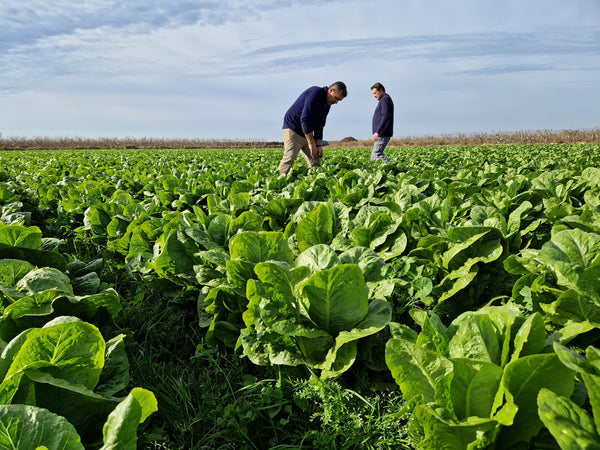

At Campos del Abuelo, among other fruits and vegetables, we grow oranges. Valencian oranges have always been a family tradition, which is why we love talking about them so much.
This time we asked Eduardo, founder of Campos del Abuelo to tell us about orange groups and varieties. So let's see what our experienced citrus grower has to share.
Before we carry on, a tip: if you want to learn more about growing oranges in Valencia, you can read this article on Valencian oranges. And one more thing: for orange trees to bear fruit of any of the varieties we'll meet today, they have to be grafted. In this article, also with Eduardo, we tell you why trees are grafted.
Now, on to the main event…

Orange families
In the July heat, there's nothing we fancy more than resting in the shade of a tree. So here we are, right in the middle of an orange grove, in the shade of the leaves, waiting for a breeze to soften the summer sun…
Making the most of the break, we asked Eduardo to tell us about the groups of oranges:
Well, with oranges, there's the Navel family and the Blonde family. There are other families, but basically these are the two that get sold…

This distinction between Navels and Blondes also helps us tell juicing oranges from eating oranges. And although at Campos del Abuelo we always say you can juice any orange and eat any orange, it's handy to know which is which. Right, let's keep going, because within the groups there are also varieties.
Orange varieties in the Navel family
At Campos del Abuelo, we grow varieties from the Navel family. The Navel orange became popular in Washington, but it's originally from Brazil. It was first found in Salvador de Bahía around 1820
Since they became popular in the United States, Navels got their name because in English the word navel means belly button. About the varieties of these belly-button oranges, Eduardo tells us:
We have the Navelina variety, which is the first to arrive. Roughly at the end of November, but we like to start picking them in early December, so they're a bit riper. And it's an orange that keeps perfectly until March.
It's the one we grow most at Campos del Abuelo. It's really versatile and once it starts producing, it's very generous. That's why we're not the only ones who choose to grow it: lots of fellow farmers do too.

Navelinas come from a natural mutation of the Navel that happened in California. They were named Navelinas at the Valencian Institute of Agricultural Research because they share the Navel's traits but are a little smaller. Let's carry on, there are more varieties to discover with Eduardo.
Then we have the Lane Late, also an exquisite eating orange that arrives in January and lasts until March or even April, too.
Funnily enough, this Navel variety comes from Australia, just like another one:
And then we have the Powell, the Navel Powell, which starts from late April and stays through May and June on the market, at its best for eating. After that, there are no more eating oranges. There are other varieties besides ours, but they all fall in the same time window.
In this video we filmed during Powell season, Eduardo talks about the Navel Powell Summer variety and, knife in hand, shows you how to get all the flavour and juice out of this delicious citrus.
Orange varieties in the Blonde family
We still have a few more varieties to meet, this time in the Blonde group. Unlike Navels, these don't have a belly button.
These are the varieties considered ideal for juicing. Oh! And if your orange juice turns out bitter and you need a hand, check out this article where we walk you through the perfect orange juice. Let's keep going, Eduardo is still telling us about the world of oranges…
So, then we have the juicing orange, from the Blonde group, where, like I said, there are basically two varieties. Well, there are more, but we have two: the Salustiana, which comes in the winter months, between December and April; and then we have the Valencia Late which comes in the summer months, from May to July.
The Valencia Late is also great because you can keep it in the fridge and it lasts quite a while. And those are basically our varieties, so we cover the whole range, from November to July. There are more Navel varieties and new ones too, but these are the ones we know.
What Eduardo shares here is worth remembering: at Campos del Abuelo, from late October or early November until July, we have fresh oranges straight from the tree to your home.

Now let's get to know Salustiana oranges a little better.
The Valencian origin of Salustiana oranges
Eduardo once told us that with just two oranges of this variety you get a full glass of juice, and you can tell he loves them, because this is how he talks about Salustianas:
They're oranges with much more juice in their flesh than eating oranges. That's why they're specifically juicing oranges. Although the Salustiana, for example, which is the winter orange, besides having loads of juice, is also a really good orange for eating.
Still, it sells more for juice, and it's an orange that usually goes for export, because there isn't much of it and here in Spain it's not very well known.
The fact that it's little known in Spain is no small detail, because the Salustiana variety was born 100% on our land.
As I told you, juicing oranges are from the Blonde group, and the orange that was around back then was actually the Valencia Late... And what happened was there was a natural mutation in a field in a Valencian town, a little village in Valencia called Enova, in the field of a man named Salustio.

This man noticed that this Valencia, instead of ripening in May, was ready from December. And that it was better for juicing than the Valencia, but also sweeter, with much finer flesh, because of course, ripening in winter, the flesh is much finer; heat makes the flesh thicker.
So, from there, people started propagating it, and in that man's honour, it's called the Salustiana orange. So those are the two varieties. Then there are other Blondes, like the Barberina which, let's say, sits between the Salustiana and the Valencia Late.
The Salustiana finishes around April, and the Barberina is good during April and May. And then there are the modern Valencia varieties that have come out, like the Delta and others, but they're all pretty similar, all from the same family.
The heat isn't letting up, but the conversation keeps flowing. Now that we know the orange families and varieties, a silence hangs in the air. So we take the chance and ask Eduardo which orange is his favourite.
Well, look, my favourite eating orange is a nice ripe Navelina. Nothing beats an orange like that. Because it has it all: sweetness, just the right acidity. It's not very acidic, but it has that touch of tartness so it tastes like orange and not sugar water… and its flesh is fine. For me it's the one that ticks all the boxes.
And then, among the juicing oranges, the Salustiana is without a doubt an extraordinary orange for juice, because its flesh is really, really fine, it's practically all juice and it's super sweet.

Bonus: oranges from the Blood family
To wrap up, we have to mention this type of orange because, even though it's not so common to find, there's no denying it turns heads.
This orange is known as blood orange, Sanguinelli orange, red orange or bull's blood orange. Both its flesh and its juice are this colour, which comes from the fruit's exposure to low night-time temperatures.
The colour is explained by the presence of anthocyanins, natural pigments that don't just give that deep red but also contain loads of antioxidants.
You can find it between February and May and, although it's more popular in Italy, there are areas in Spain where it's grown.
It's considered an eating orange, but it can also be used to make juices with a really striking colour…

Wrapping up orange families and varieties…
Our tour with Eduardo through orange families and varieties comes to an end, for now. At Campos del Abuelo we're proud to be part of the Valencian tradition of growing oranges, so we'll definitely keep writing about their wonderful world.
We hope this info, straight from the field to your home, has helped clear up any doubts or taught you something new. Remember, by visiting our online fruit and veg shop you can get seasonal produce straight from the field to you.
You can customise your box however you like and get it at home in under 24 hours, with no post-harvest chemicals whatsoever.
Until next time, and thanks for reading!


