
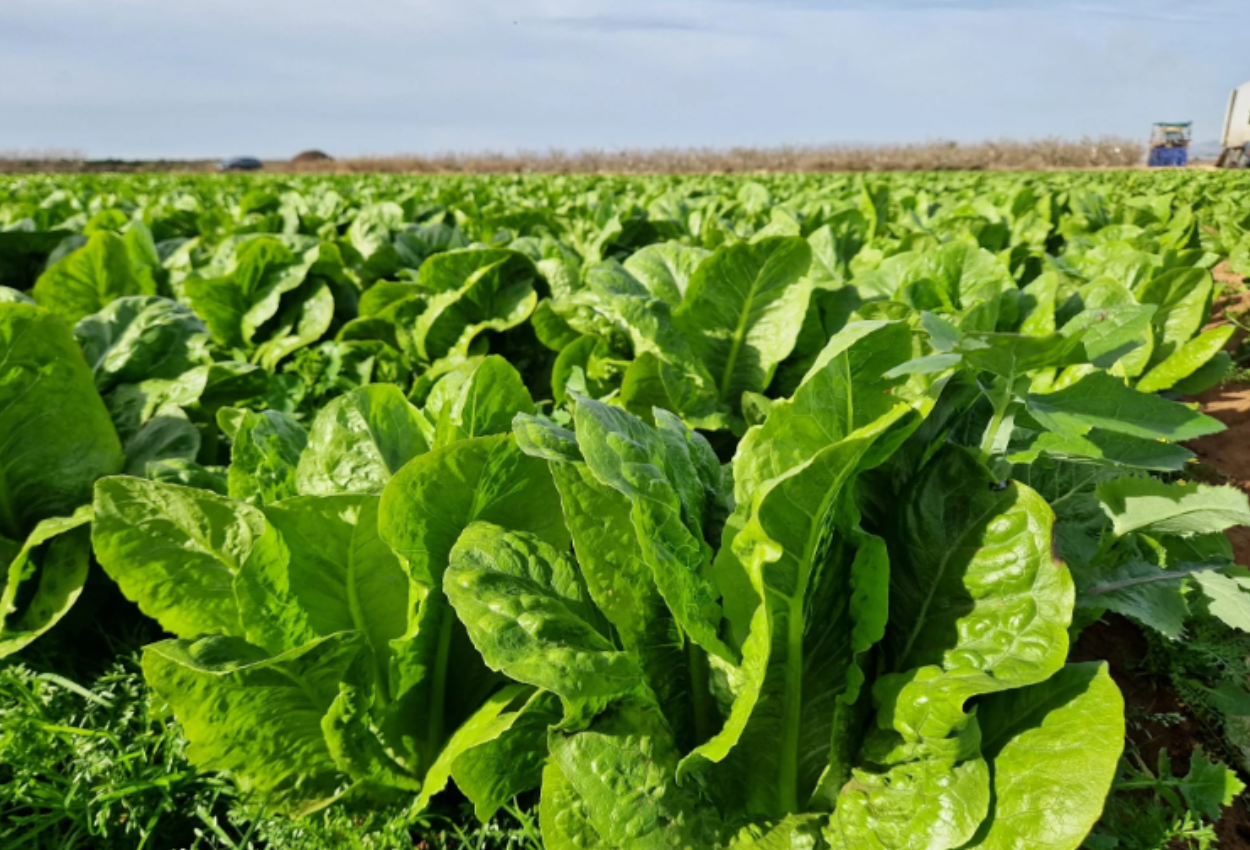
If you've never had the opportunity to see a lettuce field, the truth is you're missing out on a spectacle. Walking between the ridges, we can see them very clearly. They are well-anchored to the ground, with each of their leaves reaching for the sun, and it's as if, at their center, they hold a secret.
But guess what! It's not just one, but several secrets that lettuce has to tell us. So, from Campos del Abuelo, we will discover them through this article with our fellow farmer, Vicent. Let's go, straight from the field, we'll learn all about lettuce and about romaine lettuce, the favorite of the Spanish.
Did Romaine lettuce come from Rome?
Well, no. We already said that romaine lettuce is Spain's favorite. So much so that it is known as Spanish lettuce. Although we can also find it as "lechuga orejona" or "oreja de burro" (donkey's ear lettuce)… And of course, the question arises, "Why is it called 'romana'?"
But first, let's talk about lettuce in general. While some sources say that lettuce originated in India, others claim that this green delicacy comes from southern Europe. What is not debated is that its cultivation has existed for more than 2500 years.

Another theory is that its cultivation originated in Egypt and involved the god Min, associated with lunar cycles, fertility, and vegetation. History says that from the Egyptians, it passed to the Greeks and from the latter to the Romans. And now, returning to romaine lettuce, it was they who named it, which is why we know it as romaine lettuce.
A curious fact is that the famous Caesar salad – whose star ingredient is romaine lettuce – was created by an Italian chef, but not in Rome, but in Mexico, specifically Tijuana. Don't tell me this isn't an unexpected secret from our friend with the frilly leaves.
How to grow lettuce
To learn how lettuce is grown, we will hear from Vicent, a fellow farmer. Vicent also grows organic potatoes, carrots, cauliflowers, and many more vegetables.
At Campos del Abuelo, you can purchase romaine lettuce freshly harvested by us, the farmers. We send lettuce directly from the field to your home, because we know that the taste of freshly harvested fruit and vegetables is incomparable.

Returning to lettuce, to fully understand the cultivation process, let's start at the beginning.
The first thing to do, says Vicent, is to check the condition of the soil, and if we see that it's "burned," meaning exhausted from the previous crop, it needs to be fertilized. Next, the land is plowed, and then a rototiller or tractor is used, depending on the available equipment. Vicent says:
Ridges are made in the soil approximately 60 to 63 cm wide, which is the broad ridge, and we plant the lettuces approximately 25 cm apart. They are planted at this distance so that when the lettuce is large, it doesn't stick together. Another problem we avoid this way is the development of fungi.
And, of course, planting continues until harvest. In this image, you can see some of this year's romaine lettuce harvest:

But before that final step of harvesting, the lettuces must be planted. Vicent tells us how:
First, seedlings are made, and then they are planted. This is because the process used many years ago, with direct seeding, was very complicated. Making the holes was a lot of work, and when seedlings started to appear, that option was chosen.
In the past, a seedbed was made first, sown very late, and then the plants were pulled from there. But when summer came, it was complicated because they grew too fast and didn't work well. Now we prefer to do it directly with seedlings.
Lettuce is planted all year round, but as Vicent tells us, some seasons are more favorable than others:
It is planted throughout the year, but some seasons are more favorable and others less so. The most favorable are spring and autumn, and thirdly winter. And the most complex of all is in winter because the seeds, when they suffer from cold for a long time, become quite bitter. And the least favorable season is summer, but it is still planted.
In this video, Alberto and Javi, also fellow farmers from Campos del Abuelo, tell us about the challenge of planting lettuce in summer. They also share a very curious fact: there are heat-resistant varieties.
The first is oak leaf lettuce and the second is a new variety of romaine lettuce. However, they tolerate high temperatures but, as our fellow farmers explain, they require abundant irrigation.
We return to Vicent, who tells us that, since it is planted during different times of the year, the irrigation also depends on that. You won't be surprised, but Vicent, Alberto, and Javi all agree on irrigation during the hot months:
Irrigation is done when they are thirsty, and that depends on the time of year, it depends on the season. If the heat is intense, you have to water very often, and in our area, it gets very hot in the summer, so you have to water every two days.
In winter, sometimes 15 days or a month pass, and it is not necessary to water it. Because there is a lot of humidity, the water table is very close, and it is not necessary to water it as much.
As we mentioned earlier, lettuces are planted in ridges and spaced about 25 centimeters apart for several reasons, one of which is the possibility of fungal growth. Vicent tells us about this:
It depends on the time of year. In winter, when there is a lot of humidity, then there are fungi, such as mold, or powdery mildew, as it's called in Spanish. And there are also pests, but it depends… If it's hot, between 20 to 22, 25 degrees, then aphids and green aphids, whiteflies, can also appear.
To make the ridges in the soil, Vicent relies on the help of his mare, Amor. Here, the romaine lettuce harvest has already passed, and what you see are his fields with unplanted spaces so the soil can rest. Let's continue with the lettuce cultivation process...

The avocado, oranges, apples, all are fruits or vegetables that need to go through the pollination process. Vicent tells us that in the case of lettuce it is different, since you sow the seedling sprout you like best, then the seedlings are made and planted, and there is no pollination. Curious fact, isn't it?
Vicent's love for the land is evident. He has been dedicated to organic farming for over 40 years and always speaks of his work with passion. When asked about the lettuce harvest time, he responds with that affection for the field…
It's like love. When it's at its peak, then you pick the lettuce. And seriously, depending on the season, you have more or less time. In winter, you wait longer for it to be just right. And when you have to rush the most is in summer, everything goes very fast. You either cut it a day or two, or it bolts and becomes tough.
As Vicent said, lettuce can be planted all year round, but there are varieties that prefer some times of the year more than others, as in the case of romaine lettuce:
The best season for romaine is spring and also part of winter, because winter is mild. However, in summer, "maravilla de verano" (summer marvel) does much better, which is like a Batavian lettuce, not as tall. The romaine variety is also called donkey's ear.
You know that "donkey's ear" is large and doesn't do well in summer. It bolts very quickly and doesn't last long, so we use another type of planting.

Benefits of adding romaine lettuce to your diet:
- Contains vitamins A, K, and C, strengthening our immune system and providing antioxidants.
- It is rich in iron. Therefore, many nutrition professionals suggest seasoning it with lemon, as the citrus helps in its absorption.
- It has a large amount of water in its leaves and is low in carbohydrates.
- Provides our body with minerals such as phosphorus, calcium, magnesium, and potassium.
- It is a source of protein and fiber.
The queen of salads
Lettuce, as versatile as it is nutritious, is the essential ingredient for a good salad. You can season it with apple cider vinegar, lemon, or olive oil; you can mix it with other vegetables like tomatoes, Hass avocado, and even, if you dare, it's delicious with fruits like oranges or strawberries. Another option is to add amaranth, chia, or sunflower seeds.
I hope that this journey through the secrets of romaine lettuce has made you as eager for a good salad as I am. And remember, if you ever have the good fortune to see a field of romaine lettuce live, whisper to them that between you and them, there are no more secrets.
Remember that at Campos del Abuelo, we have fruits and vegetables directly from the farmer to your table without post-harvest chemicals. By visiting our online fruit and vegetable store, you can purchase romaine lettuce and other seasonal products.
Until next time and thanks for reading!


