


Making orange juice might seem simple, but the truth is that, to get it just right, there are a few things to keep in mind.
When it comes to juice, everything matters: from the type of oranges we use to how we extract the juice. On top of that, remember there are juicing oranges and eating oranges.
At Campos del Abuelo we believe you can juice any orange and eat any orange for dessert, but let's be honest, when they're juicier you really notice it. The world of the Valencian orange is fascinating and, as orange growers, we take everything to do with them very seriously.
That's why we're going to give you some tips so you get the best possible result. We'll also answer the most common questions, so let's go in search of the perfect juice.
Let's get started!
Choosing the right oranges for juice
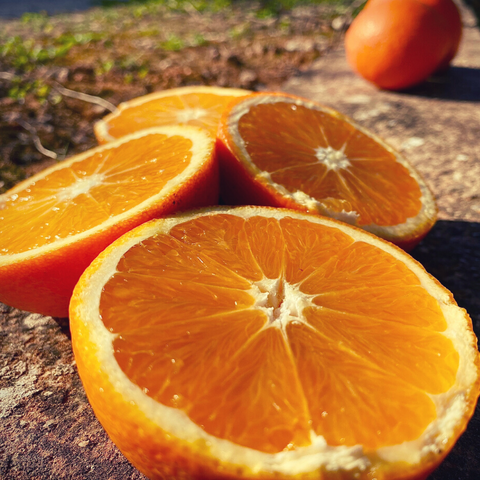
It's really important to choose the right variety. Even though you can juice them all, there are different groups of oranges and, within those groups, some varieties are special because they're much juicier. That way you'll get more juice from fewer oranges.
So, we'll go for oranges packed with juice inside. Medium-sized, so they're easy to handle on the juicer, and sweet but also tangy.
Two varieties tick all these boxes: Salustiana and Valencia Late. Both belong to the blond orange group. Let's get to know each one a little better:
The Salustiana variety is ideal for juice because its pulp is fine, so it's practically all juice. Two oranges are enough for a full glass, which is why we consider it one of the top oranges in the blond group. Its season runs from December to March.
The Valencia Late variety is also considered one of the best for juice because, besides being very juicy, it has just the right balance of sweetness and acidity. It's the latest of the season, so you can buy it from May to the end of July.
Depending on the time of year, at Campos del Abuelo you'll find different orange varieties.

How many oranges do I need for a glass of juice?
Let's start from the idea that one juicing orange gives you just over 100 ml of juice. So two oranges will be enough for a glass of juice.
Different ways to make orange juice
So you can pick the way that suits you best, we'll walk you through the most popular methods for squeezing oranges. And at the end you'll see which one Eduardo, a Campos del Abuelo farmer, chooses for his orange juice.
Manual methods
If you don't have a juicer, simply squeezing the orange will get you juice. So you're not relying only on hand strength, you can help yourself with a fork.
Although it's handy when there's no juicer around, it doesn't get out all the juice, so we don't think it's the best way to make the most of the fruit.
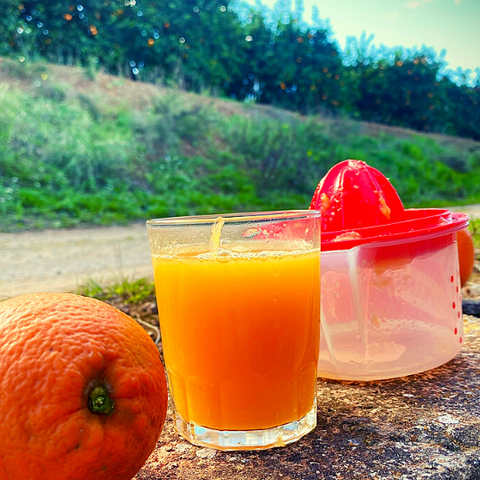
Then there's the classic manual juicer. It's the one we use at Campos del Abuelo when we're out in the fields. That's why we see it as the method that never fails — just look at this juice:
Electric methods
When it comes to methods that need electricity, there are two. The first is the electric citrus juicer. There are loads of them, at all sorts of prices and with different features. The good thing here is that the machine does the work, not you. It's important not to over-squeeze the orange, because if you reach the white part, your juice will turn bitter. With a citrus juicer, of course, you can only juice citrus fruit.
The juice extractor is the one that -as the name says- extracts juice from any fruit or vegetable. You'll also find a wide range of extractors on the market. To make orange juice in an extractor, you need to peel the orange first.
If you're wondering which is better, a citrus juicer or an extractor, here's a comparison image showing what each one offers to help you decide:

Making orange juice step by step
It's really easy, just follow these 3 simple steps
- Choose your oranges: you can juice any orange, but if you go for Salustiana and Valencia Late, you'll be using the best oranges for juice.
- Cut 2 to 3 oranges in half.
- Extract the juice with the method you've chosen.
To make it even clearer, here's a video where Eduardo, an orange grower at Campos del Abuelo, shows you how to make the perfect juice:
Bonus: our fellow farmer prefers his juice with pulp, but if you don't like it that way, you can strain it.
Eduardo is very generous with his know-how, and in this article about Valencian oranges, he shares everything he knows about growing this delicious fruit in Valencian soil.
How long does freshly squeezed orange juice last?
Orange juice keeps perfectly well for up to 12 hours in the fridge. You can also freeze orange juice. You've probably heard that the vitamins vanish really fast, something like in under a minute — well, that's a myth. A very widespread one, mind you, but it's not true, so if you want to freeze your orange juice to drink later, go right ahead.
How much orange juice should you drink a day?
According to the National Institutes of Health (NIH), the recommended intake is between 65 and 90 mg of vitamin C a day. And one orange contains 69.7 mg of vitamin C. That means 1-2 oranges more than cover your recommended daily amount of vitamin C.
Why did my orange juice turn out bitter?
If you've followed our tips and it still came out bitter, there are a few possible reasons. Let's take a look.
First, check that the orange you're juicing is good. In this article we give you some tips to check whether an orange is good. On the other hand, as we said, you can juice any orange, but it'll always turn out better with juicing oranges. If you're not sure whether your oranges are for eating or juicing, in this article Eduardo, straight from the fields, gives you some tips to tell when an orange is for juicing and when it's for eating.
Try to pick the right variety, as some are more bitter than others. The ones we've recommended here are Salustiana oranges, which are very juicy, and Valencia Late oranges for a juice that's sweet and tangy at the same time.
Another thing to watch is whether your juicer is squeezing the orange too hard, right down to the albedo, which is the white part of the orange. This part is usually bitter and can change the flavour.
And last but not least: Try to drink your juice within 12 hours. That's when it starts to oxidise and its flavour changes.
From all of us at Campos del Abuelo, we hope your next juice turns out perfect. And remember, in our online shop you can buy fruit and vegetables straight from the farmer.


