
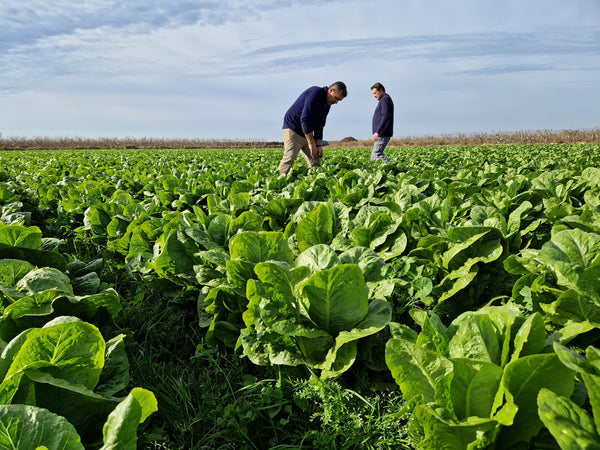

For a lot of people, chestnuts are a smell: the smoke from the chestnut seller on a corner of the square, the paper cone made of newspaper and the blackened fingers. Our fellow farmer Antonio knows this well, and he thinks that's exactly the problem:
“I think everyone knows chestnuts from the seller they see in the square in town or in the village, and that's it.”
Roasting chestnuts at home is much easier than it looks, and with good chestnuts the result is every bit as good as the ones on the street. In this article we'll show you how to do it in the oven, in a pan and in the air fryer, the trick to make them peel themselves, how to store them once roasted and other ways to enjoy them beyond the paper cone.

An autumn tradition
In almost every chestnut-growing area of Spain, autumn is celebrated around a bonfire with chestnuts. In Galicia and El Bierzo it's the magosto; in Asturias, Antonio's homeland, the amagüestu; in Catalonia, the castanyada on All Saints' Day. The name and what goes with it change, sweet cider in Asturias or new wine elsewhere, but the scene is always the same: chestnuts roasting over the fire, family and neighbours gathered round and sooty hands.
The essential step: the cut
Before roasting a chestnut, you have to cut it. Antonio calls it giving it a grin:
“You give it the grin, pop it in the oven and the chestnut cooks itself.”
The cut does two jobs. The first is safety: as it heats up, the water inside turns to steam, and if it has no way out, the chestnut can burst with real force. The second is practical: the shell opens along the cut as it roasts, and it's then much easier to peel.

- Horizontal cut across the rounded side, from edge to edge, not too deep. It's the easiest one.
- Cross cut, the street vendor's classic, also on the rounded side.
Use a small, sharp knife, and rest the chestnut on its flat side on a cloth so it doesn't slip.
How to roast chestnuts at home
In the oven
- Preheat the oven to 200 °C.
- Cut all the chestnuts and place them on a tray, cut side up.
- Roast them for 20 to 30 minutes, depending on size. From 15 minutes on, start keeping an eye on them: they're ready when the shell opens along the cut and the flesh is tender.
- Don't overdo it. An over-roasted chestnut turns hard and dry.
In a pan
Ideally, use a chestnut pan, the one with holes, if you cook on gas or a wood fire. On a ceramic or induction hob, a regular heavy-bottomed pan will do. Add the cut chestnuts, cover and cook over medium heat for about 15 or 20 minutes, stirring now and then so they toast on all sides without burning.
In the air fryer
Once cut, about 15 or 20 minutes at 180 °C, shaking the basket halfway through. They come out really well and there's no mess at all.
In the microwave
It's the quickest option, but the least tasty. Do small batches of six or seven cut chestnuts, on high power, in short bursts, making sure they don't dry out.
The trick to make them peel themselves
As soon as they come off the heat, wrap them in a kitchen towel, ideally slightly damp, or in newspaper, and let them rest for five minutes. The steam they release softens the thin inner skin, and then it comes off almost by itself. Peel them while they're still warm: once cold, it's much harder.

And if the chestnut is good, that's all you need. Antonio, who has eaten thousands of them, insists that the flavour of a freshly picked chestnut needs no extras. The difference is in the produce, and a fresh, flavourful chestnut roasted at home beats many of the ones sold on the street.
Roasted and into the freezer
At Antonio's house they roast extra on purpose:
“We roast them and put them in the freezer. And when we take them out, it's as if we'd just made them.”
Peel them while warm, let them cool completely and freeze them in portions. Later, a few minutes in the oven or in a pan and they're like freshly roasted. The only thing to avoid is refreezing them once thawed. You'll find more ways to store them in how to store chestnuts at home.
Beyond the street vendor
Roasted is the most popular way, but not the only one:
- Raw, well peeled, as a snack out in the fields. We tell you all about it in can you eat raw chestnuts?
- Boiled in salted water, sometimes with a little anise or fennel, as they do in many parts of northern Spain.
- As a purée or soup, to go with game or in a pumpkin and chestnut soup.
- In stews, as they were used before the potato arrived, when chestnuts were the backbone of mountain cooking.
- As flour. Antonio remembered it: “you make flour from chestnuts”. Chestnut flour is gluten-free and is used in sponge cakes, breads and doughs, with a sweet, earthy flavour.
- As sweets, in syrup or candied, like marron glacé.
Frequently asked questions
Do you have to soak chestnuts before roasting them?
It's not necessary. Some people leave them in water for 10 or 15 minutes so they come out juicier, but if the chestnuts are fresh there's no need. If you do, dry the outside before roasting.
Why do chestnuts explode?
Because they haven't been cut. The water inside turns to steam and, with no way out, it bursts the shell.
How do I know they're done?
The shell opens along the cut, the flesh turns golden and it's tender when you prick it, like a baked potato.
Can you roast frozen chestnuts?
Yes, straight from frozen, without thawing, with a few extra minutes of cooking.
From the chestnut grove to your table
A good chestnut roasted at home is one of the simplest pleasures of autumn. We're working with Antonio on a way to bring his freshly picked chestnuts right to your door. In the meantime, in Reserve your harvest you'll find the autumn fruit we pick the same day it ships. From the field to the box, and from the box to your home. That simple, that real.

