
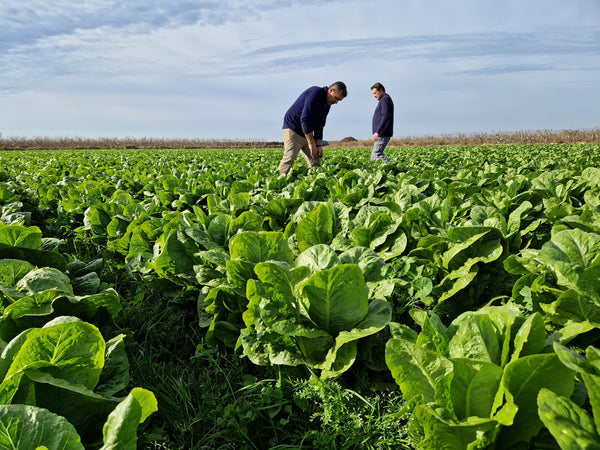

When we asked our teammate Sergio, who looks after the sheep and makes the team's cheeses, what the biggest con in the cheese world is, he ended up talking about trees. "A tree doesn't grow in two days," he told us. It needs time for its roots to settle, to grow strong, and it takes years to bear its first fruit. "Well, cheese is just the same. Nature asks for patience."
That line sums up a way of understanding food that our whole team shares, top to bottom: everything has its time. Cheese needs its days of ageing, tomatoes need their summer, and we, as Sergio says, also change with the seasons: in autumn we get ready, in winter we hunker down, in spring we blossom and in summer we celebrate.
Now that it's October, with the first chestnuts and persimmons peeking out in the fields, we're going back over what he told us about eating in season and living to the rhythm of the seasons. And, as always, we've checked it against the science: some hunches hold up really well, and others deserve a bit of nuance.
Nature asks for patience
Here's how he puts it:
A tree doesn't grow in two days. It needs time for the roots to settle, for it to be strong. How long does a tree take to give you fruit, three, four years? Well, cheese is the same. In the end, nature asks for patience. If we rush it, we're distorting its natural process.
Timings vary a lot depending on the species, the rootstock and the care, but the idea is spot on: no fruit tree gives a good harvest the year it's planted. And it's the same in our cheese dairy. Manna and Ambrosia, our lactic-curd cheeses, need about 15 days to complete their development. Patamulo, a slow-fermented cheese, is ready after two or three months. And for raw milk cheeses, the usual health benchmark is 60 days of ageing, unless the dairy can prove other safety guarantees, as we explain in Is raw milk cheese safe?.
For Sergio, when you rush that process, the problems start: additives, lower-quality fats, poorly done fermentations. We talk about it in the great "artisan" cheese con.
We want everything now
And he takes it beyond cheese:
We have to understand those processes, and we don't. We want everything now, everything so fast, and to consume everything, everything, everything. When it's tomato season, it's tomato season because your body needs that kind of produce, because of your need for vitamins. Nature gives you everything you need at every moment.
Today, supermarkets have almost everything all year round. That's possible thanks to three tools: greenhouses, imports from the other hemisphere and cold storage. None of them is bad in itself, but all three come at a price we don't always see: fruit harvested too early so it survives the journey, weeks in the cold and, very often, less flavour.
Eating in season simply means choosing what the nearby fields are giving right now, harvested at its best. Let's see why you can taste the difference.
Tomatoes, in their season
The tomato example isn't random. The tomato is probably the vegetable where you notice the biggest difference between eating it in season (in Spain, grown outdoors, from late spring to early autumn) and eating it in the depths of winter after a long journey.
Ripening on the vine or in the cold store
To withstand transport, many tomatoes are picked mature green or just starting to colour, and finish ripening in storage rooms, sometimes with ethylene, the plant hormone that triggers ripening. They turn red, sure. But the University of California's postharvest guides note that aroma and sensory scores tend to be better the more colour the fruit had when it was picked.

Something similar happens with nutrients. A Hungarian study published in HortScience (Pék et al., 2010) compared vine-ripened tomatoes with ones ripened after harvest:
- The vine-ripened ones had more lycopene (4.5 mg per 100 g versus 2.1 mg in those ripened afterwards at 30 °C).
- And more vitamin C: 17.5 mg per 100 g versus 14–15 mg in those ripened off the vine.
Lycopene, the red pigment, forms best between about 16 and 22 °C and slows down above 30–32 °C. And vitamin C depends heavily on light: the more intense it is during growing, the more vitamin C, according to the classic review by Lee and Kader (2000). That same review points out that, after harvest, vitamin C is gradually lost with time, heat and dehydration.
The cold steals the flavour
A 2016 study in the journal PNAS (Zhang et al.) stored tomatoes at 5 °C for a week: they lost up to 65% of their aroma compounds, and a panel of 76 tasters found them clearly less tasty. The cold "switches off" the genes that make those aromas, and three days at room temperature weren't enough to get them back. Below 10–12 °C, tomatoes also suffer chilling injury.
A fair point: a greenhouse tomato that's well ripened and arrives quickly can be wonderful. The key isn't so much the greenhouse as the harvest point, the distance and the time it takes to reach your kitchen.
Avocado in August, watermelon in summer
Chatting with Sergio, another example came up that he agreed with straight away: we reach for an avocado in August when a good watermelon would refresh and hydrate us far more.
Spanish avocados, grown mainly in Málaga and Granada, start their season in autumn: early varieties are picked in October and November, and Hass reaches its best around mid-November. In summer, much of the avocado we find is imported. In 2023 Spain imported over 240,000 tonnes, more than half of it from Peru, which supplies us mainly during the summer months.

Watermelon, on the other hand, is the summer fruit par excellence and is more than 90% water. That's no small detail: according to EFSA, around 20% of the water we take in each day comes from food. In the hot months, fruits like watermelon, melon or cucumber help top it up.
Does the body really "crave" what each season brings?
Here it's worth being honest. Sergio's idea that nature gives us exactly what the body needs at each moment is a lovely traditional hunch, very much of the countryside, and it has real coincidences: very juicy fruit in the hot months, vitamin C-rich citrus in the middle of winter, hearty stews with pulses and vegetables when it's cold.
But the evidence adds nuance: there's no proof that our vitamin needs change with the seasons, or that the body "craves" tomatoes in August. We need vitamin C just as much in July as in January. What is clear is that seasonal fruit and veg usually arrive riper, tastier and often with a better nutritional profile than produce picked early and stored for weeks. More than enough reason to choose it.
What's in season in October
October is one of the most generous months of the year. According to the Spanish Ministry of Agriculture's fruit calendar, plus the typical autumn vegetables:

| Fruit | Vegetables | From the woods and the pantry |
|---|---|---|
| Grapes, pomegranate, persimmon, quince, apple, pear, kiwi, first mandarins, grapefruit | Pumpkin, sweet potato, chard, spinach, leek, cauliflower, broccoli, cabbage, red cabbage, carrot, turnip | Chestnuts, walnuts, almonds, mushrooms |
And for the rest of the year, broadly speaking, the Ministry's fruit calendar:
- Winter: orange, mandarin, lemon, grapefruit, kiwi, persimmon, apple, pear.
- Spring: strawberry, loquat, cherry, apricot, peach, nectarine, plum.
- Summer: watermelon, melon, peach, nectarine, plum, raspberry, fig, plus outdoor tomatoes.
- Autumn: grapes, persimmon, quince, chestnut, apple, pear, kiwi, mandarin.
You feel the seasons in your mood too
From food, Sergio moved on to mood, and he did it with an image that's very him:
Trees change, and we are nature and we change too. In autumn you get ready to switch off: you want to shut yourself in, you're at home more, you need to feel more settled. In winter you hide, you need a cave. Then spring comes, you start to blossom, your mood changes, you go out, you see the sun. And summer is madness: almost all the village festivals are in summer. It's celebration.
Anyone who's lived in a village knows he's right about the festivals: August, with the Assumption on the 15th and San Roque, is packed with patron saint festivals. And lots of people notice that on short days they have less energy and more of an urge to curl up under a blanket.
Science partly backs this up. Light regulates our internal clock, and with fewer hours of sunlight, melatonin and serotonin change. For some people it goes beyond a slump: it's seasonal affective disorder, a type of depression that usually appears in autumn and winter and improves in spring. Its symptoms include persistent sadness, loss of interest, tiredness, sleeping and eating more than usual and trouble concentrating. It's treated with talking therapy, medication and, in some cases, light therapy lamps, always under professional guidance.
Sergio also said that "everyone gets depressed at some point". To be precise here: we all go through spells of sadness or feeling low, and that's normal. Depression is something else. The WHO describes it as low mood or loss of interest lasting at least two weeks and affecting daily life, and estimates that around 5% of adults experience it. There are effective treatments.
Meditation: what it does and doesn't do
"Before it hits you, start meditating. Maybe you'll avoid getting depressed. Maybe not, but maybe yes," Sergio told us. His caution is well placed, and the evidence partly agrees with him:
- A 2014 meta-analysis in JAMA Internal Medicine (Goyal et al.), covering 47 trials and more than 3,500 participants, found that mindfulness meditation programmes modestly improve anxiety, depression and pain.
- Mindfulness-based cognitive therapy (MBCT) has the strongest data. An analysis of 9 trials with 1,258 people with recurrent depression, already in remission, showed a 31% lower risk of relapse over 60 weeks compared with usual care (Kuyken et al., JAMA Psychiatry, 2016). The UK's NICE guideline includes it as an option to prevent relapse.
In other words: meditation can help look after your mental health and reduce relapses in people who've already been through depression, especially in structured programmes. But it doesn't replace treatment or guarantee that depression won't come. If you're having a hard time, talk to your GP or a psychology professional. In Spain, the 024 helpline offers free, round-the-clock support to people with suicidal thoughts and their loved ones, and in an emergency, call 112.
Living in tune, without stress
It's not about becoming strict or feeling guilty for buying an avocado in August. It's about listening to the land a little more. A few simple ideas for this autumn:
- Shop by season: ask what's being harvested right now and let that guide your menu.
- Store what you buy properly: tomatoes and other cold-sensitive fruit are best kept out of the fridge if you'll eat them soon.
- Seek out the light: go for a morning walk, especially as the days get shorter.
- Cook more slowly: autumn is the time for stews, pumpkin soups, roast chestnuts and homemade quince paste.
- Respect your rhythms: wanting a "cave" in winter is normal. Feeling low for weeks and being unable to get on with life isn't: ask for help.
Frequently asked questions
Is seasonal fruit more nutritious?
Often yes, though not always. Picked at its best and eaten soon, it usually keeps more vitamin C and, in the case of tomatoes, more lycopene than produce picked green and stored for weeks. And it almost always tastes better.
Why shouldn't I keep tomatoes in the fridge?
Because the cold reduces the compounds that give tomatoes their aroma: at 5 °C for a week they can lose up to 65%, and they don't fully recover once taken out. If they're ripe and you'll eat them within a few days, keep them somewhere cool in the kitchen.
Is there Spanish avocado in summer?
Not much. The Spanish season starts in autumn and Hass reaches its best around mid-November. In summer, much of the avocado sold in Spain is imported, mainly from Peru.
Is it true the body craves what each season brings?
It's a traditional hunch with real coincidences (watery fruit in summer, citrus in winter), but there's no proof that our vitamin needs change with the season. Eating in season is justified by flavour, freshness and closeness.
Does meditation prevent depression?
No one can promise that. Mindfulness-based cognitive therapy reduces the risk of relapse in people with recurrent depression, and meditation modestly improves anxiety and mood. But it doesn't replace professional care.
Harvested at the right time
At Campos Del Abuelo we work this way because we believe in it: harvest to order, straight from the farmer. We don't keep fruit in cold stores for weeks: we pick your order the same day it ships and it reaches your home within 24 hours. And alongside autumn fruit and veg, you'll find the raw milk cheeses Sergio makes in our dairy, Manna, Ambrosia and Patamulo, made without rushing. If you want to know why, we tell you in why having your own sheep changes the cheese and in living foods and the microbiota.
Take a look at what the fields are giving this week and reserve your harvest. From the field to the box, and from the box to your home. That simple, that real.
Sources
- Spanish Ministry of Agriculture, Fisheries and Food. Seasonal fruit calendar.
- Pék Z, Helyes L, Lugasi A. Color changes and antioxidant content of vine and postharvest-ripened tomato fruits. HortScience, 2010.
- University of California ANR. Tomato harvest maturity, ripening and postharvest handling.
- Lee SK, Kader AA. Preharvest and postharvest factors influencing vitamin C content of horticultural crops. Postharvest Biology and Technology, 2000 (Aprifel summary).
- Zhang B et al. Chilling-induced tomato flavor loss is associated with altered volatile synthesis and transient changes in DNA methylation. PNAS, 2016.
- Cosmos Magazine. Why you shouldn't store tomatoes in the fridge.
- IFEMA Fruit Attraction. Avocado, star product (production and imports in Spain).
- Portal Frutícola. Spain begins its avocado season (OIAM).
- Consumer (Eroski). Everyday fruits with the highest water content.
- EFSA. Scientific Opinion on Dietary Reference Values for water, 2010.
- NHS. Seasonal affective disorder (SAD).
- World Health Organization. Depression: fact sheet.
- Goyal M et al. Meditation programs for psychological stress and well-being: a systematic review and meta-analysis. JAMA Internal Medicine, 2014.
- Kuyken W et al. Efficacy of mindfulness-based cognitive therapy in prevention of depressive relapse: an individual patient data meta-analysis. JAMA Psychiatry, 2016.
- NICE. Depression in adults: treatment and management (NG222).

