
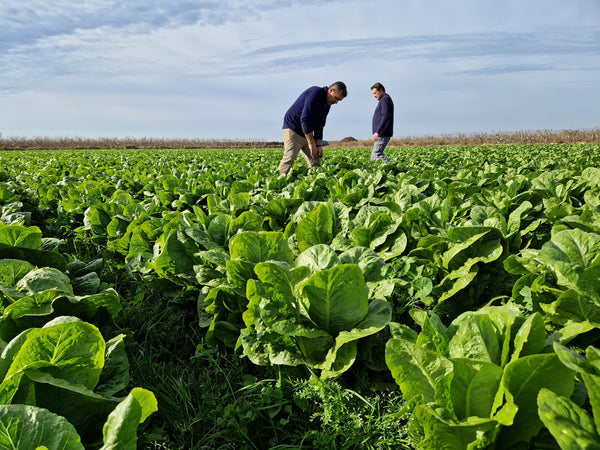

Everyone knows the chestnuts from the street vendor in the square, in a paper cone and burning your fingers. Very few people know what's behind that cone: weeks of October and November crouched under the chestnut trees, with thick gloves, opening burrs one by one with your foot. Our fellow grower Antonio sums it up with a line he often repeats as he walks among his trees:
“You don't just turn up and get this done in half an hour. You're out here all day.”
Antonio grows chestnuts in a mountain valley where the trees climb the slopes, among oaks, up to about 900 metres. He's from Asturias and came to the valley for love. The family of Laura, his partner, has worked with chestnut trees all their lives: some groves were planted by her grandmother. In this article we tell you how chestnuts are harvested by hand, why it's still such hard work and what happens to them from the moment they fall from the tree until they reach a kitchen.

From burr to ground, from ground to hand
The chestnut grows inside a capsule covered in spines, the burr. When it ripens, in early autumn, the burr opens and drops the chestnuts, or falls whole to the ground. The first to fall are the early varieties, and the season stretches over a few weeks, from October to November depending on the area, the year and the variety.
Harvesting is done by hand in most mountain chestnut groves, because the slopes, the stones and the size of the plots make it impossible to bring in machines. Antonio puts it plainly:
“You grab the burr, you step on the burr, out comes the chestnut and you pick up the chestnut.”
Put like that, it sounds simple. In practice, the burr really does prick, even through thin gloves. That's why burrs that haven't opened on their own are opened with your boot: you step on it carefully, roll it a little so the two halves come apart and take out the chestnuts with your gloved hand. Whatever you gather goes into the bucket or sack hanging from you.

How many chestnuts are in each burr?
A burr usually holds between one and three chestnuts. When there are three, the middle one tends to be flatter and the side ones rounded on one side. When there are one or two, they're usually bigger, because they have more room to grow. As Antonio says, “it depends on the year”: with a good spring and some rain at the end of summer, the burrs fill up more and the chestnuts plump up.
Blowing, sieving and sorting
When you pick up from the ground, it's not just chestnuts that come up. Leaves, bits of burr, soil and the odd twig come too. In the field, the first clean is almost instinctive: you blow on the handful so the light stuff flies off and the chestnut stays. Then, back home or at the warehouse, everything goes through a sieve, a mesh that sorts by size and lets the soil and debris fall through.
“First you blow. And then all you're left with is the chestnut.”
Sorting also starts at the sieve. Chestnuts with holes, empty ones, crushed ones and those with spots or a rotten base are set aside. And they're separated by size, because the market pays by size. On that, on what you miss out on if you only buy big chestnuts, Antonio has a lot to say, and we tell you about it in small or large chestnuts: which taste better?

A life spent bending down, since the age of six
In Laura's family, chestnuts have always been part of life. She started going out to pick them at six, with her parents and grandparents, and she remembers it like any child from a chestnut village:
“On the first day you go and it's really fun. But by the third you tell everyone: you go, I'm not bending down anymore.”
Her grandfather had a foolproof trick. They'd take the animal feed buckets to the field, well washed, and he'd offer each grandchild 50 céntimos for every full bucket. That way little hands joined the harvest, and they learned what work is worth.
Today the scene repeats itself with new faces. When lunch is over at home and the chestnuts come out on the table, everyone's happy to peel and eat them, but bending down under the tree is another story. Antonio says it with humour and a fair bit of truth: there's plenty of work in the countryside, what's hard is finding someone willing to bend their back for days.
What happens to the harvested chestnuts
Once picked and sieved, chestnuts can go several ways:
- The cooperative or warehouse. This is the most common destination. There “everything goes”, as Antonio says: it's graded, treated and sold in bulk, often outside Spain.
- Direct sales. More and more growers set aside their best chestnuts to sell themselves, with more control over quality and price.
- Eating at home. The ones kept for winter, for family gatherings, for pig-slaughter season or simply to have roast chestnuts in January. We tell you how they keep them in how to store chestnuts at home.
There's something that makes the journey from tree to shop delicate. The chestnut is a living fruit, full of water, and it can carry inside the larva of a weevil you can't see from the outside. That's why sorting in the field matters so much, and why, as Antonio says, sometimes a chestnut that looked perfect shows a hole “after three days in the warehouse”. We explain it in depth in why chestnuts get worms and how to tell if they're good.
The work no one sees: clearing the grove before the harvest
The harvest starts long before the first burr falls. In August and September it's time to clear the groves: cutting back grass, removing brambles and clearing fallen branches. If the ground is clean, you can see the chestnuts when they fall and they don't get lost in the undergrowth, and the risk of fire in the height of summer goes down. It's also the moment to check the trees, because a chestnut tree damaged by a storm or bad pruning can get sick. We tell you why in chestnut blight and why pruning is so delicate.
Frequently asked questions
When is chestnut season?
In Spain, from October to November in most areas, starting with the early varieties. Fresh chestnuts are available from late September to December, and cold-stored ones a little longer.
Can you pick chestnuts from any chestnut tree?
No. Almost every chestnut tree has an owner, even if it's up in the hills and looks abandoned. Picking chestnuts from someone else's land without permission is taking someone else's harvest. If you want to enjoy the experience, look for farms or festivals that offer it.
How do you open a burr without getting pricked?
With thick gloves and your foot. Step on the burr with your boot and roll it gently until the two halves open. Then take out the chestnuts with your protected hand.
Should you wash chestnuts after picking them?
Better not. Wet chestnuts spoil sooner. Just blow on them or brush them dry and set aside the damaged ones.
From the chestnut grove to your table
Every chestnut that reaches a kitchen has passed through hands that bent down to find it among the leaves. We're working with Antonio on a way to bring his freshly picked chestnuts to your home. In the meantime, in Reserve your harvest you'll find the autumn fruit we pick the same day it ships. From the field to the box, and from the box to your home. That simple, that authentic.
Sources
- Spanish Ministry of Agriculture. The chestnut, a fruit tree (Hojas Divulgadoras 23-24/78)
- ADICAP. Guide to good practices in the cultivation, treatment and marketing of chestnuts in Asturias
- Frutas y Hortalizas. Post-harvest care of chestnuts
- Campo Galego. Health of the chestnut tree and the chestnut

